
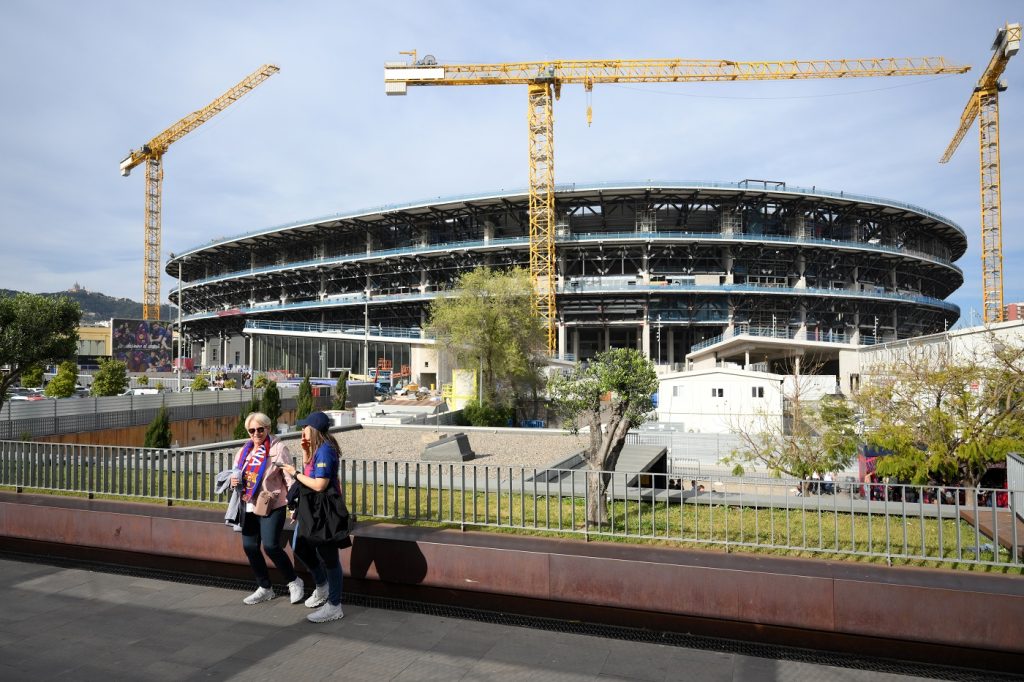
Barcelona have barely had time to get used to playing in a renovated stadium before they will have to move out again to allow the work to be completed. As reported by The Athletic, the move was already part of the plan for the final stages of the Camp Nou redevelopment. Now the club has also set out the timetable. At Saturday’s general assembly, vice-president Ferran Olivé said Barcelona will finish the 2026-27 season at Camp Nou before moving back to the Estadi Olímpic Lluís Companys in Montjuïc for around half of the following season. The aim is to return to their own stadium in January 2028.
The next phase of the work comes with another major financial commitment. On Saturday, members approved a new €510 million financing package: €300 million will go towards completing Camp Nou, while a further €210 million will cover other operational costs. The approval takes Barcelona’s overall debt well beyond €2 billion and, depending on the various repayment deadlines, could take it as high as €2.6 billion. The total cost of the Espai Barça project, which includes the reconstruction of Camp Nou, now stands at €1.8 billion, three times the €600 million initially forecast in 2014. Even that will not be enough to complete the entire project. President Joan Laporta told members that the additional €300 million for Camp Nou does not include the construction of the Palau Blaugrana, the future home of the basketball and handball teams.
Barcelona left the stadium in May 2023 and, after delays to the redevelopment — the return had initially been scheduled for November 2024 — remained away until November 2025. Throughout the 2023-24 season and the following one, the Catalans played their home matches at the Estadi Olímpic Lluís Companys in Montjuïc, in the Olympic park built for the 1992 Games. Last season, further delays forced the club to play two La Liga matches at the Estadi Johan Cruyff, the 6,000-capacity ground near the training centre.
The return to Camp Nou came on November 22, 2025, with a 4-0 win over Athletic Club in front of around 45,000 spectators. Since then, the work has continued without a break. The current capacity has risen to around 62,000 and the first two tiers of the stadium have been completed. That figure is expected to increase from the beginning of 2027, when the third tier opens.
To complete the stadium, though, Barcelona will have to leave again. The main issue is the roof: the plan is to build it from inside the stadium, meaning the pitch will have to be used as a work area and for storing materials. Olivé said the work on the roof will “begin progressively as soon as the team has played its final game of the season, in May”. The club has already reached an agreement with Barcelona City Council to return to Montjuïc, where Barcelona will play their home matches until January of the 2027-28 season. The aim is to return to Camp Nou in January 2028 with a capacity of around 95,000.
“This will allow us to once again recover all the economic potential needed to run the club properly,” Olivé said. The stadium may still not be completely finished when Barcelona return. The final capacity of the new Camp Nou is expected to be 105,000, compared with 99,354 at the previous stadium, which was already the largest football stadium in Europe. Barcelona nevertheless want the stadium completed and operating at full capacity by the start of the 2028-29 season. That matters after UEFA awarded the 2029 Champions League final to Camp Nou, with the match scheduled for June 2 that year.
The club, though, does not want to risk setting another deadline that proves too optimistic. “We expect all the most important parts of the roof to be built by October or November 2027, but we do not want to find ourselves racing against time again,” Olivé said. “That is why we have planned our return for January of the following year: it gives us some margin in case of further delays.” The delays have already come at a significant cost. Staying away from Camp Nou for longer than planned meant Barcelona could not benefit sooner from the increased revenue expected from the new stadium. The club has also said it incurred €17 million in “operating expenses” and a further €24 million in “investments related to this phase” of the work.
But the real issue remains financial. The debt not directly connected to Espai Barça is the part that matters most. The debt linked to the project, enormous though it is, is backed by the revenue the new stadium should generate once it is completed. The operational debt, by contrast, was originally taken on to meet liquidity needs and is not tied to an investment intended to produce new revenue over the long term. At the end of June 2026, debt unrelated to Espai Barça stood at €597 million out of total debt of €1.84 billion. The new €210 million will take that figure beyond €800 million.
Barcelona’s debt could exceed €2.6 billion, before adding the 25 per cent of La Liga television revenue sold in 2022 to Sixth Street, the private equity firm, as well as the future costs of the Palau Blaugrana. The new home of Barça is still some way from being finished. It is already very expensive.