
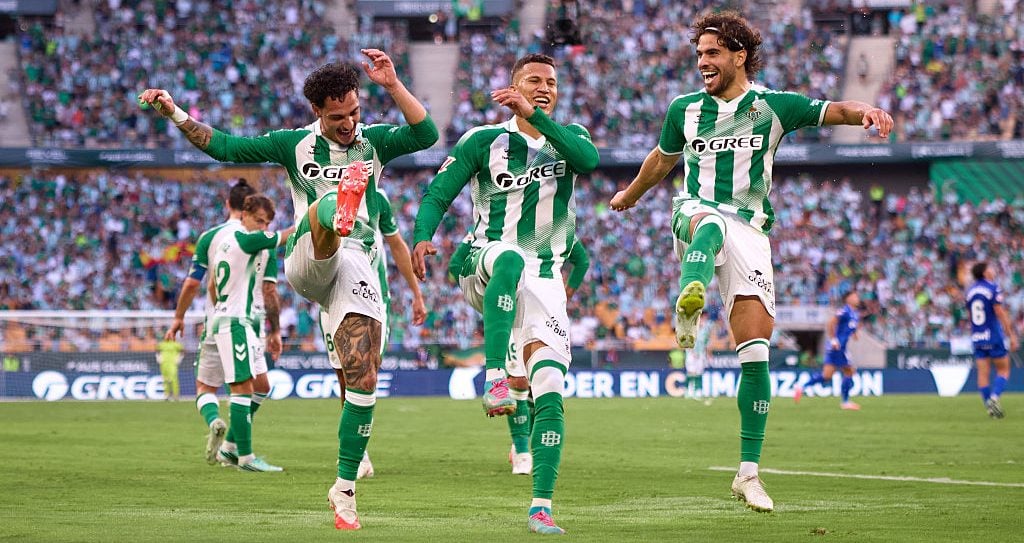
It has been a long wait for Betis fans. Back when Sevilla were filling their trophy cabinet with Europa League titles, the other club from the Andalusian capital were relegated to the second division for the last time in their history. It was 2014/15: the collapse, but also the beginning of the climb back. Because right when they needed it most, the battered green-and-whites responded to the verdict on the pitch with record numbers: more than 40,000 season-ticket holders, more than many La Liga clubs could count on. That alone would be enough to confirm the bond between the club and its people. From there, though, Betis have simply kept climbing. And for several seasons now, they have looked down on their city rivals. More importantly, they have kept looking at themselves, at a fresh, healthy football culture, capable of drawing people in and passing its enthusiasm on to anyone who pulls on the shirt these days. Ask Antony, Isco or Lo Celso.
For six seasons in a row – with the Copa del Rey in the cabinet in 2022 – Betis have finished at least seventh in the league. Last season they returned to the Champions League after two decades away. Today, aside from an unexpected thumping at Levante, they have started strongly and, after six games, sit second in La Liga alongside Real Madrid, behind only the runaway leaders Barcelona. The rise has been steady, gradual, without rushing anything or leaving anyone behind. And it starts with those same supporters who are the soul of the club. Its owners too, to a large extent: as El País reported in this detailed feature, Betis, now the fifth most-followed club in Spain, have more than half of their shares spread among thousands of supporters. All of them have a say in the future of the team, regardless of the size of their investment.
This model of popular share ownership, still fairly unusual at the highest levels of football, allows the green-and-whites to draw on a range of resources while keeping speculation and hostile takeovers at bay. And in this respect, one of the clearest examples in recent years came from one of Betis’s most passionate supporters, and one of its most beloved figures on the pitch: Joaquín Sánchez, eternal captain and record appearance-holder, who returned home for the final stretch of his career after years spent elsewhere. In Seville, the former Fiorentina man only got better with age. His final spell lasted eight years, taking him all the way to 42 – remarkable for an attacking winger whose game was built on long runs up and down the flank – and he even had the pleasure of winning the Copa del Rey again in green and white, 17 years after the previous triumph.
But his biggest gesture was taking a 2% stake in his own club, precisely to keep it out of the wrong hands and convince further investors of the strength of the project. He put his name and money behind it – several million euros, in fact. Today he is an established executive, acting as a link between the club’s hierarchy, the football department and the vast bético community: one of the most active in Spanish football, well beyond Seville and Andalusia. Another link between the club and the people who make it what it is.
The international breakthrough is still to come – Antony and his teammates reached the Europa League final in 2025, but stopped there – yet Betis continue to dream big, and the extensive redevelopment of the Benito Villamarín is very much part of that ambition. Every week the atmosphere is electric, the players repay the club’s faith – and its strategy, with the core of the squad forged in Latin America – with high-level performances, and the green-and-white badge is starting to find its way into new media and commercial spaces. Inevitable, when the results keep coming. But Betis are different, because when the results were not coming, the green-and-white tide was still there in the stands, singing at the top of its lungs. A team like that is hard not to root for.