
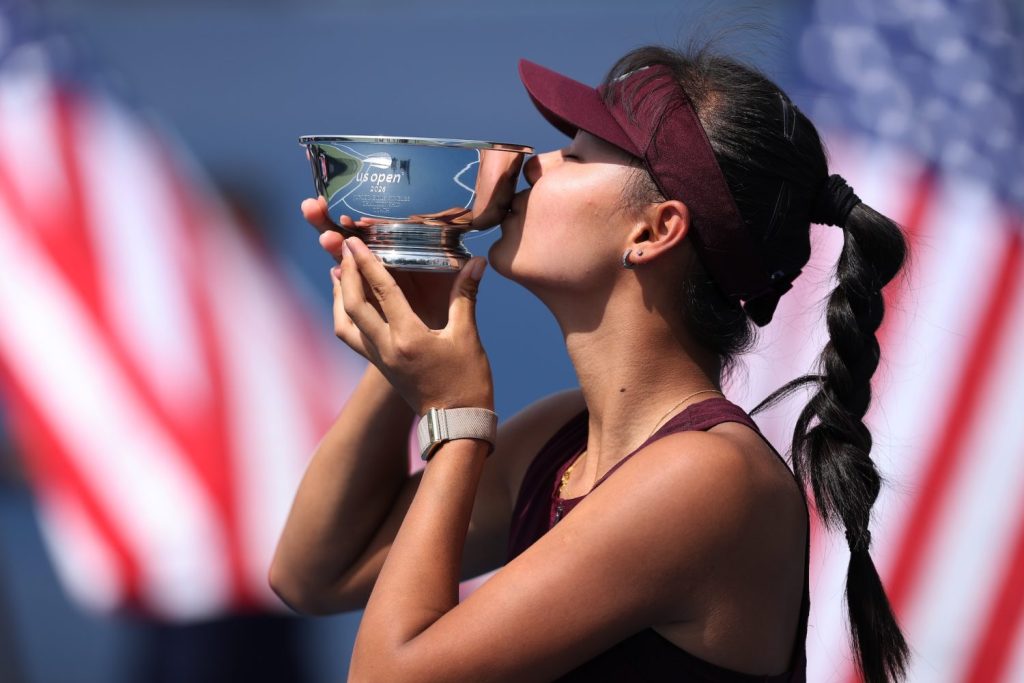
There was an air of revenge, of unfinished business, at the US Open Junior Championships, at least for those watching. Sun Xinran, meanwhile, kept repeating that “any result is okay”, as long as you fight for every point. Across the net was an opponent Sun knew well, perhaps too well: Anna Pushkareva. Two months earlier, at Wimbledon, Pushkareva had beaten Sun in the final, coming back from a set down to win 5-7 6-3 6-4 after two hours and 23 minutes. In Paris, Sun had lost the final to Alisa Oktiabreva. Three junior Grand Slam finals in one season and two defeats that, before New York, might have been enough to knock her off course. But in her interviews, Sun Xinran keeps returning to the “mental” side of the game: the head, the resilience, that indefinable quality that makes you keep going in spite of everything and everyone. In spite of the disappointments. Against Pushkareva, this time, it ended 6-4 4-6 6-0. In the third set, the Chinese player stopped giving her opponent any room, took the ball early and began dictating the rallies with greater consistency. She made just three unforced errors. Pushkareva made eleven. The match suddenly accelerated, and the finish was beginning to take shape.
In tennis, as in sport more generally, memory is often short: we remember the latest achievements, or the latest defeats. But before New York, Sun had already built a record worth taking seriously. At 15, she finished 2025 by winning the Orange Bowl and, a few weeks earlier, had taken two consecutive W15 titles in Sharm El Sheikh. In May, she won the Trofeo Bonfiglio in Milan, becoming the first Chinese player to claim the women’s singles title. In the meantime, she had risen to No. 1 in the junior rankings and to around No. 600 in the WTA rankings. Put together, those numbers say something. But tennis at that age is a sui generis game, and a slightly cruel one, too: girls can win a lot for a few months, enter the radar, and then run into the professional circuit, where they have to start measuring themselves against more experienced opponents. Sun is still there. She was born in Shenzhen and has trained in Serbia for years with Goran Životić, whom she met as a child, building much of her development in Belgrade. Her story is therefore more international than it might seem: a very young Chinese player growing up far from China, between training sessions, junior tournaments, her first professional events and the endless travel that comes with being a young tennis player. In May, when she won the Bonfiglio in Milan, all the elements that now seem to form a recognisable path were already there, although at the time she was simply a 16-year-old who had played better than the others for a week.
On the eve of the New York final, Sun had said that she would play “as if I were going to lose”. She did not want to walk onto court thinking about what had happened in Paris or at Wimbledon. Pushkareva was the same opponent, but this was a different match. In the first set Sun found a way to take charge; in the second she lost a few shots, particularly in aggression, and the contest was level again. Then came the thing people often try to explain with words that are too large, when on court it is actually much simpler: she started hitting the ball better. She took more risks, shortened the rallies and took time away from her opponent. The 6-0 arrived without much trouble. The title makes Sun the second Chinese player to win the US Open girls’ singles title, after Wang Xiyu in 2018, while Chinese women’s tennis has meanwhile moved into another dimension and the name inevitably brought into the conversation alongside Sun is Qinwen Zheng. Zheng built part of her development in Barcelona with Pere Riba and went on to reach the Australian Open final and win Olympic gold in Paris. Sun dreams of following a similar path. She has said so herself: she would like to win the Australian Open and, one day, face Zheng on the main tour. For now, the two players have not met, but Sun keeps a ball signed by Zheng, made especially for her, close at hand.
The junior rankings will matter less and less from here on. Professional matches last longer, carry a different weight and often demand something else when the important points arrive. There will be tournaments in which Sun starts as the favourite and loses in the first round, others in which she will have to spend three hours against a 24-year-old ranked much lower than she had imagined, and days when she will have to serve better, defend when she cannot dictate and work out how much she can force without losing control. These are things you do not learn by winning a junior title. For now there is the victory in New York, after two lost finals: a success that says more about Sun than any interview could. She lost, came back, and found another way through. Across the net there is still Pushkareva, and Sun plays the third set with a calmness, almost a kind of stoicism, that a few months earlier she might not have found. Sun is, after all, 16. In a few weeks she will be back playing another tournament, probably on a court far less crowded than the one in New York. There will be no junior trophy to decide the day and no one will give her the points back if a match goes badly. That is where the most unpredictable part of the story will begin. Probably the part worth following most closely.