
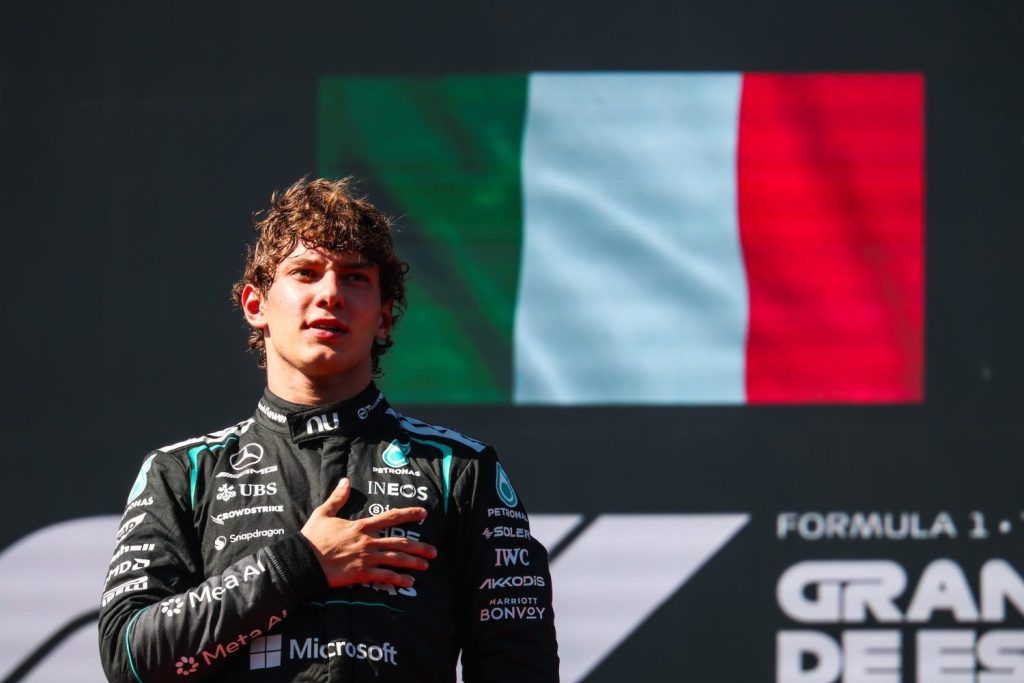
Kimi Antonelli began winning the Spanish Grand Prix before he ever found himself in front. Starting alongside Lando Norris in second, he tried to go for the lead immediately, but at the first corner he realised in a fraction of a second that there was not enough room to complete the move. He ran wide, off the track, and had the presence of mind not to turn a risk into a mistake: he gave the position back to the Englishman and settled in behind him. No insistence, no desperate attempt to take back straight away what he had wanted. He knew, evidently, that the Madrid Grand Prix was a long race and that this would not be his last chance. A small detail, perhaps, but one that says a lot about the driver Antonelli has become.
Norris, starting from pole, seemed to have the race under control. McLaren had the pace to stay ahead, and the Madring, the new circuit on the World Championship calendar, did not seem to offer much in the way of overtaking. Antonelli stayed there, without using up his tyres unnecessarily and without turning every lap into a fight. Then came the moment that changed everything: the Virtual Safety Car, brought out by Lance Stroll’s stationary car, opened a strategic window that Mercedes read perfectly. Antonelli came into the pits at exactly the right moment, while Norris missed the pit entry under neutralisation. That was the turning point. It was also why Antonelli had no problem admitting over the team radio how much the situation had favoured him: “I feel a bit guilty for Lando.” He knew he had been given something by the race, by circumstance, perhaps by luck, but there was no reason to give it back. In Formula One, opportunities have to be recognised, and then taken. From there, though, the win was far from settled. This was where Antonelli did the harder work.
At the halfway point, he had to manage his tyres carefully, keeping a calculated distance from Charles Leclerc. The Ferrari was ahead and provided a useful reference: Antonelli did not need to attack, but he had to stay close enough to benefit from Leclerc’s stop. He kept the pace without asking too much of the tyres, held his position and, when Leclerc came in, found the road ahead clear. He did not need to be faster on every lap. He needed to be fast when it mattered. He knew when to attack, when to leave space, when to preserve the tyres and when to build the margin he needed. That is what made the victory at the Madring so telling. Mercedes did not appear to have the clear advantage it had shown at other rounds, while the pace of Norris, Verstappen and Leclerc meant there was little room for error.
Madrid says something about the driver Antonelli is becoming. Talent is no longer the new thing. Everyone already knew there was plenty of it. The same goes for outright speed. What is changing is the way he puts everything together, the ability to stay composed when a race moves away from the plan and, above all, the understanding that a Formula One race does not have to be won by taking every risk that presents itself. After a 2026 season in which he has already put together an extraordinary run of victories, Antonelli is increasingly looking like a more complete driver. These are the wins that matter in a championship, built through patience and an instinct for what the race is asking for as much as through pace. The numbers are difficult to ignore. The victory in Madrid was the eighth of his career, moving him one ahead of George Russell, who has seven. It also made him the first winner of the Spanish Grand Prix at the new Madring and gave him his eighth victory of the season.
More significant still is the championship. After Madrid, Antonelli’s lead over Russell stood at 81 points. A huge advantage, built on remarkable consistency. In 2026, he has missed the podium only in races that ended in retirement, in Barcelona and Silverstone; otherwise, he has been there at the front, very often at the very front. That consistency is what makes the title increasingly difficult to dismiss. The Madrid victory may be one of the most significant because of the way it was built: not through the need to be fastest at every moment, but through reading the race, managing the tyres, waiting and knowing when the opening had come. Antonelli waited, recognised it and took it. With 81 points between himself and Russell, the World Championship is beginning to look less like a dream and more like something within reach.