
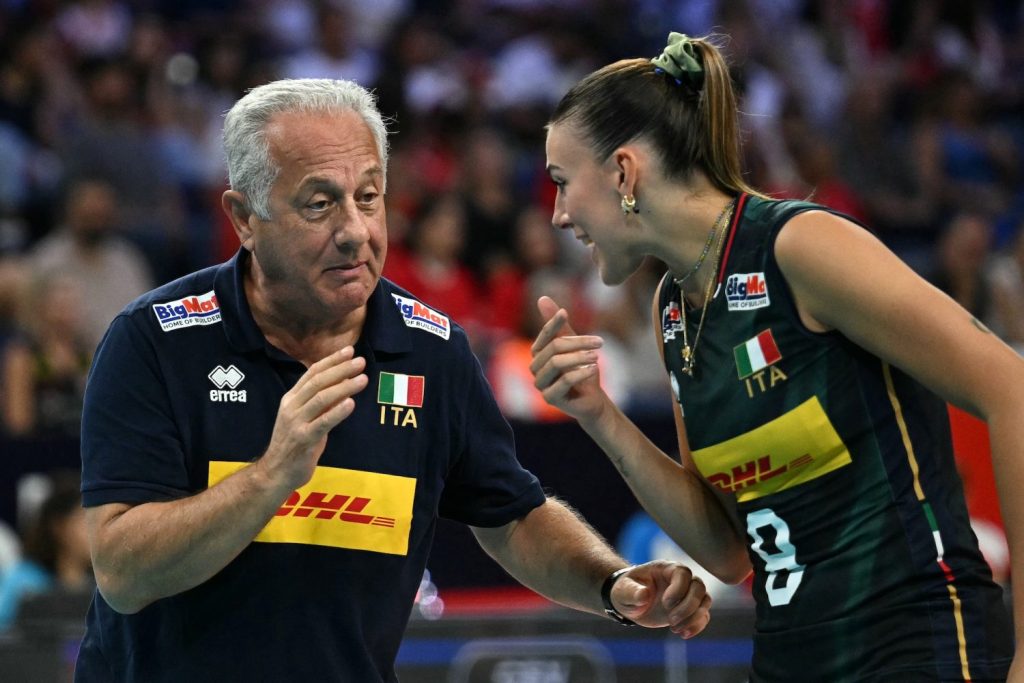
There are defeats that hurt, and defeats that, with time, can even prove necessary. Italy’s loss to Turkey in the European Championship final in Istanbul probably belongs to the second category, although it will take a few days, and above all some distance from that feeling of a missed opportunity that inevitably comes with a 3-2 defeat at the end of such an unusual match. A match in which the Azzurre had more than one chance to take definitive control. Italy had started well, won the first set, responded when Turkey seemed to be pulling away, dominated the third 25-12 and, in the fourth, stayed in the match for a long time before giving way in the fifth. Something was missing, above all in those moments when the match demanded clarity, continuity and the ability to play one ball at a time without being carried away by the momentum of a final in which every mistake seemed to weigh twice as much.
Turkey won because, quite simply, it is a very strong team right now. And because it knew how to survive the moments when Italy seemed to have something more. Melissa Vargas was once again the reference point in attack for a team that found resources even when its game became stuck, while the crowd at Sinan Erdem Sports Hall turned the setting into part of the match, adding to the pressure on the Azzurre, especially towards the end. Italy, by contrast, went through stretches in which it lost the continuity that had accompanied it through much of the tournament. After dominating the third set, it gradually gave Turkey room to come back into a match that had seemed to be moving towards the Olympic and world champions.
The tie-break was a matter of details, as it almost always is when a title is decided in a fifth set, and this time those details went the way of the home side. But to stop at the result would be ungenerous to a national team that, once again, showed that it remains one of the strongest in the world. Italy reached the final after eight consecutive victories and finished the tournament with a silver medal that cannot be considered a failure simply because, over the last two years, this team has accustomed us to winning almost everything there was to win. After the Olympic gold in Paris and the world title in Bangkok, the European Championship was the chance to complete an extraordinary journey. The fact that the third consecutive title did not arrive changes nothing about what these players have built, and above all does not prevent them from looking with confidence at what they can — indeed, must — build next.
Perhaps the most interesting thing to emerge from this European Championship is precisely the feeling that Italy is not a team at the end of its cycle, but one learning to change without losing its identity. The clearest example is Ekaterina Antropova, whom Julio Velasco has decided to use in a role different from the one we have become accustomed to associating with her. Kate is no longer simply the alternative to Paola Egonu at opposite, but is learning to become an outside hitter, with everything that entails technically and tactically. It is an experiment that requires time, because it means asking her to change habits, responsibilities and reference points on the court, but it could give Italy an extraordinary solution for the future: having Antropova and Egonu on court at the same time means having two players capable of shifting the balance in attack and, above all, forcing opponents to prepare for the match in a completely different way.
In the final, Antropova scored 16 points, while Egonu had 28, numbers that already give a fairly clear idea of the potential of this pairing. Egonu carried Italy’s attack through the most difficult moments and continued to be the player Alessia Orro could look for when the situation became complicated. Orro is now much more than a setter: she is the brain of a team that knows her rhythms, her qualities and her responsibilities, while Danesi continues to provide presence, personality and quality at the net. They are players from the generation that learned to win with Velasco, and now have to learn how to deal with a defeat too, turning it into something useful rather than allowing it to remain simply a negative interruption.
And then there is Eleonora Fersino, perhaps the most interesting figure in the transition this national team is going through. Taking over the legacy of Monica De Gennaro was never going to be simple, because the libero at the centre of Italy’s great triumphs in recent years has been one of the defining players in the position, in Italy and around the world. Fersino, however, has shown that she can carry that responsibility with growing confidence. In some ways, Italy needed to remember that it is not unbeatable, not because this team needed to be brought back down to earth — it has already shown that it belongs in the history of Italian volleyball — but because no winning cycle can continue without finding new sources of motivation. Winning all the time risks turning victory into a habit; losing a final after having a real chance to win it leaves a question open, and great teams are the ones that know how to live with that question.
The next objective will be the World Championship, but in the background there is already Los Angeles 2028, the great appointment with which Velasco has decided to bring his time in charge of the national team to an end. And that is perhaps not a minor detail. Had Italy won this European Championship too, completing the cycle that in recent years has brought Olympic gold and then a world title, Velasco would probably have had one more reason to consider his mission complete; instead, this defeat leaves something still to be won. Not so much because there is a need to add another trophy to an already extraordinary cabinet, but because there is still the possibility of accompanying a group that is changing towards one final great objective.
For that reason, Istanbul can become a starting point rather than an ending. Turkey showed that Italy can be beaten, but Italy showed that it still has Egonu, Antropova, Orro, Danesi, Fahr, Fersino and a generation of players capable of taking on new responsibilities without losing their ambition. It lost a final, not its identity. And perhaps, after two years in which almost everything went according to plan, this was exactly the kind of pain that was needed, not to start over, but to carry what comes next with a little more urgency. The World Championship will be the chance to respond. Los Angeles, perhaps, the chance to close the circle. Because great teams are not those that never lose; they are those that, when they lose a match they could have won, know how to live with it and keep going.