
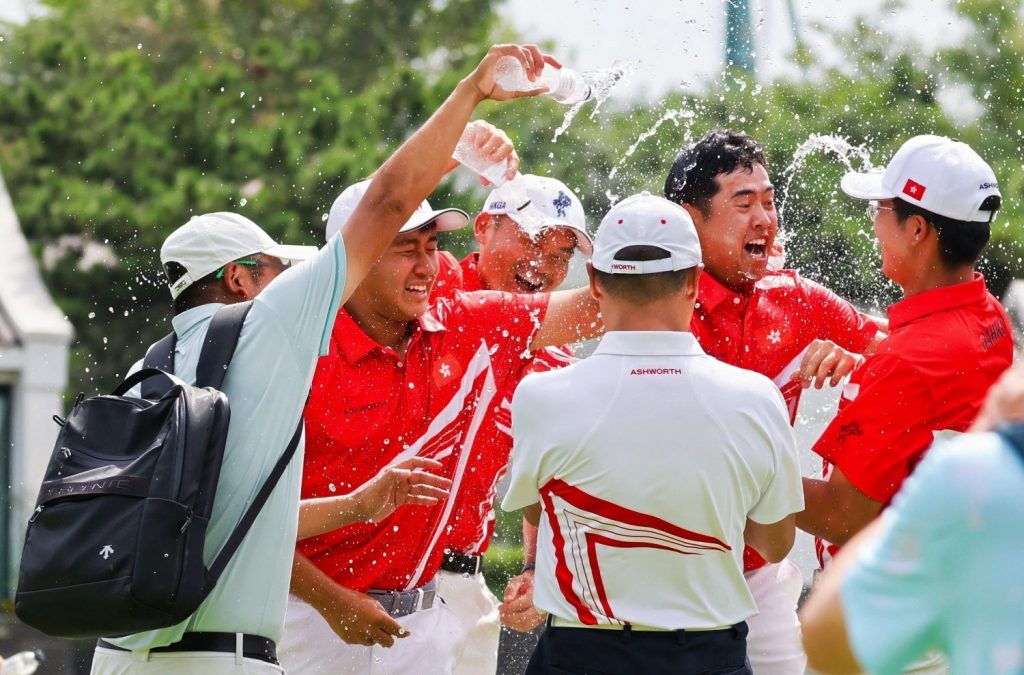
On paper, it was supposed to be impossible. Japan arrived at Bayhood No. 9 with 2,500 golf courses, five million registered players and ten Nomura Cup titles in the cabinet. Hong Kong had three teenagers, a talent pool drawn from just six clubs and no history in the tournament. Four days later, on the 18th green in Beijing, Markus Lam, Jeffrey Shen and Ethan Tian were lifting the cup against all expectations.
Team golf carries a peculiar, silent pressure. You are out there alone with your ball, yet every hook into the rough feels like a betrayal of the two teammates walking the fairway behind you. The Nomura Cup counts only the two best scores each day: one bad afternoon can undo a week of collective effort. You are playing your own shot, but the two rounds beside you are always there. Hong Kong set the pace on Wednesday with a team score of 140, but Thursday morning belonged to Markus Lam. He studied the course with cold, surgical aggression, hunting flags, collecting eight birdies and signing for a 67. With Tian right behind him on 68, Hong Kong suddenly found itself six shots clear at the top of the leaderboard.
By Friday morning, the course had shown its teeth. A stiff northerly wind swept across Bayhood, drying the bentgrass greens until they were hard, fast and bright as mirrors. The flags were tucked into the most awkward corners, protected by deep bunkers. Tian lost his rhythm off the tee early, pushing drives into the rough and slipping to a heavy 78, while Japan’s Kaito Sato went round in a clean 68, drawing level with Lam at the top of the individual standings and cutting Hong Kong’s lead to two. The cushion was almost gone.
Saturday afternoon turned on thirty seconds at the 15th, a 170-metre par three. Lam and Sato, level at the top of the individual standings, shared the tee while Hong Kong defended a two-shot lead in the team competition. In the crosswind sweeping across the water, Lam shaped a perfect draw with a six-iron to around ten metres from the flag, leaving himself a steep downhill putt along the ridge of the green. He picked his line, trusted the pace and watched the ball slide straight into the heart of the cup. Sato, under enormous pressure with little more than five feet left, pushed the putt just enough to catch the left edge and watched it race away. It took thirty seconds, and two shots had changed.
Hong Kong never let the advantage go. Shen closed out the back nine with icy authority, saving par from the greenside bunkers at the 16th and 17th to sign for a 70. Tian put Friday behind him with a 69. At the 18th, a par five, Lam laid up cleanly, threaded a wedge to five feet and rolled in his eighth birdie of the afternoon to close with a 67. A final-round 136 gave Hong Kong a total of 557, 19 under par, and a four-shot victory over Japan. Lam also took the Taimur Hassan Amin Trophy as individual champion, finishing one shot ahead of Sato. When the winning putt dropped, the composure went with it: putters landed on the grass, caps flew into the air and head coach Tim Tang was swallowed by a group embrace in the middle of the green.
Tang’s instructions throughout the week had been simple, stripped of rhetoric: forget the leaderboards, choose a target, play the shot in front of you. That was all. And yet the simplicity of it reaches well beyond four days in Beijing. Since Shun Nomura helped found the tournament in 1963 alongside officials from Chinese Taipei and the Philippines, the Nomura Cup had largely belonged to Australia, Japan and Chinese Taipei. Vietnam’s breakthrough in 2024 in Hai Phong had already shown that the old hierarchy could be breached. Hong Kong’s victory in Beijing made the point again, this time with three teenagers from six clubs. Asia-Pacific golf is no longer quite the closed world it once was.