
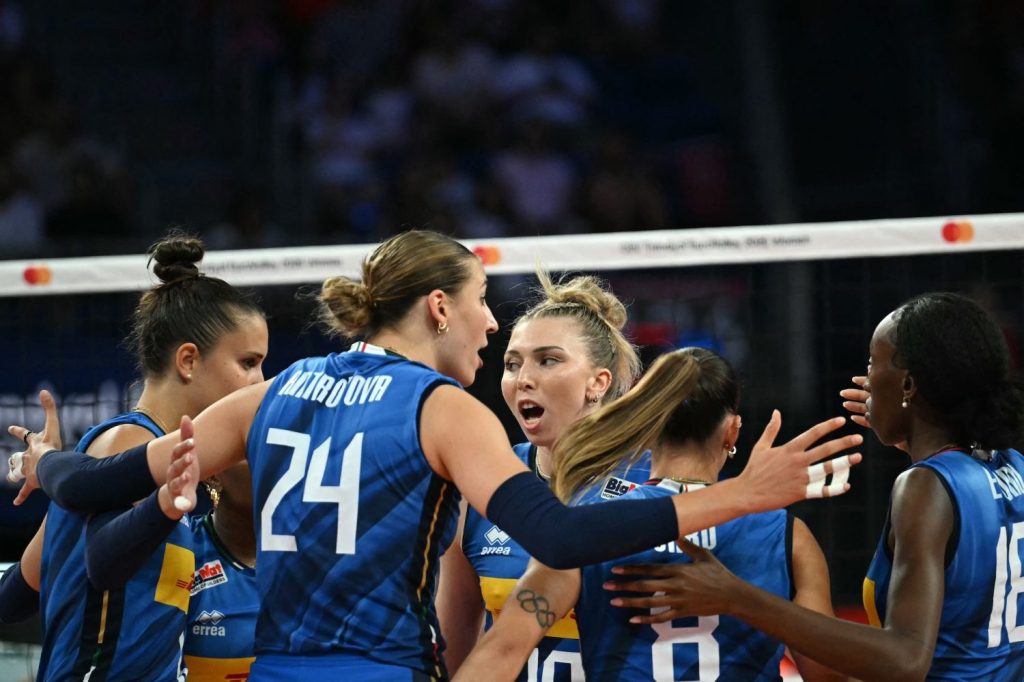
For two sets, it had seemed almost routine. Then the match changed shape, presented Italy with a problem it had not yet encountered and asked the Azzurre for something beyond simple technical superiority. In the end, Italy beat Poland 3-1, reached the European final and earned the chance, tomorrow against Turkey, to complete an achievement with few precedents: winning Olympic gold, the World Championship and the European Championship one after another. The opening stretch of the Italy women’s volleyball semi-final had been almost perfect. Italy had taken control without having to force too much, playing orderly, precise volleyball in which every part of its game seemed to fall into place. Perhaps the statistic that best captured those first two sets was the total of just four unforced errors. Four. Far too few for a Poland side that needed a messy game, a few gifts, a few moments of hesitation from the Azzurre to really get into the match.
None came. The first 25-19 showed a team in command, able to keep Poland at a distance and find different solutions as the match required. The second set followed the same script: a few moments of balance, then Italy accelerated and built its lead. Another 25-19. Two sets to love. It looked like the prelude to a third set without much resistance. Poland, though, had no intention of leaving the semi-final quietly. And Stefano Lavarini, Italy’s coach on the other side of the net, found the player capable of changing the match: Julia Szczurowska. Her introduction gave Poland another attacking option, but above all the consistency in side-out play that had been missing until then. Lavarini understood that this was the route back and began to lean on it.
Italy, meanwhile, lost something. Not necessarily control of the match, but its rhythm. Poland began to apply more pressure, defend better and play with greater confidence. The Azzurre still had the strength to recover from a difficult start, drawing level at 9-9. It seemed like the moment to pick up the thread of the first two sets. It wasn’t. By then, the problem was no longer only Poland, but Italy too. Velasco put it with his usual clarity: everything depended on the Italian players. “The problem wasn’t when the ball was in the opponents’ hands, but when Italy had it,” the coach said. Poland were growing, certainly, but they were also growing because the Azzurre had stopped playing with the same cleanliness and conviction they had shown at the start. The third set became a chase Italy never quite managed to complete. Szczurowska remained an effective option, Poland found the side-out more regularly and the Azzurre could no longer string together two, three, four consecutive actions at the same level. Poland’s 25-21 reopened the semi-final and inevitably changed the shape of the match. It was no longer a game to close, but one to take back.
And Italy’s response came in the fourth set. The Azzurre went back to doing what they had done at the beginning: playing. There was no sudden acceleration, no need to invent anything. They simply found their rhythm again. The serve began to trouble the Polish reception once more, the block started reading the attacks again and Orro’s distribution restored balance to the game. Italy moved ahead early and, this time, never allowed Poland to properly come back into it. Egonu found her shots, Antropova gave the attack greater weight, while Danesi and Fahr continued to provide important options through the middle. Every point widened the gap a little further, until the fourth set became the answer to what had happened in the previous one. The 25-16 closed out the match. And it was fitting that Anna Danesi put the final ball away. The captain scored the point that sent Italy into the final, almost as if signing her name to the journey of a team that, for several years now, has stopped being satisfied with simply being strong and has begun to measure itself against history. Tomorrow there will be Turkey. A different final, probably louder, heavier and more demanding. But Italy arrives having come through the most delicate passage of this semi-final: the moment when a match that seemed already won suddenly asked to be won again.