
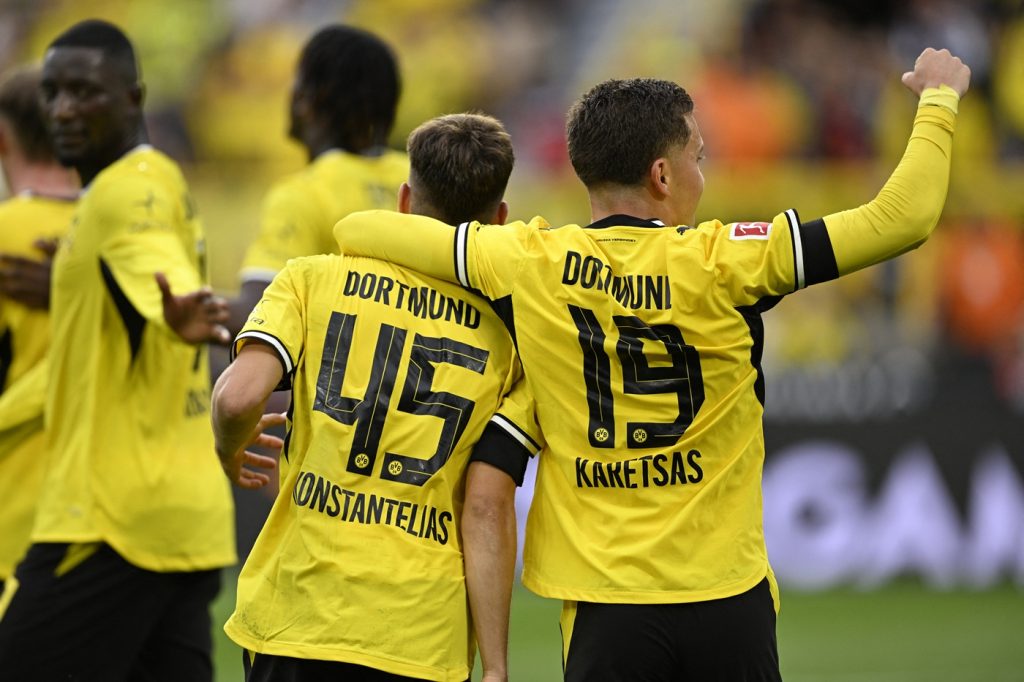
It may seem strange, given that Greece failed to qualify for the World Cup after finishing third in a group with Denmark and Scotland, but the national team could be one of the surprises of the years to come. With less than two weeks to go before the transfer window closes, 20 Greek players have been involved in moves this summer, for a total of almost €160 million. That is around €55 million more than a year ago, when 34 Greek players were involved in transfers. Even more strikingly, four of the ten most expensive transfers in the history of Greek football have taken place during this summer window. The most expensive Greek player of the summer — and of all time, having taken the top spot from Kostas Manolas — is Christos Tzolis, for whom Arsenal paid €40 million. The former Brugge forward was named the best player in the Jupiler Pro League last season, after scoring 22 goals and providing 29 assists as Genk won the title. “He’s settling into the team really naturally,” Mikel Arteta said after the Community Shield, in which Tzolis started on the left wing and immediately made a case for a place in the starting XI with his first two assists. Borussia Dortmund have also turned to Greece for two of the country’s brightest young talents to strengthen Kovac’s squad. First came Konstantinos Karetsas, for whom they paid €30 million. The youngest goalscorer in Greek national-team history had finished the previous Belgian league season as the second-highest-scoring Greek at Genk, behind Tzolis. Then came Giannis Konstantelias from PAOK for €26 million.
Italian clubs have also been looking to this new generation of Greek talent. Konstantinos Koulierakis, after his spell at Wolfsburg, joined Roma for €16.5 million. Two years ago, Stefanos Tzimas left Greece for Nuremberg in a €22 million move before immediately signing for Brighton, who paid €26.5 million for him. At the AMEX Stadium, he now competes for the centre-forward position with another Greek, Charalampos Kostoulas, for whom Olympiacos received €35 million exactly a year ago. Greek football has also collected €23.3 million from Tzolakis’s move to Hull City, newly promoted to the Premier League. A little more, €23.6 million to be precise, had been paid by Newcastle for Vlachodimos, now one of the main contenders for the starting spot in goal for Greece. Alongside those already mentioned, there are Pavlidis at Benfica, Douvikas at Como, Mouzakitis at Olympiacos, Mavropanos at West Ham, Ioannidis at Sporting, Mandas at Lazio and Vagiannidis at Sporting. “These players are the future of Greek football,” said Ivan Jovanovic, the national-team manager, who last March, during the international break, stressed the importance of supporting the growth of this new generation: “We have to give them every opportunity so that, through the experiences they gain and by working alongside more experienced players, they can have the chance to represent their country in the years to come.”
What Greece achieved in 2004, with its historic European Championship victory, remains difficult to repeat. But there is now enough talent coming through to make a return to a major international tournament a realistic prospect. Greece last appeared at the European Championship in 2012, while the national team has not been at a World Cup since 2014. On that occasion, Greece reached the round of 16 — its best result at the World Cup. Repeating a performance like that could be a much more realistic target.