
One evening a few years ago, Ryan Lam was playing pickleball beneath a bridge in Kwai Fong. It was hardly an ideal place for sport: the court was a badminton court, the light was poor and, after a while, the ball became difficult to see. Lam went there at night because finding somewhere to train in Hong Kong was not easy. At the time, pickleball was a sport many people had never even heard of.
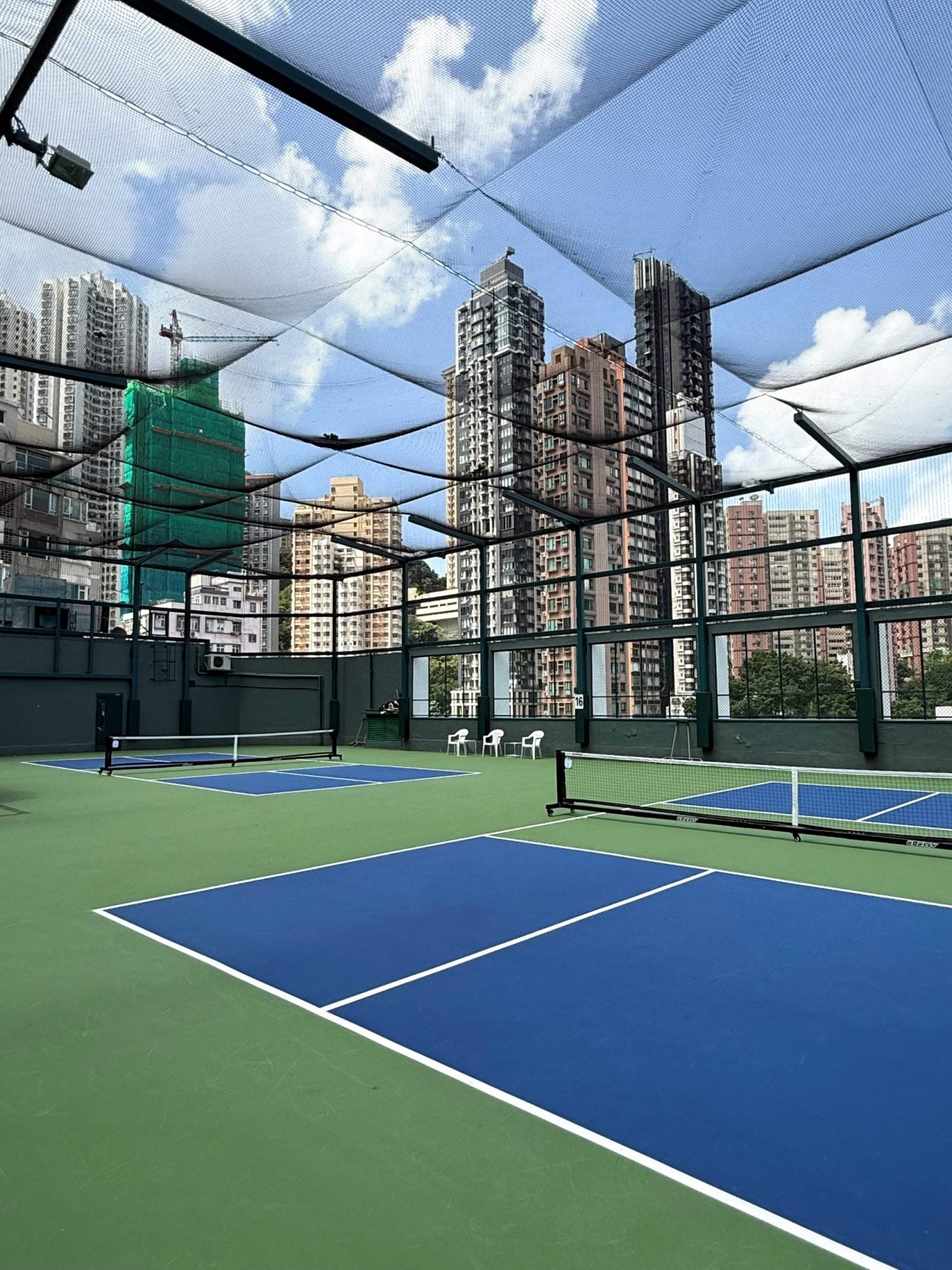
Today, Lam is 29 and a professional. He left a corporate job at Uber in the United States to return to Hong Kong, sign the city’s first professional contract and devote himself to the sport full-time. In February 2026, he reached the top of the World Pickleball Championship circuit rankings in the 19+ category, having been outside the top 100 only two years earlier. Pickleball has changed his life. Hong Kong has changed around it, too. You can now play on the rooftop of the Chinese Recreation Club in Tai Hang, where there are four outdoor courts; on the ninth floor of Landmark South in Wong Chuk Hang; or at Pickle City in Tsuen Wan West. The ball flies over the net while the usual frantic life of the metropolis carries on around it: offices, traffic, restaurants. It is not a sports complex on the edge of the city. It is in the middle of it, just a little higher up.
Land is the real problem here. There are buildings everywhere, and daily life already happens on several levels. You go up to get home, to work, to eat. Now you go up to play, too. Basketball is a good example. Between 2019 and 2023, American photographer Austin Bell went looking for the city’s outdoor basketball courts and photographed them. He catalogued 2,549. He started at Choi Hung Estate, after spotting the colourful courts from above, and kept going for four years. Eventually, the playgrounds became a way for Bell to get to know the city. They sit between housing estate towers, beside schools, in the middle of residential neighbourhoods. Then there are the roofs of shopping centres. At H.A.N.D.S. Shopping Centre in Tuen Mun, more than 10,000 square metres have been turned into a bright sports space with basketball, football, an athletics track and a skatepark that, seen from above, looks almost like a Joan Miró painting. It used to be nothing more than an unused roof. Now people go there to play.
Pickleball fits neatly into this particular version of Hong Kong, helped by the sport itself. A pickleball court is the same size as a doubles badminton court. The serve is underarm, games usually go to 11 points and there is the kitchen, the area near the net where volleys are not allowed. You can turn up for the first time and start playing almost straight away. You do not need to know tennis, and you do not need to arrive with a ready-made group of friends. Venise Chan, once Hong Kong’s number one tennis player, started playing in 2019, when pickleball was still largely unknown. In 2021, she organised the first Hong Kong Pickleball Open. Today she runs an academy in Wong Chuk Hang. In interviews, she has also pointed to a more practical reason for the sport’s growth: the courts are small, and land in Hong Kong is very expensive.
In 2025, the Hong Kong government began allowing some public badminton courts to be used for pickleball as well. Why build another facility when, for a few hours, you can give an existing one a different purpose? That same year, Hong Kong reached the final of the Pickleball World Cup and, in December, hosted a World Pickleball Championships event at Discovery Bay Recreation Club, with almost 900 players from at least 16 countries and regions. In October 2026, Hong Kong will host the Hong Kong Slam on the PPA Tour Asia, with $1.1 million in prize money. Ryan Lam will be one of the players to watch. Jack Wong Hong-kit, a former professional tennis player, is now the highest-ranked Hong Kong player in the PPA rankings.
Padel is the other big arrival. The court is larger than a pickleball court and the walls are part of the game: the ball can hit the glass and come back into play. It is usually played in fours. The basics are easy enough to pick up. Getting good is another story. In Hong Kong, the growth has been driven largely by new clubs. PADEL+ in Sai Kung was among the first to build a scene around the sport. Then came GO PARK Sai Sha, with courts for padel, pickleball, tennis and other sports. In November 2025, it hosted FIP Silver Hong Kong, with 268 players from more than 30 countries and regions and more than 170 matches. According to the South China Morning Post, it was the padel tournament with the highest participation ever recorded at an Asian event. Then came the bigger news: in March 2026, padel was officially added to the Asian Games in Aichi-Nagoya as, for now, a demonstration sport. It will be played between September and October. For players across Asia, it is no longer just another tournament. There will be national teams, medals, the chance to represent a country. Someone training today at GO PARK or one of Hong Kong’s new clubs can now look towards a competitive path beyond the city.
It is happening in different parts of Hong Kong, across different sports. Basketball is already woven into neighbourhoods and housing estates. Pickleball is moving onto badminton courts that are already there. Padel is arriving with new clubs, new developments and a lifestyle that sits somewhere between a Richard Mille on the wrist and a drink on the terrace at Ozone. In the end, the question is always the same: where do you put a court? In Hong Kong, it can be beneath a bridge, as it was for Lam a few years ago. On the roof of a club in Tai Hang. On the ninth floor of a building in Wong Chuk Hang. Inside a shopping centre. Or on an old badminton court that becomes something else for a few hours. Lam, meanwhile, no longer plays beneath that bridge. Today he is at the top of his circuit, playing at the highest level internationally.