
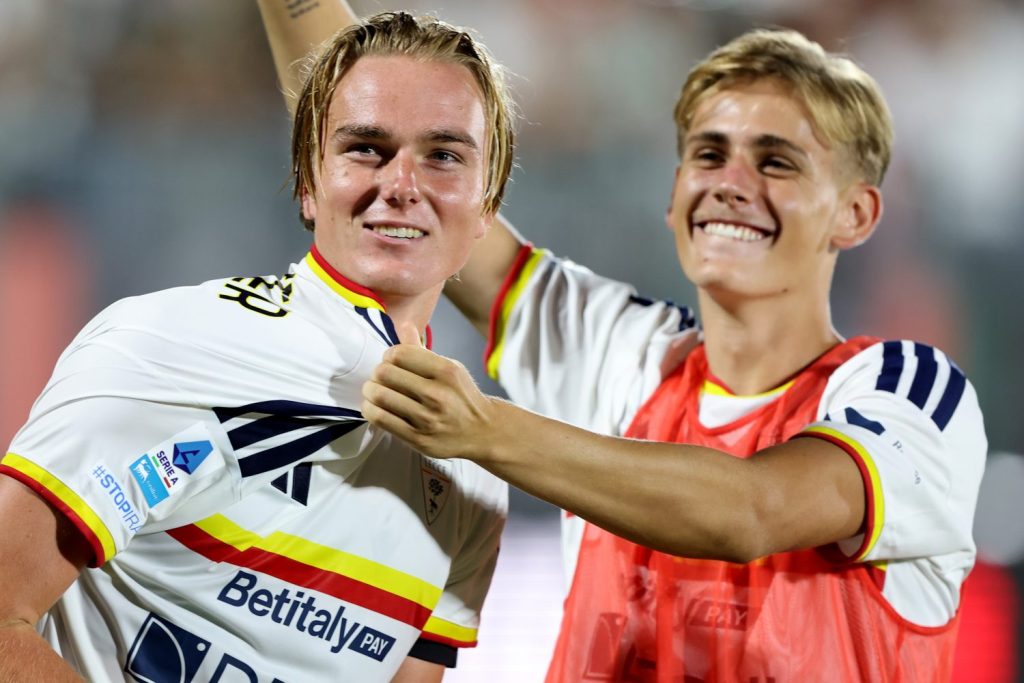
Before Venezia-Lecce 0-2, the opening game of the 2026/27 Serie A season, Olaf Gorter was known to just three groups of football fans: fantasy football players who had already held their auction, Lecce supporters and those who follow the Primavera Championship. In reality, the last two groups have tended to overlap for several years: Lecce are one of the very few Italian clubs that run a truly international recruitment operation for their youth teams and then keep the route to the first team open. Pantaleo Corvino, the former coordinator of the club’s technical area, put it in his own way — clearly, and with some colour — in an interview with Undici: “For us there is no other solution than to build up our technical assets by starting with the search for talent, both for the first team and the youth teams. If we want to compete, we have to look to other countries to find talent to develop and then give their Serie A debut.”
That is how Lecce found and developed Olaf Gorter: two years ago, they spotted him in Ajax’s fertile academy, when he was 19, signed him for €200,000 and spent the next two seasons with him in their Primavera side. In 2025/26, they gave him a taste of senior football in three brief appearances, two in Serie A and one in the Coppa Italia, and this season Di Francesco started him on the opening day. Gorter responded with a goal that effectively set Lecce on their way to a win of real significance, away to a team that will be fighting alongside them to avoid relegation, but Gorter’s story matters for a different reason: it shows that the Lecce model still works, that it remains a virtuous one. The numbers are striking: alongside Gorter, if we look at the players who have featured for at least a minute in Lecce’s first two matches of the season, the Coppa Italia game against Palermo (0-2) and the win in Venice, there are three who had spent significant time with the Primavera. Gorter himself, the Spaniard Esteban and the Dane Laerke. The squad also includes Bulgarian goalkeeper Penev, called up for both matches, and of course Medon Berisha, who is currently out injured.
Yes, they are all foreign. But that is precisely the point: the method devised by Corvino, and presumably to be carried on by sporting director Trinchera, has turned Lecce into a club that keeps developing talent, starting the process — scouting and then recruitment — earlier than most others, when these players are still teenagers. The fact that almost all of them come from abroad does not really change the substance of the model. Thanks to it, Lecce have become a sustainable club. Or rather, one that sustains itself. The best operation of all, in this sense, was the one involving Patrick Dorgu: the Danish winger, sold to Manchester United for more than €30 million, arrived in Salento in July 2022, aged just 17, from the Nordsjaelland academy; Corvino and his staff initially placed him with the Primavera, where he played a leading role in their 2023 title win, and then made sure he was brought into the first team. Two and a half years after arriving in Italy, in January 2025, came the offer from the Old Trafford club that Lecce could not turn down. And so the Giallorossi made the biggest transfer fee — and, naturally, the biggest capital gain — in the history of the club. It is hard to imagine Olaf Gorter’s story ending in the same way, at least for now, but Lecce have remained in Serie A for four consecutive seasons — a record in the club’s history — despite having one of the smallest budgets in the entire league, often the smallest of all. It is not much. Actually, it is a lot.