
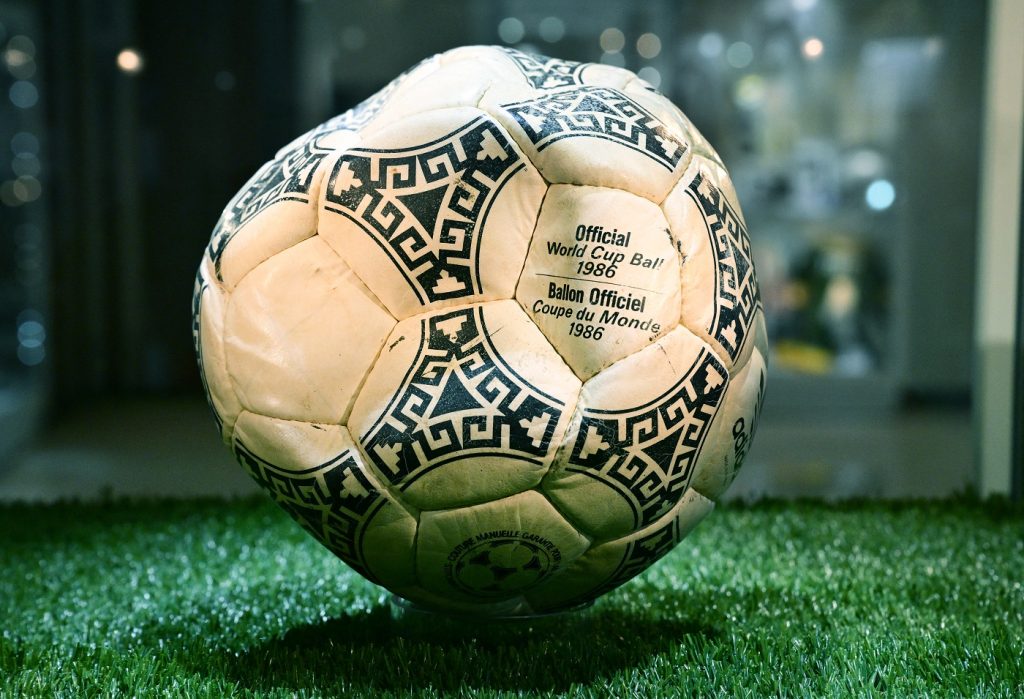
For several weeks, there had been fears that the auction could reach as much as $10 million. In the end, almost $3.5 million was enough, if “enough” is the right word. The most famous and controversial ball in football history, the Adidas Azteca used by Diego Maradona to score two of the most celebrated goals ever in Argentina’s 2-1 victory over England in the quarter-finals of the 1986 World Cup, has found a new owner. The ball was sold by Heritage Auctions on Saturday evening for $3.35 million, after bidding opened at $2.5 million. Heritage had presented it, identified through a meticulous comparison of photographs, as potentially “the most famous ball in the history of any sport”. The ambition was to make it the most expensive piece of football memorabilia ever sold. It fell short.
Before the auction, organisers had anticipated a price comparable to that achieved by the shirt Maradona wore in the same match. In 2022, the Argentina No. 10’s shirt was sold by Sotheby’s for just under $9.3 million, setting a record at the time for a piece of sports memorabilia. That same year, however, a 1952 Mickey Mantle baseball card surpassed it, reaching $12.6 million. Today, the record belongs to the New York Yankees jersey worn by Babe Ruth in the 1932 World Series, which sold in 2024 for $24.12 million. The “Hand of God” ball, though, had something no other piece of memorabilia could claim: it had been used for a goal that would become part of football history. Six minutes into the second half, Maradona pounced on a loose ball and beat England goalkeeper Peter Shilton to it, striking it with his left hand and sending it into the net. Tunisian referee Ali Bin Nasser did not see the infringement and awarded the goal. Maradona would later admit that it should not have stood, but by then it was too late: the “Hand of God” had become legend.
For decades, the ball remained in the hands of Ali Bin Nasser, the referee that day. In 2022, the Tunisian sold it through Graham Budd Auctions for $2.37 million. The following year, it returned to the market through Goldin Auctions, where the final bid reached $2.04 million. That sale, however, did not go through because the bid failed to meet the reserve price set by the owner. Its return to auction in the summer of 2026 seemed well timed. The World Cup held in the United States, Canada and Mexico had helped reignite interest among American fans in football memorabilia, in a market where sports collectibles traditionally command the highest prices. Perhaps, though, the timing was not quite perfect. The auction ended more than a month after Argentina’s 1-0 defeat to Spain in the final, after extra time. And, as if that were not enough, the brawl involving the Argentine players at the end took some of the poetry out of the moment.
None of this changes what that ball means in Argentina. For around 40 million people, its importance cannot be measured by an auction price. It is the ball from Maradona’s most iconic match, present for two of the most memorable moments in football history, four minutes apart: the handball and the dribble. Heritage had hoped to sell it for $10 million. The market put it at $3.35 million instead, but for those who grew up watching Maradona at the Azteca, that ball remains, quite simply, priceless.