
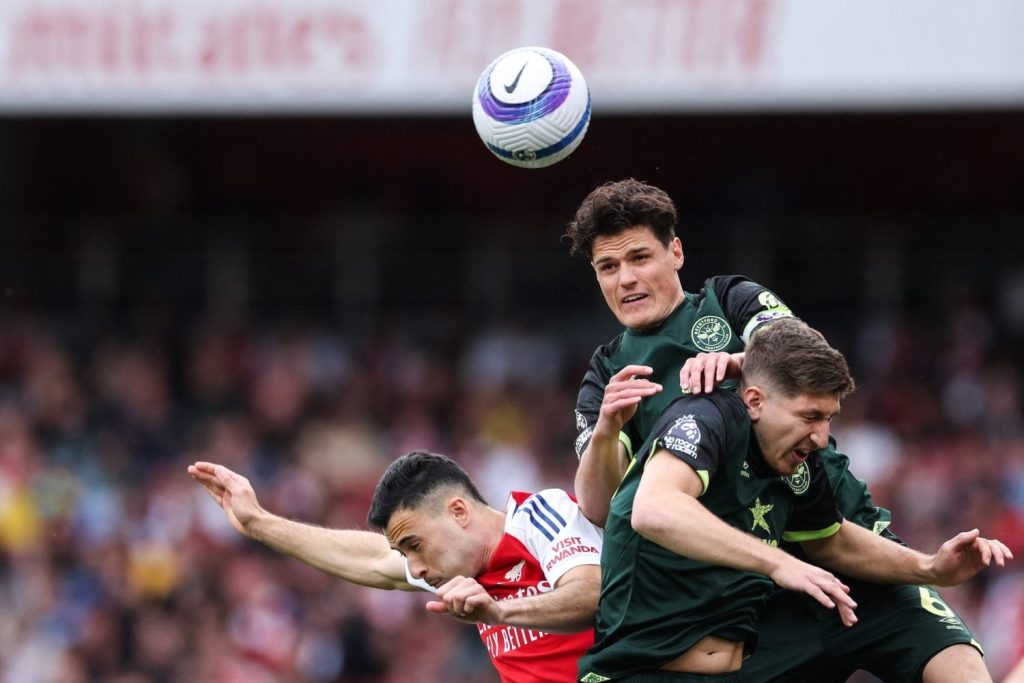
Last season, inside Premier League penalty areas, just about everything happened. Holding, pushing, grabbing, man-to-man marking, shirt-pulling and players wrapped around their opponents became a constant whenever a corner or free-kick sent the ball into the box. An epidemic, they called it in England. At a certain point, even the referees began to look more like spectators to the battle than its judges: “The feeling is that referees don’t really want to intervene in any of these situations anymore,” Everton manager David Moyes said after the match against Manchester United last February. “It’s really serious that they haven’t tried to solve the problem.” A few months later, in May, another incident reignited the debate: West Ham’s goal against Arsenal was disallowed after a VAR intervention, in an action in which as many as five possible fouls occurred at the same time. It was clear that something had to change. The issue was brought to the centre of the summer discussions between referees, managers, captains and other representatives of English football. Now the Premier League has decided to intervene. Not by changing the rules, but by changing the way they are applied.
As the BBC reported, from the new season, which begins today with Arsenal against Coventry, referees will be expected to be firmer, stricter and, above all, more willing to punish what are described as “non-football actions of holding that have no place on a football pitch”. The principle is simple: physical contact will remain an integral part of the game, but not everything that happens inside the box can be considered normal. A defender who turns his back on the ball and thinks only about blocking the attacker’s movement, a player who wraps both arms around an opponent, pulls his shirt or holds him for a prolonged period in a way that affects the course of the action will have to be punished. It will no longer be enough to wait for the situation to get out of hand. Howard Webb, the former referee who now oversees Premier League officials, has asked them to be more reactive and more proactive: “We’re trying to make sure referees have all the confidence they can to sanction what they see,” Webb explained. The formula is telling: fewer warnings, more decisions. And if the number of fouls falls, it should be because the players have changed their behaviour, not because the referees have stopped intervening.
The Premier League’s aim is not to turn every corner into a penalty lottery, nor to prevent players from physically competing for space. At the World Cup, where the protection of goalkeepers had been taken particularly seriously, holding at corners fell sharply. England will not go that far. Simple contact with a goalkeeper who is not attempting to play the ball will continue to be considered part of the game. It will be different when that contact actually prevents the goalkeeper from intervening. That was what happened to David Raya against West Ham: the movement of his arm was restricted by an opponent. Incidents of this kind will continue to be punished.
The problem, though, is that between an obvious foul and normal contact there is a vast grey area. And that is precisely where football can become divided. Every summer, Pro Ref, the new name of the organisation that brings together English referees, visits clubs’ training grounds to show players a series of incidents and explain what they should expect. The reactions are not always unanimous. Sometimes, in fact, opinions can be completely opposed even within the same team. “One player will tell you that, if the penalty isn’t given, he expects the VAR to intervene, knowing perfectly well that this will infuriate the other half of the room, who don’t think there are grounds for a penalty,” Webb said.
The referees, though, will be helped by preparation. Pro Ref continues to provide detailed dossiers before matches on teams’ tactical behaviour, not to suggest a decision but to allow the referee to be in the right place at the right time. If a team uses particular routines at set pieces, the referee can adjust his position to find a better angle. “We have highly qualified analysts doing a great deal of work before matches,” Webb explained. “That increases the chance of referees looking in the right place at the right time.” And this is where the heart of the problem lies. Set pieces are no longer a marginal detail of English football. They have become a fundamental part of the game.
Last season, 269 goals were scored from set-piece situations, excluding penalties and direct free-kicks: 25.7 per cent of all Premier League goals, the highest figure among Europe’s major leagues. Serie A, second in this particular ranking, still reached 22.3 per cent. Arsenal were the league’s best side from set pieces, scoring 25 goals and conceding just seven, the best defensive record in the competition. Some of their success came from elaborate routines repeated over and over again, but another component was inevitably physical. Manchester United scored 21 goals, Tottenham 19 despite a difficult season. At the other end of the table, Liverpool conceded 19 goals from set pieces, more than anyone else, while Chelsea and Newcastle conceded 17.
Changing the way the game is refereed therefore means changing, at least potentially, the way it is played. If holding is punished more frequently, teams will have to alter their routines. If attackers can no longer block a defender before the ball arrives, or defenders can no longer turn every corner into a free-for-all, managers will have to find different solutions. This is the real experiment that will shape the beginning of the new Premier League. It is not simply about awarding a few more penalties or free-kicks: it is about finding out whether refereeing can alter the strategies of teams without stripping away the physical element that has always made set pieces so compelling.
It is a delicate balance, almost impossible to draw with a straight line. And the risk is familiar. Every season, during the opening weeks, referees suddenly seem stricter. Then, slowly, old habits return. Players work out how far they can go, referees lower the threshold, and penalty areas once again fill with shirt pulls and markings that are almost impossible to distinguish. The Premier League’s challenge is precisely this: to show that this will not be a temporary crackdown, that the chaos seen throughout last season is no longer acceptable, and that, finally, even inside the penalty area, the line between football and a wrestling match can become recognisable again.