
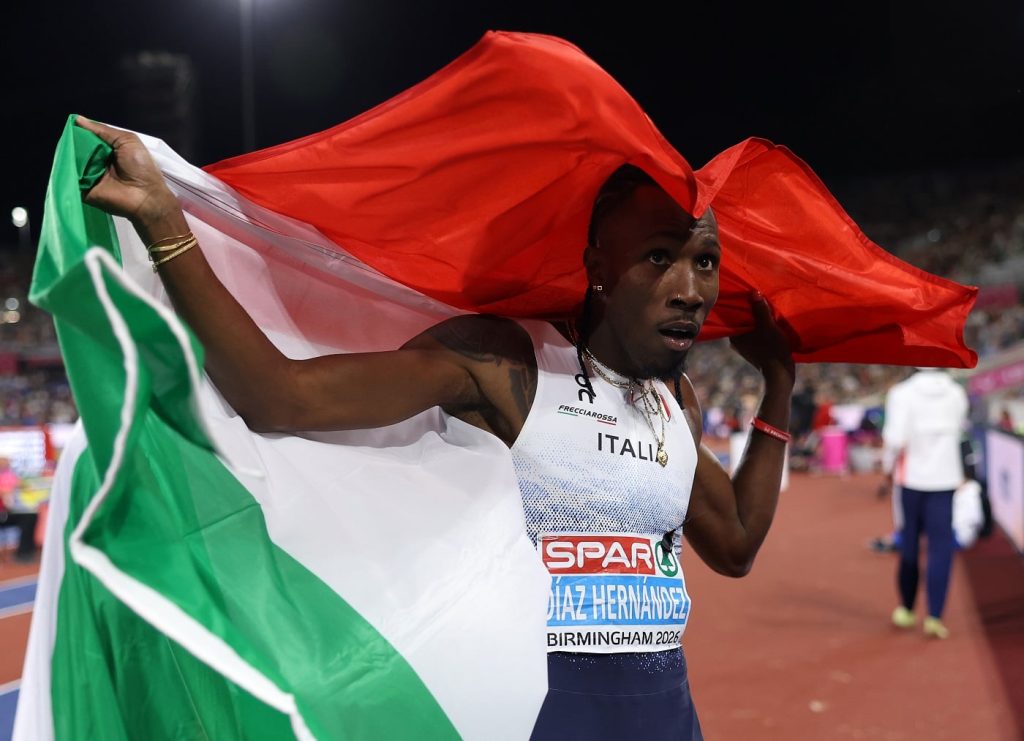
There is something almost natural, even elegant, in the way Andy Díaz moves down the runway. The triple jump, an event that often seems to ask the body to absorb a series of violent shocks, becomes in his legs a matter of rhythm, balance and lightness. Three contacts, then flight, without any apparent strain. In Birmingham, in the European final, that ease produced something no Italian athlete had ever managed before: 18.15 metres. A mark that won gold, a new Italian record, the best performance in the world this year and, above all, fourth on the all-time list. Ahead of him are only Jonathan Edwards, Christian Taylor and another Díaz, Jordan, the Cuban-born athlete who became Spanish and jumped 18.18 in Rome in 2024. The competition was virtually decided on the second attempt. Díaz’s first jump had already suggested that something unusual might happen: a foul by just three centimetres, but one that carried far enough to make even the world record seem possible. Then came 18.15, this time perfectly valid. The wind, +1.7 metres per second, was within the limit. The 18-metre mark, crossed by only a handful of athletes in the history of the event, had finally been cleared by him too.
And the most striking thing is that Díaz did not need to put together a perfect series. After the masterpiece came another 17.78, then he passed on his fourth attempt, fouled on the fifth and did not take the sixth. There was little reason to do anything else. Pedro Pichardo, the great rival, was left a long way behind: 17.76 for the Portuguese, almost four tenths short of the Italian. Andrea Dallavalle completed a magnificent evening for Italy with bronze at 17.37. It was also a podium that said something about the depth of Italian triple jump: an athlete born in Cuba and now Italian at the top, a Portuguese athlete also born in Cuba behind him, and another Italian on the third step.
But Díaz is already looking beyond the European title, towards a mark that has seemed to belong to another era of athletics. Jonathan Edwards’s 18.29 has stood since 7 August 1995. Thirty-one years later it is still there, untouched, at the top of the world lists. Díaz has come closer to it than any Italian before him and, after the competition, admitted that the legendary record no longer feels impossible. Officially, he was 14 centimetres short in Birmingham. But the feeling was there. “The world record? I know I can do it,” he said after the competition, explaining just how close he had come to turning that first attempt into something historic.
It is not only the distance that makes this story special. It is the road Díaz has had to travel to get here. Andy Díaz Hernández was born in Havana on 25 December 1995. When he was eight, his mother Milagros took him to an athletics track for the first time. He tried several events before the triple jump became his home, helped by the example of his cousin Osniel Tosca, an accomplished international triple jumper. As a boy he also went through Cuba’s sports school system before turning to studies in electronics. In 2012, though, he returned to athletics, working with Yoelbi Quesada, the 1997 world triple-jump champion. The talent was already there. In 2014 he finished fourth at the World U20 Championships, in 2017 he cleared 17 metres for the first time and at the World Championships in London he finished seventh. His path seemed to be leading towards a major career in Cuban athletics. Then came 2021, the year of Tokyo. Díaz was part of the Cuban delegation, but an injury kept him from competing. On the way home he made a decision that would change his life: he left the Cuban team and chose Italy.
His destination had a name: Fabrizio Donato. Díaz had admired the Italian triple jumper for years, including his Olympic bronze in London in 2012, and decided to get in touch. Donato initially took him into his own home for two months, then helped him find his place in the Italian sporting system and train at Castelporziano. In 2022, with Libertas Unicusano Livorno, Díaz broke through for good, winning the Diamond League final in Zurich with 17.70 and beating Pichardo in the process. In February 2023 came Italian citizenship, granted on sporting merit. From then on he became a regular presence among the world’s best. At the 2023 Golden Gala in Florence he jumped 17.75 and took the Italian outdoor record from Donato. In 2024 he joined the Fiamme Gialle and, once eligible to represent Italy, won Olympic bronze in Paris with 17.64. In 2025 he won the European Indoor Championships in Apeldoorn and the World Indoor Championships in Nanjing, where he raised the Italian record to 17.80. In 2026 he retained his world indoor title in Toruń and, shortly before Birmingham, had already moved the national record to 17.87.
In England, though, something different happened. Díaz did not simply win: he moved into a different part of the event’s history. The 18.15 put him in territory where every centimetre starts to matter, and where Edwards’s record can be seen less as something untouchable than as the next number to chase. He left Pichardo behind and gave Italy one of the most extraordinary performances in its athletics history. The jump itself looked light, almost simple, but inside those 18 metres and 15 centimetres there was everything: Cuba, Italy, Donato, Livorno, the injuries, the decision to leave, the citizenship, the medals and a career built again from the ground up. Fourteen centimetres remain. For everyone else, that is an enormous distance. For Andy Díaz after Birmingham, it looks like the next challenge.