
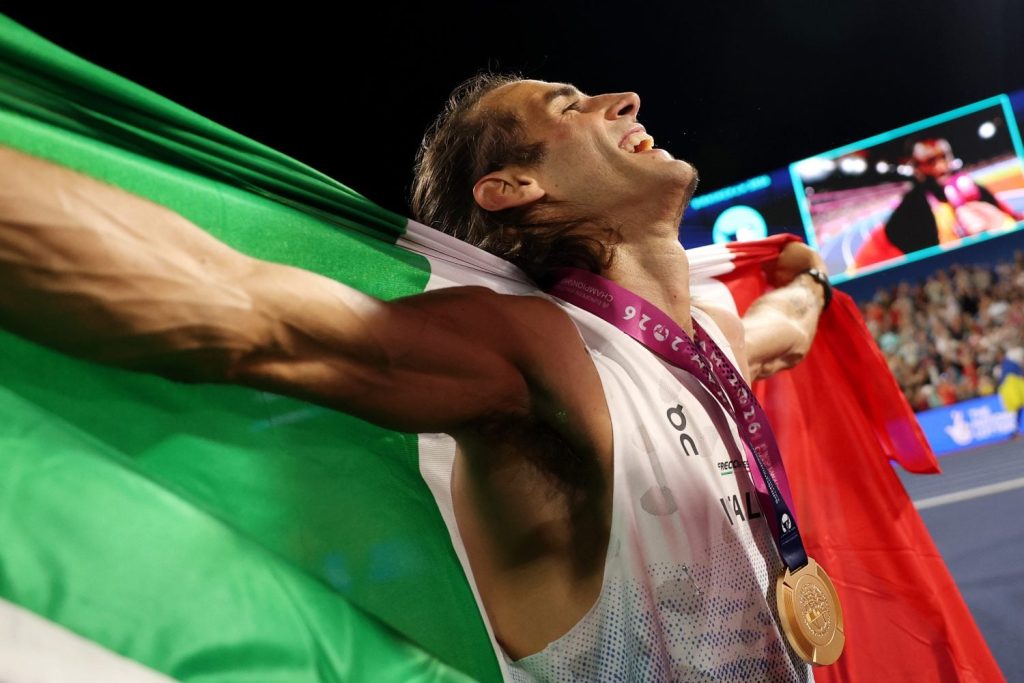
Gianmarco Tamberi waited for the bar to fall the wrong way before he finally let go. It took one mistake from Oleh Doroshchuk at 2.32, the height the Ukrainian had already cleared this season and which looked as though it might become the dividing line between gold and everything else. Tamberi never even attempted it. By then he had already built his victory, putting together a competition of clean jumps, composure, experience and, above all, that look on his face that had seemed to be missing for too long. When Doroshchuk missed, Gimbo realised he was European champion for the fourth time. Then he became the Tamberi we know. Jumps and somersaults on the high-jump mat, the climb into the stands to find the supporters, the embraces with Matteo Sioli and finally one with a stunned Doroshchuk. A celebration with no brakes, excessive in the way only he can be, spontaneous in a way we had not seen for some time. The Birmingham gold came with 2.32 at the second attempt, but the height itself almost feels beside the point. Tamberi had won against something that cannot be measured in metres: the difficult months after Paris, the fatigue, the doubts and the feeling he had spoken about in recent months of no longer being completely in control of himself. Before the European Championships, he had admitted that he was in good physical condition but still had a problem with his competition technique, and perhaps with that “fearlessness” that had become his trademark over the years.
Because the old Gimbo is not only the man who put an Olympic gold medal around his neck in Tokyo; he is also the man who turns a high-jump runway into a stage, who shouts, dances, jokes, provokes and brings the crowd into the performance. The one who seems to enjoy himself most precisely when the pressure should be crushing everything else. It is the Tamberi who needs to feel free to win. In Paris, after the Olympic gold in Tokyo and a career that had already entered legend, that lightness seemed to have gone. There had been the controversies, the arguments over the way he presented himself on social media, the wedding ring lost in the Seine, the criticism over how he had handled the kidney stone that disrupted his Olympic build-up and, more generally, an exposure to the media that had turned almost every gesture into a story. Then came his relationship with his father and coach, Marco, and the decision to end a partnership that had accompanied almost his entire career. All of it had taken something away from Gimbo.
Perhaps most of all, it had taken away his smile. That is why watching him sing the Italian anthem at full volume during the medal ceremony, dance on the podium and then take the mascot and hand it to the crowd feels almost as important as the medal itself. It is the image of an athlete who seems finally to have made peace with himself. Even the half-shaved beard was back, another piece of the old Tamberi, the one from 2014 and 2015, before the Achilles injury that kept him out of the Rio Games. It was never just an aesthetic choice. It was a ritual, a way of finding his way back to himself. In Birmingham, though, the half-shaved beard was no disguise. It had become a symbol again. Gimbo had found what he had been looking for for months: a competition that felt like his again.
The context only makes it sweeter. He had begun 2026 with a huge question mark hanging over him. After almost 300 days away from competition, he returned in Monte Carlo in July, cleared 2.23 and finished sixth. Doroshchuk won there with 2.32. A little over a month later, the same two men met again in Birmingham, only this time the story had a different ending. Matteo Sioli was there too, the young Italian Tamberi had identified as one of his heirs, who went on to take a fine bronze. Gimbo had praised him before the championships for his ability to compete, ask questions and learn. And then there is Camilla. Tamberi’s daughter turned one that very day. Her present arrived a few hours early and could hardly have been more beautiful. When Gimbo talks about her, his voice changes. The birth of his daughter had already allowed him to look at Paris with less pain and find the desire to continue. He had said that Camilla had given him enormous strength and changed the balance of his life. After the final, there was no question who that gold belonged to. “It was a special evening. Camilla gave me a push because she couldn’t keep watching her dad get beaten up everywhere, so I believed in it and I want everyone to believe,” he said after the competition. “I reacted when it mattered. Even tonight, the other competitors congratulated me on the YouTube documentary, which pushed me on even more. That feeling is enough for me. The gold is for my wife and my daughter. I never gave up.”
It is the old Gimbo, finally, without brakes and without filters, capable of turning a medal into a show and a show into a story. Only this time the show is not an escape from the pressure. It is what remains when the pressure no longer has the same hold on him. A 34-year-old man running, jumping, climbing into the stands, singing the anthem and smiling as he holds the medal. The fourth European gold takes him further into the history of Italian athletics, and Sioli is beside him on the podium, but those things almost feel secondary now. The image is Gimbo himself, back in the middle of it, celebrating as if he had never left. The old Gimbo is back. This time, that is a good thing.