
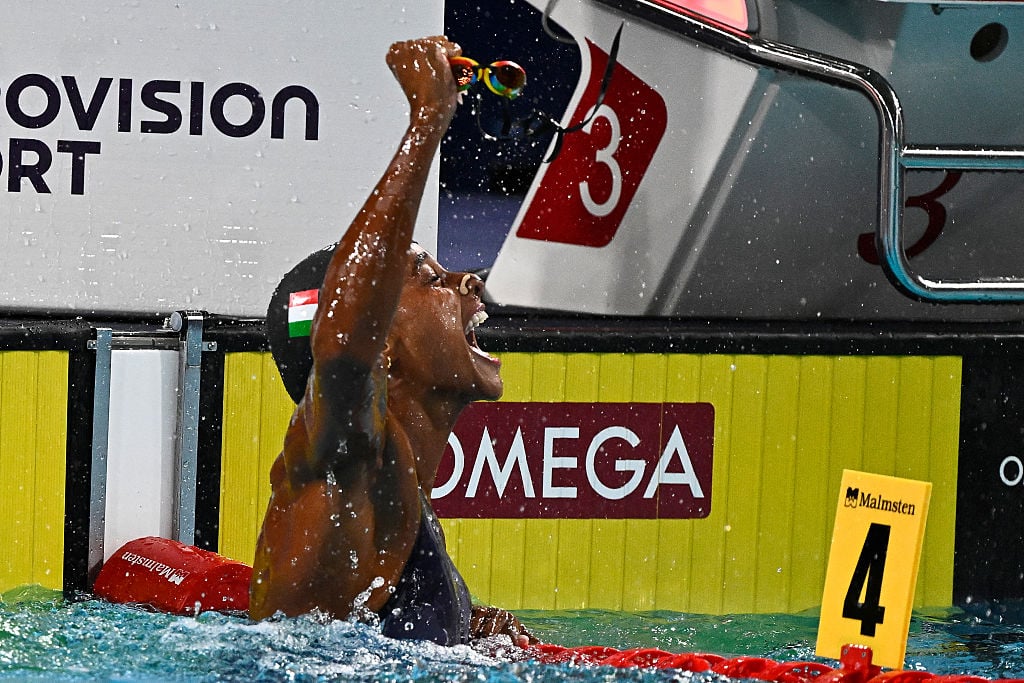
“Swimmers have a different kind of endurance from other athletes, because from a very young age you have to learn how to manage training, pressure and all the details of a race. I did my first race away from home when I was six. At that age, many children can’t even tie their own shoelaces.” Sara Curtis said that last summer, in an interview with us. Read again now, after what happened at the European Championships in Paris, and the sentence almost feels like a preview of her world record. Because, in the end, it is all there: the habit of never holding back, the naturalness with which she learned from childhood to be inside a race, to manage the tension and, above all, to push. Always, even when there would be no need, even when, as in a European semi-final, it would be enough simply to do what was necessary to make the top eight. Curtis did what she evidently knows best: she raced, or rather swam, as if there were no reason to leave anything behind. The clock gave her something that belongs to swimming history: 26.63 in the 50m backstroke, 23 hundredths faster than Kaylee McKeown’s previous world record, which had stood at 26.86 since 2023.
It is an enormous improvement in a race that lasts little more than 26 seconds, built around a start, an underwater phase, a few strokes and, in this case, no turn at all. Fifty metres in which there is no room to recover, to correct, to wait. You have to go. Curtis went fast, very fast, and ended up with the fastest time ever swum by a woman in the event. Perhaps the most surprising thing is that 26.63 came in the semi-final, not the final, not in a race built around chasing the record, not with the certainty that this was the one chance of the evening.
Curtis only had to qualify. Instead, she broke the world record. “It’s crazy, I don’t know what to say. It’s the dream of a lifetime. I got up there and told myself: ‘I don’t care, I’m just going to do one hell of an underwater and give it a go.’ I knew I had it in my legs, even though it still doesn’t feel real! I honestly don’t know what to say, I have no words. I’m so happy, it’s everyone’s dream and I can’t believe I’ve done it.” It is a reaction that fits the girl who had just described how early she learned to live with competitive swimming, with all the demands that come with it before you are old enough to know what they mean.
In Paris she had already won bronze in the 100m freestyle, confirming that she now belongs firmly among the leading international sprinters. Then, last night, she added another page: first the world record, then, less than an hour later, silver in the 4x100m freestyle alongside Virginia Manicucci, Chiara Tarantino and Alessandra Mao. Two completely different races, two medals and a world record in between. It is hard to imagine a European Championships moving any faster, and yet there is still the feeling that Curtis has more to give in Paris. Today, from 18:36, she will return to the water for the 50m backstroke final. This time she will no longer have to qualify: she will be trying to become European champion in the race in which, more than any other, she seems to have found her place.
The 50m backstroke will also be one of the new events on the Olympic programme at Los Angeles 2028, and the record she has just set makes the possibilities ahead of her look different. Curtis turns 20 in six days, on 19 August, and already her name is attached to a world record. More than that, she seems to have a long way still to go. It is no coincidence that the record came in the backstroke. Her 27.07 at the Sette Colli in Rome a few weeks ago had already become the Italian record for the distance. To understand the scale of what she has done, look at Italian women’s swimming. Before Curtis, only three Italian swimmers had set an individual world record in long-course swimming: Novella Calligaris, Federica Pellegrini and Benedetta Pilato. Calligaris did it in the 800m freestyle at the 1973 World Championships, Pellegrini in the 200m freestyle, the event that made her the Divina and turned her into the greatest Italian swimmer of all time, while Pilato took the 50m breaststroke world record down to 29.30 at the 2021 European Championships in Budapest.
They are names from different generations, and they have filled Italian swimming with European, world and Olympic titles. Calligaris, Pellegrini, Pilato. Now Curtis. Twenty in six days, a world record won almost before she had time to take it in, and a European final to face with the same philosophy that has accompanied her since childhood: do that bloody underwater and give it a go. If the birthday present comes today, it could hardly be better. Following Calligaris, Pellegrini and Pilato means stepping into a very big part of Italian swimming history. Sara Curtis, in Paris, seems to have only just begun.