
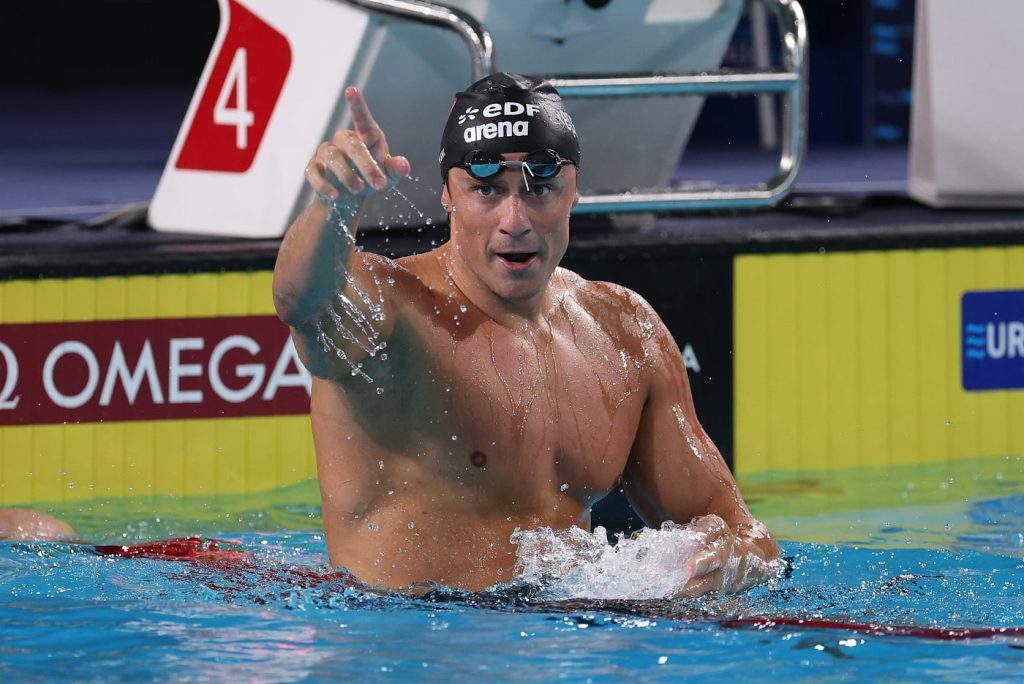
For several months, Nicolò Martinenghi was not even sure he would make it to Paris for the European Championships. There was no guarantee he would recover from his shoulder injury, no guarantee he would get back in the water in time, no guarantee he would earn his place on the team. At one point, apparently, he even began to wonder whether it was time to stop. Then the pain gave way to feeling, uncertainty to confidence, fear to the desire to race again, to feel the water beneath him. Martinenghi kept smiling, as he had throughout the whole process. And once he realised he could genuinely feel good again, really feel good, he began to believe he could win at the European Championships once more.
He controlled the 100m breaststroke final with the composure of someone who knows exactly how these races work, and finished in a time that meant much more than a gold medal: 58.58. It was the performance that brought back the Martinenghi who had seemed to disappear, the champion who knows how to be in front when it matters, how to read a race without being swept up in its urgency, how to wait for the right moment before delivering the decisive stroke. That 58.58 is, above all, a signal. It is his fastest time in four years, a performance that has taken him back to the level of his best days and carries a particular weight precisely because of what came before it. The comparison with Paris 2024 makes it even more significant: in the Olympic pool in France, two years ago, Martinenghi won Olympic gold, producing one of the finest achievements of his career. Now, in the same country, he is swimming at that level again. No longer the young swimmer trying to prove he could still compete, but the veteran who knows exactly how to win a final.
And what a final. Italy also put Simone Cerasuolo on the podium, a superb bronze in 58.90, just two hundredths behind his national-team teammate. An almost invisible margin, but enough to show how high the level was, especially with Russia’s Kozakin taking silver in 58.68. This was not a victory built on overwhelming superiority. It was fought for stroke by stroke and won through experience. The kind of race in which you have to manage the tension, ration your energy, resist the temptation to chase the clock or the swimmers around you, and have the coolness to wait for the instant when everything is decided. Exactly what Martinenghi did in Paris. He swam like a veteran, like a champion who does not need to lead from the first length to know he can be ahead when it matters. He stayed in control, held his nerve when the race caught fire, then found the part of himself that had made the difference in international finals for years: the instinct to compete, to keep going when the race gets tight.
The shoulder had put everything in doubt. The injury had kept him out for months and taken away the continuity that, for a top-level athlete, is almost a daily certainty. Training, races, plans: suddenly, everything was a question mark. Even selection for the European Championships had become something he had to earn. Martinenghi had to wait, recover, return gradually, then show at the Sette Colli in Rome that he could still be the swimmer he had been. Only then did Paris become certain. With this medal, Martinenghi has now reached 14 consecutive podium finishes across the European Championships, World Championships and Olympic Games. Fourteen occasions on which he has found a way to be there again, either ahead of everyone or immediately behind. A consistency that goes beyond talent and belongs to the great champions. Because winning once can be an achievement. Staying at the highest level for years is something else. “The difficulty is maintaining these standards for 14 years,” he told Sky Sport. There is a lot contained in that sentence, most of it invisible behind the medal. Nearly fifteen years of asking his body to be ready, his mind to stay clear, his character to remain hungry.
And that is why, after a race like this, Martinenghi could also speak about the hardest thought of all. The possibility of stopping. The problems with his shoulder had made him wonder whether it was still worth it, whether the time had come to walk away. Then something happened that is rare in sport and makes certain victories feel different: the answer came in the water. “I put my head, my heart and my balls into it,” he said. Everything he had. Not just technique, not just physical condition. He needed that irrational part of the great competitor, the part that lets you stand on the blocks after months spent wondering whether you would ever get back there and, once you do, swim as if you had never left. And so the final line of his story becomes almost the perfect image of this medal: “Today I realised I want to keep doing this for a long time.” The shoulder had frightened him. Doubt had crept in. Retirement had briefly become an option. Then Nicolò Martinenghi went back to doing what he does best: staying in a final, suffering, waiting, then finding the moment. And taking it.