
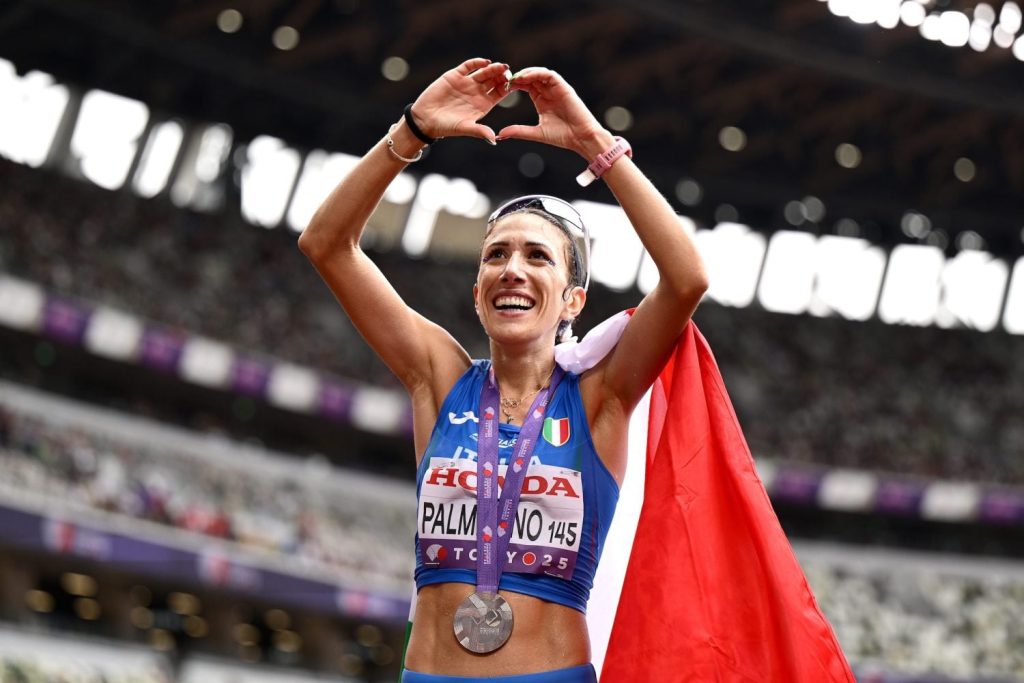
When Antonella Palmisano talks about race walking, and therefore, inevitably, about herself, she is a torrent. Stories, anecdotes, one after another, and at the same time an almost boundless love for what she does. Not just as an athlete, but also – perhaps above all – as someone who feels fulfilled, complete, happy because of what she manages to achieve on the track. In her case, that means extraordinary records and unforgettable victories. Palmisano was the first Italian woman to win Olympic gold in race walking, taking the 20km title at the Tokyo Games on 6 August 2021, the very day she turned 30. She has since added European gold in Rome in 2024 and world silver in Tokyo in 2025, along with plenty of other medals that there is neither the time nor the space to list. But that glittering collection is almost beside the point. For Palmisano, race walking has always been “a way of feeling free. I started doing it without knowing where it would take me. The victories I’ve had are a wonderful reward for the work I’ve done, for the effort I’ve put in. But the most important thing for me is that I built my identity on the track.”
Inevitably, then: where did this passion, this deep love for race walking, begin? How did that first encounter happen?
Where I was born and grew up, in Mottola, near Taranto, there wasn’t much chance to try different sports because the facilities were really limited. I played volleyball for a few years, but I didn’t feel suited to it. I was a setter and I was short, but more than anything it was a team sport and I felt the pressure too much. I wasn’t comfortable. When I was asked to switch to an individual sport, cross-country running, I took the opportunity straight away. It didn’t go particularly well. I was always finishing near the back, and at one Italian championship I came 70th. Then, one summer, I found myself taking part in some race-walking races and I was immediately hooked. There was no need for equipment, just asphalt. Six months later I had won my first Italian title.
Love at first sight, basically…
I have to say that race walking came naturally to me. The movement itself just felt right. With time you realise that it isn’t actually that simple, that if you want to go fast you have to work on so many different things. But at the beginning, the sport was also a chance to do something different, to spend time away from home, to feel part of a group and have fun. Sport wasn’t a big thing in my family, so at 15 I didn’t even know what the Olympics really were. For me, race walking was simply: I go to the track, I put on my tracksuit, I’m with all my friends, the movement feels natural, and I enjoy myself.
When did things change? When did it become clear that, for Antonella Palmisano, race walking was becoming something more than a passion?
One of the most important races in my career, and in my story, was in Chihuahua, Mexico, in 2010. I competed at the World Cup when I was still a junior, in my final year of school, and that was when I realised I was starting to develop the determination that would eventually take me to the results I achieved. My coach had me training twice a day, so I would get up at six in the morning, train, go to school, train again in the afternoon, then study. I managed to keep everything together. In Mexico I also put my lucky flower in my hair for the first time, and I won gold in the junior 10km. Around the same time I joined the Fiamme Gialle and realised that this was going to be my future.
That must have been when the work became more specific, with greater attention to certain aspects of race-walking technique.
Race walking is a discipline that covers many kilometres, so endurance is inevitably a huge part of it. As I went on, I also worked a lot on the speed of the movement. At first I had this Russian-style model in my head, which was very popular when I was coming through: an old-school technique, with a long stride and the arms moving in sync. Then the sport changed, and so did the equipment, above all the shoes. Technique evolved with it, and I had to bring my own style closer to the Chinese model, which is faster and more efficient.
And then came Olympic gold…
It was something truly extraordinary, even though it happened during such a terrible period as Covid. You always imagine a packed stadium, people cheering, all that noise around you. I experienced something completely different. All I could hear was the sound of camera shutters. And yet it was beautiful, too. I was on top of the world and could barely believe it. I couldn’t quite take it in. I kept thinking: “Me? Is this really possible?” You spend your whole life chasing a result like that, even knowing that you probably won’t make it. Then you do. And that stays with you forever.
How did Antonella Palmisano’s life change after Tokyo?
I became aware of what I had achieved. For me, it was an enormous source of satisfaction. I come from a small town and I had to overcome some huge obstacles, yet I won Olympic gold. And I did it representing a country with such a strong sporting tradition. I became part of a prestigious history that will matter even after I’m gone. And finally, though not least importantly, I think winning Olympic gold changed the way I look at my results. Before, I competed primarily for myself. Now I feel that I’m also competing to put race walking, my sport, in the spotlight.
Beyond technique, in terms of values: what has race walking taught Antonella Palmisano?
It has certainly taught me determination. It has made me feel part of a group and helped me build my identity. As a teenager I had to deal with a lot of obstacles and a lot of restrictions, and yet in the end I won Olympic gold. Another fundamental thing for me is friendship. Once you’re racing, the competitiveness and rivalry are obviously there, but the competitive side can also be healthy. I think of the relationship I’ve built with María Pérez, who won gold and silver in Paris in 2024. After those Olympics, she helped me through a difficult period. It was also thanks to her that I was able to keep going with my career.
There is a wonderful atmosphere around the Italian national team too, with the European Championships in Birmingham just around the corner…
I really believe in it. And the numbers back it up: we have the strongest Italian national team there has ever been. We first started to feel the change in Tokyo, when we were inside the Olympic Village. First Jacobs, then Tamberi, then Massimo Stano. It was as if, little by little, we were building a chain, passing that positivity from one person to the next. It showed us that nothing was impossible. That feeling is part of us now. We don’t put limits on ourselves, and I hope it leads to even greater investment in the growth of the sport. A few weeks ago we had the Youth Games and there were so many kids there. That’s where we need to start if we want to keep growing. In middle schools, teachers need to go looking for new talent. We can’t just wait for a boy or a girl to turn up at the track. We need to find them before that. That’s how you build new champions.