
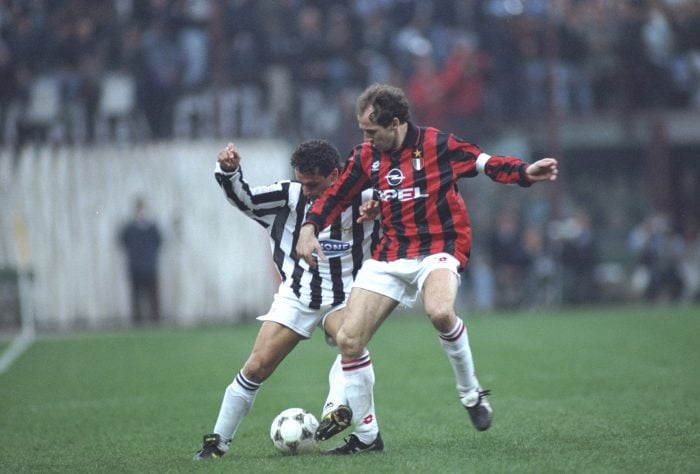
When a famous figure dies, social media is often of limited use, at least if the question is what it reveals. The tributes arrive, personal memories become universal stories, phrases are polished until they begin to resemble one another. Everything gradually settles into the same landscape: grief, remembrance, nostalgia for a time that has gone. With Franco Baresi, who died today at the age of 66, it has been different. Among the tributes, the memories and the inevitable phrases of affection, something else has appeared: the scale of the admiration for a player who was respected even by those who had no natural reason to respect him. By those who could not easily stand on his side, such as Inter supporters or fans of other Italian clubs. By those who disliked certain aspects of his character, or who questioned some of his actions on the pitch.
That kind of recognition comes from what people saw. From the footballer Baresi was. From his ability to exist between two ideas that rarely meet: the traditional defender and the modern one, the Italian centre-back and a player who seemed to belong to something beyond Italy itself. Baresi changed Italian football through the way he played and through the way he understood the role. The way he stood on the pitch, the way he led from behind, the way he interpreted the libero position: all of it anticipated something that would come later. He did not simply occupy a role. He helped redefine it. He was not the first player to move in that direction. Franz Beckenbauer, to whom he was so often compared, had already transformed the possibilities of the libero. In Italy, Gaetano Scirea had shown that a defender could combine the art of marking with the ability to build attacking moves. But Baresi brought both sides of the position together with a level of consistency and precision that few others have approached.
And he did so while becoming one of the defining figures of the greatest tactical transformation Italian football had experienced: Arrigo Sacchi’s revolution after the middle of the 1980s. It is no coincidence that Jonathan Wilson wrote about Baresi in The Inverting Pyramid: “He was not simply a defender, he was a conductor. His raised arm, calling the offside trap, became one of the most feared sights for attackers across Europe. He read space and time in a way that transformed the role of the libero from sweeper into the team’s first and most refined playmaker.”
A player of that magnitude could hardly go unnoticed by those who watched him closest: his contemporaries, the press and, above all, the opponents who had to find a way around him. Diego Armando Maradona was among them. After a Milan-Napoli match, stopped in the tunnel wearing Franco Baresi’s famous number six shirt, the Argentine offered a simple judgement: “It is the shirt of a great player, the greatest as a defender.” That judgement has remained. Today, in the messages that appeared after Baresi’s death, there are Inter, Juventus and Napoli supporters — famous or unknown, it makes little difference — remembering him as one of the greatest footballers they ever saw. Some return to the more complicated moments of his career: the famous penalty scored after Milan failed to return a ball that had been put out following an injury, the night in Marseille, his instinctive loyalty to Milan even when it seemed excessive. They remember the controversies. They remember the raised arm calling the offside trap. But even there, beneath the arguments and the old rivalries, there is the same conclusion. The aura remains. The stature remains.
Part of that also comes from the memory of the 1994 World Cup. The torn meniscus suffered in the group stage. The operation that should have ruled him out for weeks. The fact that Baresi returned for the final when almost anyone else would have been watching from the sidelines. And what a final it was. After a performance of extraordinary authority, L’Équipe wrote that what Baresi had done on that pitch belonged neither to medicine nor to the logic of sport, but to mythology. At 34, with a recently operated knee and under a relentless sun, he produced a performance that seemed to exist outside the normal limits of the game. He played through instinct, pride and an understanding of football that could not simply be taught. A monument of football. Perhaps that remains the closest description. Italian football, and the wider game, have lost one of their great figures. The most striking thing is that the loss was felt everywhere: by those who loved him, and by those who spent years hoping he would lose.