
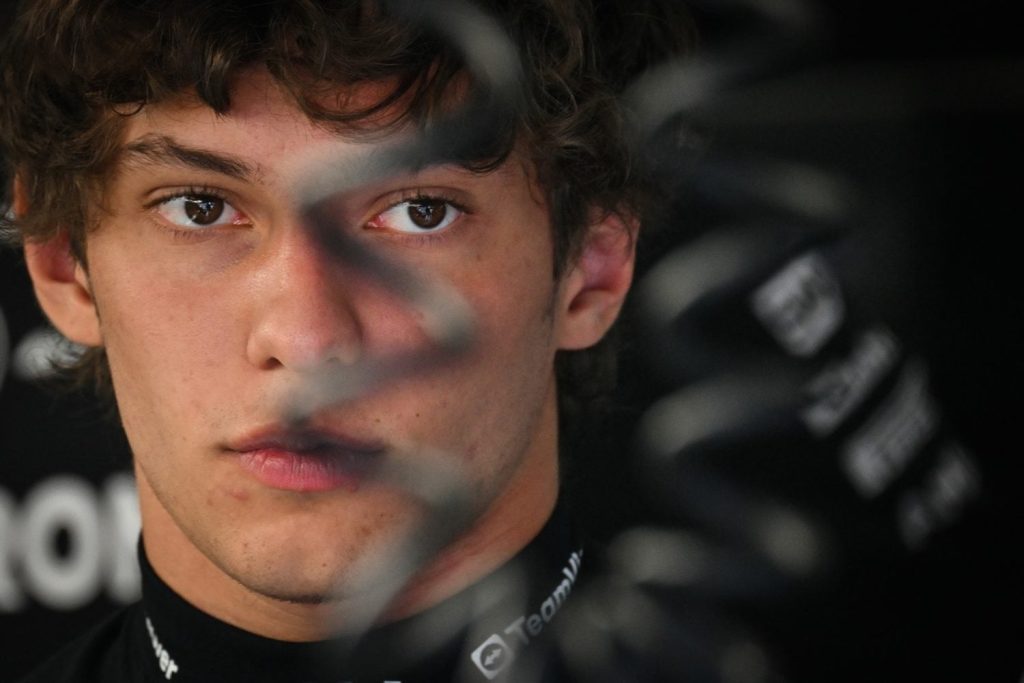
Spa was not his easiest race. It was not his most dominant either. But it may become the one people remember most. In Belgium, Kimi Antonelli showed that, despite being only at the beginning of his Formula One career, he has already learned how to win when a race refuses to follow the script. Not simply how to finish well. How to win. Spa has always occupied a special place in Formula One. The circuit is still considered the sport’s university: a place where mistakes are exposed immediately, where speed only means something when it is accompanied by courage, and where the difference between a good driver and a great one often becomes visible. Antonelli passed that test too, producing one of the most significant performances of his season. The circumstances made it more meaningful. His Sunday had begun in the worst possible way after starting from pole position, losing the lead almost immediately when Max Verstappen attacked on the opening lap. For a driver still only 19 years old, it was the kind of moment that could easily have unsettled the rhythm of the afternoon. Instead, Antonelli did not chase the race back. He let it come to him.
There was no unnecessary reaction, no attempt to answer Verstappen’s move immediately. He accepted the loss of position, managed the tyres and waited for the race to change shape. That patience is perhaps the clearest sign of how much he has already developed. Earlier in the season, the impression was built around speed, instinct and the excitement of a young driver discovering the limits of a Formula One car. At Spa, there was something different: the ability to wait. “This was not the victory of a teenager,” Toto Wolff said afterwards on Sky Sport. The Mercedes team principal was pointing to something beyond the result itself. Antonelli did not win because everything went perfectly. He won because he understood the race as it unfolded, because he avoided forcing moments that were not there and because he knew that a long afternoon at Spa is usually decided in the small spaces between decisions. The kind of understanding that normally arrives later. One moment, however, threatened to change the entire direction of the race. The turning point of the Belgian Grand Prix came on lap 23, when the stewards introduced a Virtual Safety Car to allow marshals to recover debris from the circuit. It was a decision that immediately became a subject of discussion, not least because Ferrari appeared to gain the most from the timing of the neutralisation.
Lewis Hamilton was unable to take full advantage of the interruption. His stop became complicated by the need to serve the five-second penalty received for his contact with George Russell, while he was also left under investigation for an unsafe release after making contact with a mechanic as he left the pit lane. Charles Leclerc, meanwhile, found himself with the opportunity every driver waits for. The Ferrari driver stopped at exactly the right moment, returning to the track on the same compound but ahead of the field, Antonelli included. For a few laps, the feeling was that the race had moved away from Mercedes and towards Ferrari. The shape of the afternoon had changed. Antonelli’s response was what mattered. First came Lando Norris, still on track on increasingly worn tyres and yet to make his own stop. The move arrived on lap 26 and carried the same characteristics as the rest of his race: decisive, clean, without a trace of unnecessary risk. Then came Leclerc. The Ferrari driver defended through the sections where his car was strongest, using every available advantage. Antonelli stayed close. He did not rush the attack or attempt something that was not fully prepared. He followed, observed, waited. At Spa, patience is often a form of speed. The opportunity arrived on lap 34. The overtake was not a moment of improvisation but the result of several laps of preparation, a move created gradually before being completed in one decisive sequence. It returned Antonelli to the lead and, in practice, secured the victory.
There was no celebration of the spectacular for its own sake. No unnecessary gesture. Just the precision of a driver who knew the exact moment to act. From there, the Bologna-born driver managed the race with increasing authority, controlling the pace until the chequered flag. The circumstances had changed several times during the afternoon, but Antonelli remained the constant element. George Russell’s accident undoubtedly removed one possible complication from the final stages, but victories at Spa are never simply handed over. The circuit demands more than a fast car or a favourable moment. It asks for speed, judgement, strategy and composure, and Antonelli had shown all of them. The result also carried a weight that went beyond the weekend itself. It had been 73 years since an Italian driver last won the Belgian Grand Prix. The previous one was Alberto Ascari, victorious in 1953, at a time when Formula One was still a very different world. Since then, many Italian drivers had come close without managing to return the Tricolore to the top step of the podium at Spa-Francorchamps. With this victory, Antonelli moved to six Formula One wins, matching Riccardo Patrese and becoming the second most successful Italian driver in the history of the championship. A remarkable figure already, especially considering how early his career remains.
But the number matters less than the way those victories have arrived. Antonelli is no longer winning only through speed or instinct. At the beginning of the season, his talent was visible above all in qualifying and in the confidence with which he attacked races. At Spa, there was a different quality on display. He knew when not to push. He understood when a situation needed to be managed rather than conquered immediately. He adapted, waited and then delivered when the opening appeared. The championship picture has changed with him. The victory in Belgium strengthens Antonelli’s position at the top of the standings, extending his advantage to 45 points over Hamilton and 50 over Russell. It is a lead built not only through victories but through a level of consistency that has separated him from his rivals. There is still a long way to go. Formula One has a habit of changing quickly, and no advantage remains untouched for long. Mechanical issues, changing circumstances, difficult weekends — all of them remain part of the season ahead. Yet Antonelli’s greatest asset at this stage may be the same quality he showed at Spa: the ability to remain calm when the race moves away from him. The speed was never in doubt. That has been clear from the beginning. What Spa revealed was something else. A driver capable of finding a way through the difficult moments, of waiting for the race to open up, and of taking control when it finally does. The title is still far away. But Spa-Francorchamps may be remembered as the weekend when Kimi Antonelli stopped looking like someone approaching the front of Formula One and started looking like someone already there.