
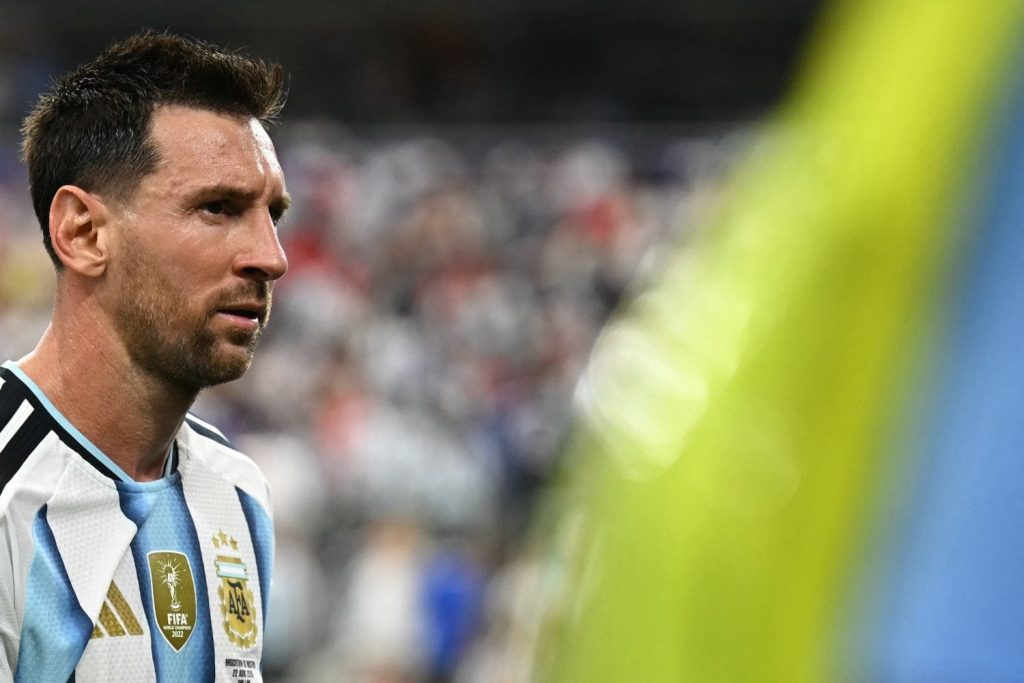
Whenever Argentina move through another round at the World Cup, there is a group that may be celebrating almost as much as the Albiceleste themselves: the brands that have managed to put Lionel Messi alongside their own names. That is no small achievement. A partnership with Messi is an achievement in itself, and for the companies that secure one the rewards can be enormous. The logic is simple enough. An eight-time Ballon d’Or winner. A player who has defined an era. One of the greatest footballers ever to play the game, a figure who sits comfortably alongside Pelé and Diego Maradona in the history of the sport. A relationship with someone like that carries a value few others can offer. Even so, it is not as straightforward as it appears. The cost of getting there is significant.
Dan Jamieson has spent almost twenty years seeing that value up close. The Englishman is CEO of Icons Memorabilia, one of the world’s leading companies in signed sports memorabilia, and has worked with Messi since 2006, when the Argentine was still a teenager expected to become the future face of Barcelona. Icons built a large part of its business around him. Signed shirts, photographs and memorabilia have been sold around the world, turning Messi’s name into one of the company’s most important assets. The World Cup in Qatar marked a different level. According to Jamieson, that tournament alone generated between eight and ten million dollars in sales and revenue, the strongest result in the company’s history. It seemed like the kind of figure that might never be reached again. Four years later, it may already be happening.
At 39, Messi remains at the centre of the global game. He has taken Argentina into the quarter-finals and, with eight goals, is competing with Erling Haaland and Kylian Mbappé for the Golden Boot. What happens during the match does not stay there. Every goal, every assist, every image of the Argentina captain adds another layer to the business that has grown around him. “I never thought we would see numbers like Qatar again,” Jamieson told Sportico. “And yet we are getting close. In fact, I think we could even go beyond them. Messi is the story of this World Cup. From our point of view, we hope he goes all the way and wins again, because right now the whole world is focused on him.” The move to Inter Miami in 2023 had already changed the scale of Messi’s commercial presence. Playing in the United States, three years before the World Cup arrives in North America, placed him in the biggest sports market in the world while preserving the global appeal he had built over the course of his career.
Sportico estimates that Messi earns around 70 million dollars a year from sponsorships alone. His partners include adidas, Mastercard, Michelob Ultra and more than a dozen other international brands. Only LeBron James and Shohei Ohtani of the New York Yankees earn more away from their respective sports, while Cristiano Ronaldo, his long-time rival, remains slightly behind. But Messi’s value has never been only about the size of the numbers. It is also about how few opportunities there are. In recent years, Messi and his representatives have reduced the number of commercial partnerships, becoming more selective about the companies allowed to associate themselves with his image. The result is a smaller circle, and a more valuable one. According to an international agent who has previously negotiated with Messi’s representatives, a standard agreement for the use of Messi’s image begins at around four million dollars. Additional costs follow for dedicated productions, appearances or social media content.
The Messi brand has become so strong that companies already working with him often do not need to reinvent their campaigns. Existing material can be brought back, carried by the attention that comes with a World Cup and by Messi’s presence at the centre of it. Several sponsors have followed that route. Stanley 1913, the drinkware company, quickly sold out a limited-edition collection dedicated to Messi before returning to content that had already been produced. Lowe’s, meanwhile, built its campaign with enough flexibility to expand across social media, stores, digital platforms and traditional media as the tournament unfolded.
Icons Memorabilia has benefited from the same momentum. Since the beginning of the World Cup, the company has generated almost 45 million Instagram views through videos filmed during a single autograph session with Messi. One of those videos was later shared on Messi’s own account, reaching more than half a billion followers. There is one thing, however, that no marketing strategy can change: there is only so much Messi available. Icons cannot simply increase production because every item depends on the time Messi dedicates to signing it. During the Qatar World Cup, much of the demand came through pre-orders, with deliveries completed only months later, partly because adidas had also run out of official Argentina shirts.
The agreement between Messi and Icons covers around 4,000 signatures a year, divided into four sessions of roughly 1,000 autographs each. That number can increase if both sides decide the moment calls for it. For Jamieson, the relationship is closer to a joint venture than a traditional sponsorship, with profits shared between both sides. The contract renews automatically every five years and has gradually become something built to continue through the final stage of Messi’s playing career, and probably beyond it. Because Messi’s value has never been limited to what he can still do on the pitch. It is also what his name will represent once the games are over. “When an athlete becomes a legend,” Jamieson said, “they may sell less than they did at the height of their career, but they continue to sell forever.” Some players remain part of football history. Messi has become part of something larger. The companies around him are investing in that future.