
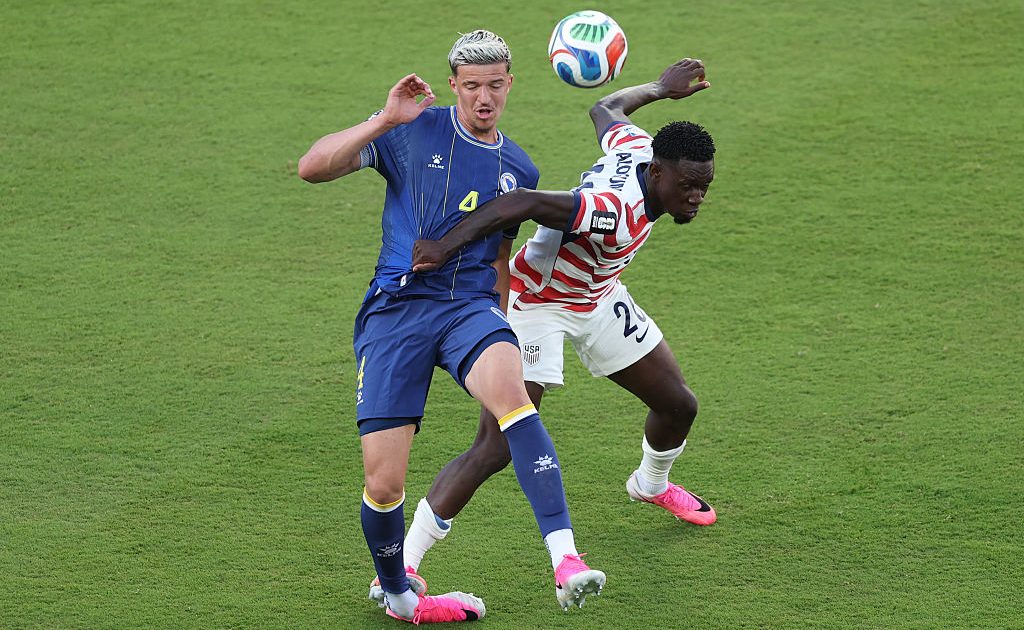
Red. Or not red. The only precedent that survives the archival drift is Mané Garrincha in Chile ’62, when a sending-off could still be reversed on a reading of circumstance, and the tournament itself was still called Copa Rimet, loosely held together, depending on local discretion more than any shared architecture. In the contemporary game, so often narrated through expansion and unity by Gianni Infantino, FIFA’s intervention around Folarin Balogun lands in a different register altogether. A red card in the round of sixteen against Bosnia, then a suspension effectively suspended again after external pressure from Donald Trump and the US administration reaches the governing body, and the idea of consequence starts to lose its fixed outline.
The incident itself is not in doubt. Balogun comes through late enough, or simply uncontrolled, catching Tarik Muharemovic in a passage of play that VAR isolates and upgrades into severity. These moments exist across every tournament and are usually absorbed without residue. Here, something lingers. Three days after USA–Bosnia, and on the eve of a quarter-final against Belgium, the sanction is reinterpreted to the point of disappearance. Expulsion no longer cleanly corresponds to absence, at least not in the way it used to.
Trump thanks FIFA publicly, calling it a correction of what he describes as a “great injustice”, and the phrasing sits somewhere between statement and instruction. The New York Times reconstructs a chain of contact that begins immediately after the match, with urgency built around the availability of a key player for the fixture against Belgium, which in that moment carries more weight than the rest. Other accounts, including Politico, describe a sequence that moves through phone calls, then into more structured meetings, with figures from the US administration in proximity to FIFA leadership, among them Howard Lutnick, and a dinner that feels less ceremonial than procedural, as if something is being stabilised rather than celebrated.
The legal anchor later invoked is Article 27 of the disciplinary code, already used in reduced form in previous disciplinary adjustments, including Cristiano Ronaldo’s suspension, though never in a way that removed sanction altogether. The wider code remains comparatively rigid in its wording, almost old-fashioned in its refusal to bend. Belgium files an appeal, framing the decision as incompatible with the basic terms of competition. Rudi Garcia speaks in a tone that widens the frame beyond the match, almost as if the match itself is no longer the subject, while Giovanni Malagò calls it a dangerous precedent, and UEFA issues a statement that hardens into something close to warning.
Elsewhere the reactions stay more contained. Mauricio Pochettino insists on the imbalance already absorbed during the match, while Thierry Henry and Zlatan Ibrahimović appear in commentary mode from a distance, registering timing more than substance, and the slightly distorted rhythm of the decision itself. What remains is a shift without announcement. Football continues as structure, but its perimeter is less stable than it was. The Balogun tackle sits inside the ordinary flow of the game, while the consequence attached to it drifts into another layer, and the old boundary between rule and interpretation — already fragile — stops behaving like a line.