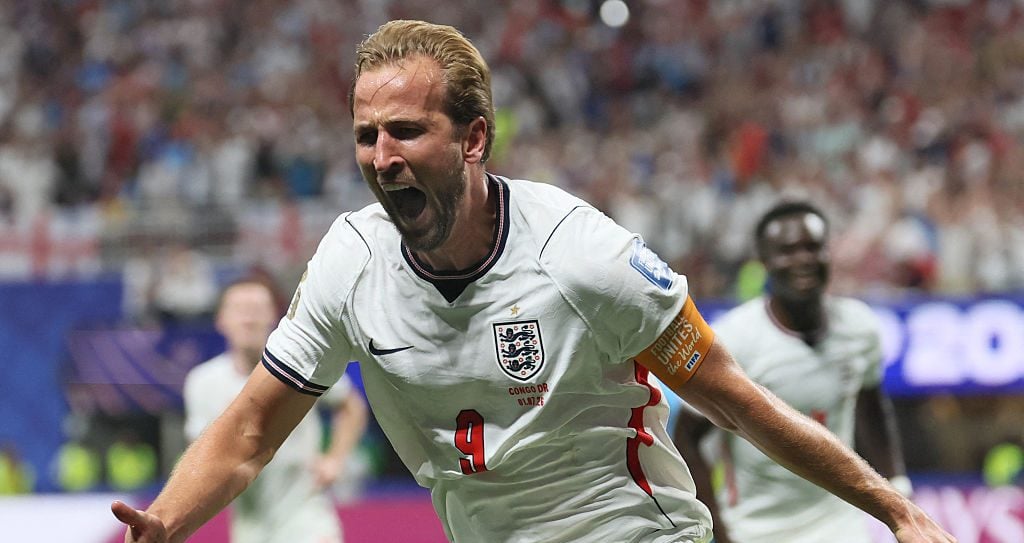
Harry Kane has long been among the best strikers in the world, and is now the best in world football

Harry Kane’s growth, improvement and leadership as England captain, in a team that depends on him and that even against Congo looked disjointed at best.
by Redazione Undici 2 July 2026 at 01:43

First came a header, almost violent in its simplicity, rising like a basketball jumper taken too early in the possession, instinct before structure had time to form. Then a strike that seemed to leave the boot without asking permission from anything like doubt, arcing hard and flat into the net, the kind of finish that keeps the old nickname alive: Hurricane.

England were untidy again, not quite slow, not quite fast, stuck in that in-between space where good teams start to look ordinary. The Democratic Republic of the Congo did not arrive as tourists. They pressed when it suited them, dropped when it didn’t, and for long stretches the match felt less controlled than England would have liked to admit. There was a moment, just after the hour, when the stadium noise tilted slightly their way, as if the result had forgotten to be settled.

It would have become one of those World Cup nights people keep replaying for reasons that are not entirely tactical had Harry Kane not condensed everything into a small, brutal interval. Five minutes, two goals, and the match no longer asking questions. Qualification in the end, but not comfortably, not cleanly, and Mexico waiting in the next round with a kind of polite threat.

For the England captain, those were goals four and five of this tournament. His season ends on 72 in all competitions, a number that sits there almost stubbornly. Only Lionel Messi, with 82 in 2011/12, has gone higher in the modern era. It doesn’t really explain him, though. Kane has passed the point where numbers describe him properly. They just sit around him now. At Bayern Munich he looks like a player who arrived slightly late to his own authority. Tottenham still hangs in the background of his profile in a way that never fully resolves itself, not even now, more a habit of thinking than a footballing memory.

We are speaking only about proper centre-forwards here, the old definition, so the rest of the galaxy can stay out of it for a moment. In that space, Kane is close to complete. Not perfect in the glossy sense. More like complete in the way a machine is complete when it stops needing explanation. He still finishes like a striker. That hasn’t changed. What has changed is everything around it. He drops into midfield at odd moments, not always to help, sometimes just because the game pulls him there. England play through him, then past him, then back into him again. There is no fixed rhythm to it, which is probably part of the point, even if it doesn’t always look like a point at all.

England’s opening win against Croatia suggested something had settled. It hadn’t. Ghana, Panama, and now the Democratic Republic of the Congo all produced different versions of the same problem: talented players without a shared tempo, moments of control that dissolve too quickly to become structure. Jude Bellingham looked at times like he was playing two matches at once, neither of them fully under command. Without Kane, this becomes something looser and more anxious. With him, it stays held together, but only just. If he is half of Thomas Tuchel’s England, it doesn’t feel like a compliment or an insult, just the current arrangement of things. Argentina have lived like this before, for years, with Messi occupying a similar gravitational space.

This match echoed the Slovakia game at Euro 2024, the 2-1 that never really felt like a 2-1 while it was happening. Only this time there was less control, more noise, and slightly less explanation for why England were making it difficult for themselves again. What has changed is Kane. England’s record scorer, now on 84 international goals, moves differently through matches. There is less waiting for things to happen to him. More taking them when they appear, even if they appear slightly wrong.

The World Cup quarter-final against France, the penalty over the bar, still exists in the memory somewhere, but it no longer defines the outline. He will miss again at some point, probably in a way that looks obvious afterwards. That is still part of the job description. It just doesn’t describe the job anymore. A striker, yes. But also something that keeps the rest from drifting too far away. To borrow Gary Lineker’s line, football is a simple game: twenty-two players chase a ball for ninety minutes, and in the end Kane scores. Germany, somehow, are already out. The tournament is still moving, but not in straight lines.


>

Read also