
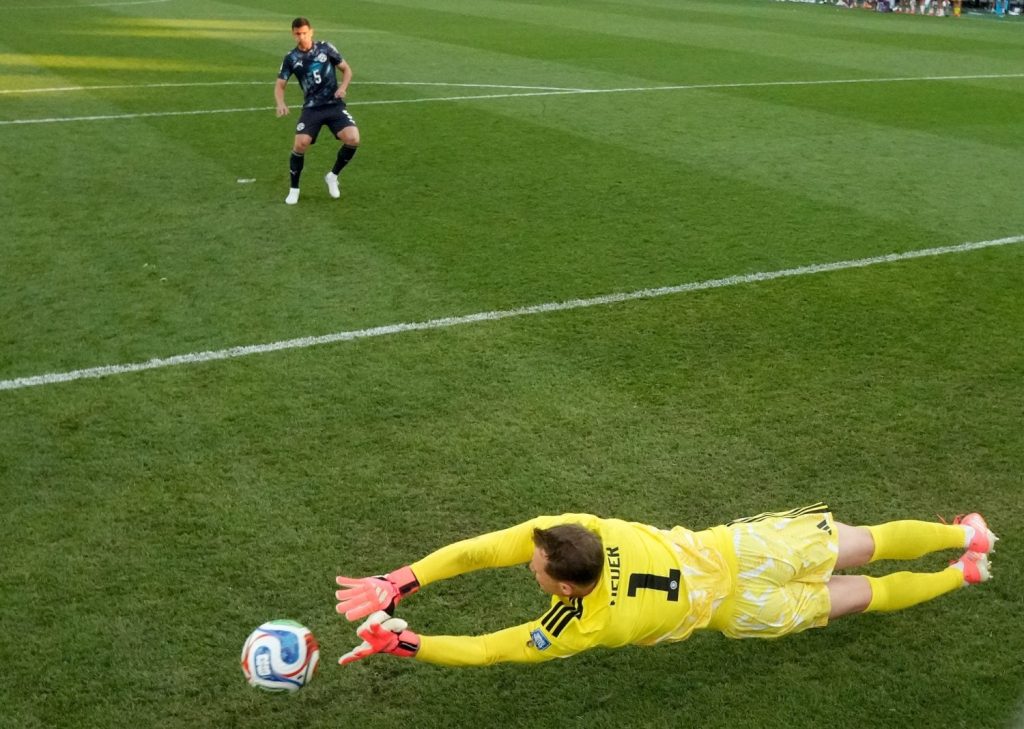
Players who come on only for penalties remain a recurring trend. Again and again. We saw it even in the round of 16 at the World Cup between Germany and Paraguay: as extra time approaches its end, coaches decide to bring on so-called specialists, fresh players who might create an advantage in the final shootout from the spot.
In the match between Germany and Paraguay it was Nadiem Amiri (introduced in the 109th minute) and Fabián Balbuena, subbed on in the 121st. The first one got away with it, the second less so: he took responsibility for one of Paraguay’s match points, stepping up cold for the national team under Alfaro, but was denied by Neuer. When things go like that, as they did for Balbuena, the argument is that certain players should not be thrown in cold, that it is difficult to enter both mentally and physically into the game. It is not just a figure of speech. The data here is fairly clear: according to Opta statistics from recent editions of the European Championship and/or World Cups, eight of the last ten players brought on after the 115th minute have then missed their penalty. A striking figure, translating into a conversion rate of just 20 percent.
Among them are also three England players: in the 2006 World Cup quarter-final against Portugal, Jamie Carragher came on in the 119th minute, touched the ball once and then missed his penalty—retaken after an infringement—contributing to the elimination of the Three Lions. More recent is the Euro 2020 final: Gareth Southgate brought on Marcus Rashford and Jadon Sancho in the very last seconds of extra time, specifically for the shootout. Both missed their attempts from the spot, opening the way to Italy’s triumph. Carragher, Rashford and Sancho at least had the chance to get into rhythm by touching the ball before the final whistle. That was not the case for Balbuena, and before him Simone Zaza: the Italian forward was introduced in the closing minutes of the Euro 2016 quarter-final against Germany without even managing to touch the ball before stepping up to take his penalty. Even there things went badly—remember the famous stuttering run-up?
The idea of introducing a player exclusively for penalties is, in reality, quite recent. Only twelve players in the history of World Cups and European Championships have come on after the 115th minute and then taken a penalty in a shootout; just three of these cases predate Euro 2016. A curious detail, especially in an era of increasingly data-driven football, because the numbers seem to favour those who are already on the pitch from the start. From Euro 1996 onwards, starters have converted 201 of 277 penalties in shootouts at World Cups and European Championships, with a success rate of 73 percent. Players introduced during the second half of extra time, by contrast, have scored only 18 of 32, a modest 56 percent.
The explanation may be as simple as it is counterintuitive: having fresh legs does not necessarily mean having a clearer mind when pressure reaches its peak.