
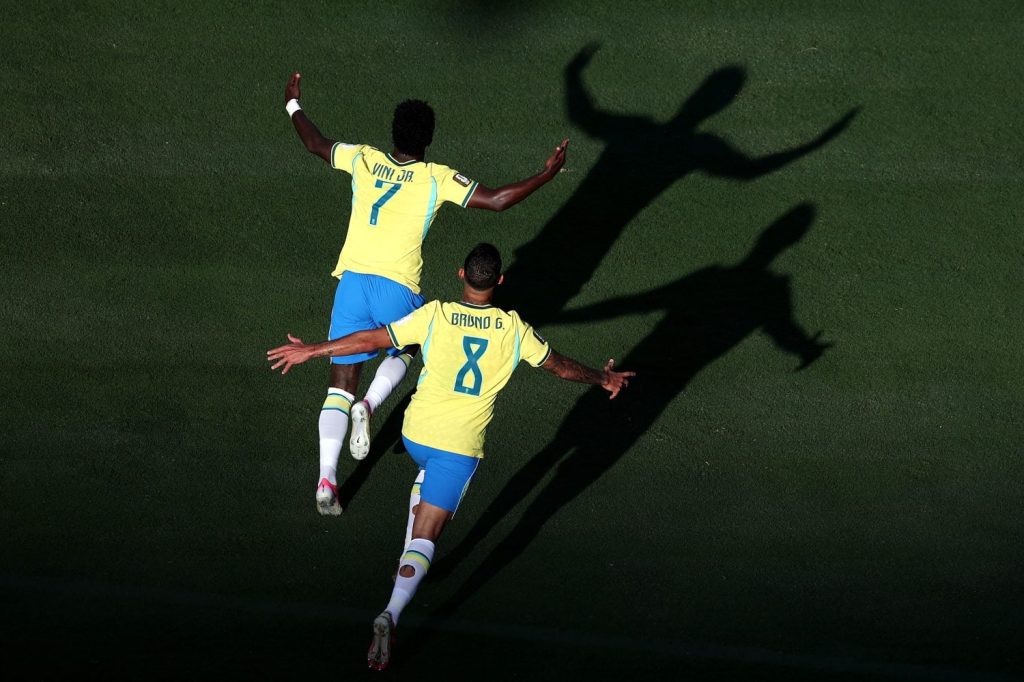
Until recently, mental health in Brazilian football was barely part of the language, almost absent from the way the game was spoken about, even more so inside the Seleção, where the assumption held for years was simple enough: enjoy the ball and everything else would follow, as if joga bonito could extend itself beyond the pitch without friction, into relationships, into the dressing room, into the way a group breathes together, or something close to that. Brazil 2.0 feels slightly different, not necessarily stronger than everyone else heading toward 2026 but more exposed to what the level demands, and inside that adjustment there is now a psychologist, the first in the history of the Seleção, Marisa Santiago, mentioned by El Mundo and already folded into the daily routine around Carlo Ancelotti, not as a symbol but as part of the structure itself, which is how it is described in camp.
“Marisa is doing an excellent job with us. Today the team looked calmer, more focused and more serene in possession,” Ancelotti said after the win over Haiti, returning again in New Jersey to the same idea that the mental side has become as decisive as the technical one, something he speaks about without framing it as novelty, more as accumulation over time, pressure included. After the 1–1 against Morocco the reaction was immediate and unfiltered, staff describing a familiar cycle that leaves little room for moderation, “When it comes to Brazil, there are no half measures: if things go well, they go very well; if they go badly, they go very badly,” and that pressure sits in the background of everything else, shaping the space in which Santiago has been working since arriving through the Brazilian Football Confederation in March 2024, before Ancelotti, then becoming more central once the new cycle began at full speed.
At The Ridge Hotel in Basking Ridge a room has been set aside for her work, individual sessions, group meetings, nothing announced outwardly as change but present in the daily rhythm, while she watches training from the edge of the pitch without crossing into the technical circle around Ancelotti and Davide, and afterwards players move through it at different speeds, some regularly, some only when needed, others still observing from distance. Her background runs through cognitive behavioural therapy, volleyball before football, then Atlético Mineiro and Bahia, before the national team, and the brief as described by the federation is almost disarmingly plain, to help Brazil compete without tension, a phrase that sits alongside a longer memory the group never fully steps outside of, the 7–1 in 2014, then 2018, 2022, accumulation rather than sequence.
Ancelotti speaks about cohesion, leadership, anxiety, stress, not as separate categories but as one continuous field that affects performance, while Santiago, speaking through federation channels, describes work explicitly oriented toward performance, focused on what interferes rather than what diagnoses, “We are not here to diagnose or do clinical therapy: everything is performance-oriented,” and within that framing the environment shifts slightly, Neymar’s return absorbed rather than disruptive, families allowed the day after matches as in other setups, and Bruno Guimarães speaking of a generation shaped by criticism and learning to manage pressure differently, or at least trying to.