
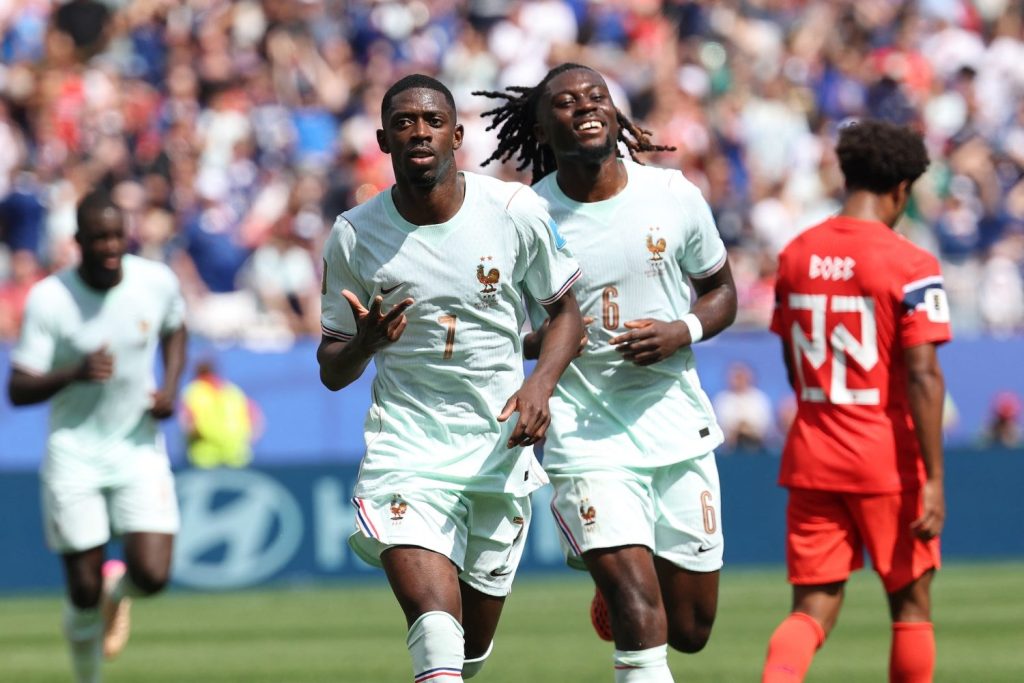
Three fingers. Then the stare at his own hand, almost doubtful, as if the count still needed confirmation. “Three?” It stays there longer than anything else from the night in Norway, more than the hat-trick itself, the gesture almost childlike in its disbelief, as though something had briefly exceeded expectation even for him. Ousmane Dembélé, Ballon d’Or, the player who carried Paris Saint-Germain through Europe, one of the most destabilising forwards of the last two seasons, yet with France always slightly misaligned with the version that dominates at club level, and that gap has always felt more structural than accidental.
Before this match the numbers sit flat in a register that refuses to move: eight goals in 61 appearances, no goals at World Cups or European Championships, a silence that never quite belongs to the player seen in recent seasons. Thirty-two minutes against Norway are enough to overturn it, not gradually but all at once. Three goals, three actions, and the same condition underneath each one: space ahead, defenders retreating, the pitch opened in a way international football rarely allows once stakes settle.
The first comes in transition, Mbappé releasing him exactly as the line breaks, one touch into stride and everything already tilted forward, the defender drawn in too early, the pause happening inside the run rather than outside it, then the finish driven low into the far corner, almost ordinary in its certainty. The second arrives from the right side, isolation already established, Dembélé drifting inside onto his left foot without interruption in rhythm, the strike from distance aligned with what has been visible all season in Paris, simple geometry executed at speed, still not contained by the structure around it. The third closes the sequence, Tchouaméni finding him inside the box, right channel, no cover arriving in time, two feints that displace the defender before the ball is even set, then the left-footed finish guided across goal rather than struck through it, control outweighing force, and time briefly loosening around him. The three fingers return, not explanation but afterimage, and even that feels slightly too small for what it marks.
In France this version has been forming for months, less excess in the dribble, fewer repetitions, the same capacity to eliminate an opponent but now directed rather than extended, compressed toward the final action instead of dispersed through it, and the change feels less technical than psychological. There was a time when everything ended one step too early in a different sense, too much creation without closure, a gap that has narrowed as decision-making accelerates and the final move becomes almost the starting point of the idea itself.
Didier Deschamps has adjusted the structure around it, Mbappé fixed in depth, Doué and Olise occupying interior corridors, Dembélé starting wide without remaining there, the movement partially written and partially left open, and all three goals arrive in motion, Norway already stretched, the defensive line reacting rather than organising, space appearing as consequence rather than plan.
The context remains present throughout: heavy rotation, Haaland absent, structure altered, resistance diluted. From here the pitch will not offer the same conditions again in the same form, knockout football rarely does, but something persists beyond the match itself, France already built around Mbappé, already defined by depth and control, now carrying another point of rupture, another player who does not need accumulation to decide.
When Dembélé, Mbappé, Doué and Olise move in the same phase, the pitch stops behaving like organised space and becomes exposure, not entirely controlled, not entirely readable. The three fingers again, not celebration, not explanation, only confirmation of something that existed for a moment and now does not.