
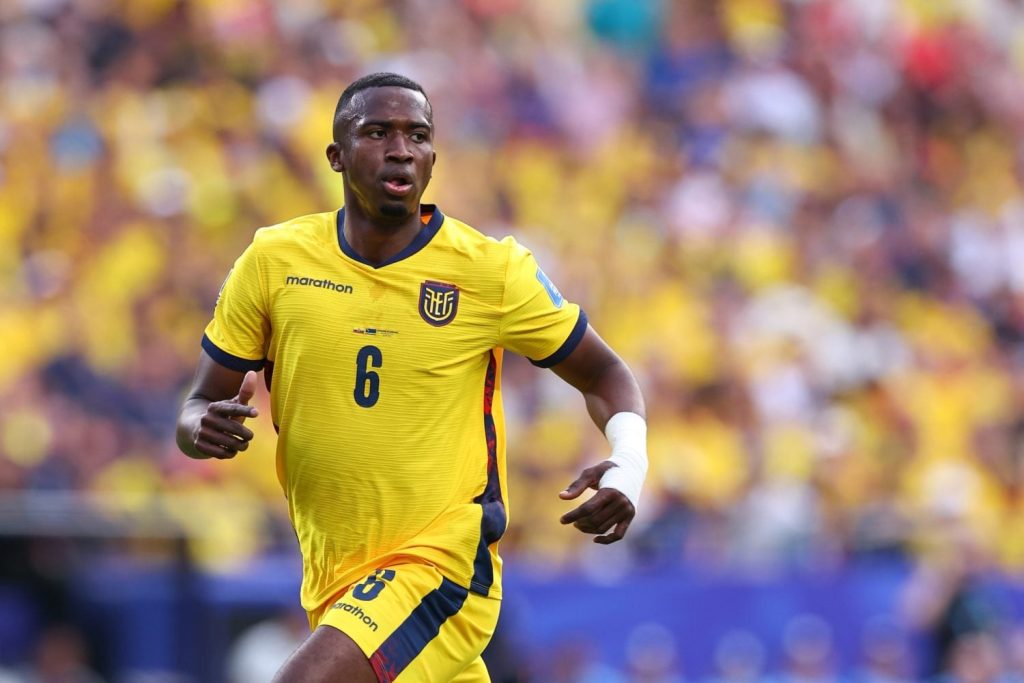
Ecuador’s victory over Germany means far more than a place in the World Cup round of 16. It feels like a breakthrough for an entire country. Alongside Venezuela, Ecuador is one of only two South American nations never to have won a major international trophy. Now it is writing a different story, carried by a generation of players who belong at the very top of the game. Many of them have one thing in common. They come from Esmeraldas, a small province on Ecuador’s northern border with Colombia that has quietly become one of football’s most unlikely talent factories. It does not even have a club in the country’s top division, yet ten of Sebastián Beccacece’s 26-man squad were born there. Nearly half the national team comes from a province that is home to just three per cent of Ecuador’s population.
Among them are Arsenal full-back Piero Hincapié, fresh from winning the Premier League, and William Pacho, now established as one of the world’s outstanding central defenders after lifting the Champions League twice with Paris Saint-Germain. Esmeraldas has supplied more Ecuador internationals than any other province at four of the country’s last World Cups: eight in Korea and Japan in 2002, nine in Brazil in 2014, ten in Qatar in 2022, and ten again this year. Six players from Esmeraldas featured in the win over Germany: Hincapié, Pacho, Milan full-back Pervis Estupiñán, Sunderland forward Nilson Angulo, who scored the equaliser, Pachuca striker Enner Valencia, and Internacional defender Félix Torres. So why Esmeraldas?
Part of the answer is historical. Around half of the province’s population is Afro-Ecuadorian, compared with roughly seven per cent nationwide. That traces back to the sixteenth century, when a ship carrying enslaved people from Panama was wrecked off Ecuador’s Pacific coast. The survivors joined Indigenous communities, and over the centuries a distinct culture took root. Today Esmeraldas is known not only for producing footballers but for producing some of Ecuador’s finest athletes. Many of the country’s leading basketball players and track-and-field athletes come from the same corner of the country. That makes another detail all the more striking. Pichincha, the province that includes the capital, Quito, is not represented by a single Ecuadorian player at this World Cup.
For all football’s popularity, Ecuador was never a traditional football nation. It failed to qualify for a World Cup throughout the entire twentieth century. Since reaching the tournament for the first time in 2002, though, La Tricolor has become a regular presence. William Pacho, Piero Hincapié and Chelsea midfielder Moisés Caicedo are the latest faces of that transformation. This is a side capable of competing with anyone. It came from behind to beat one of the tournament favourites in Germany and has emerged as one of the stories of the World Cup. The secret, if there is one, is Esmeraldas.