
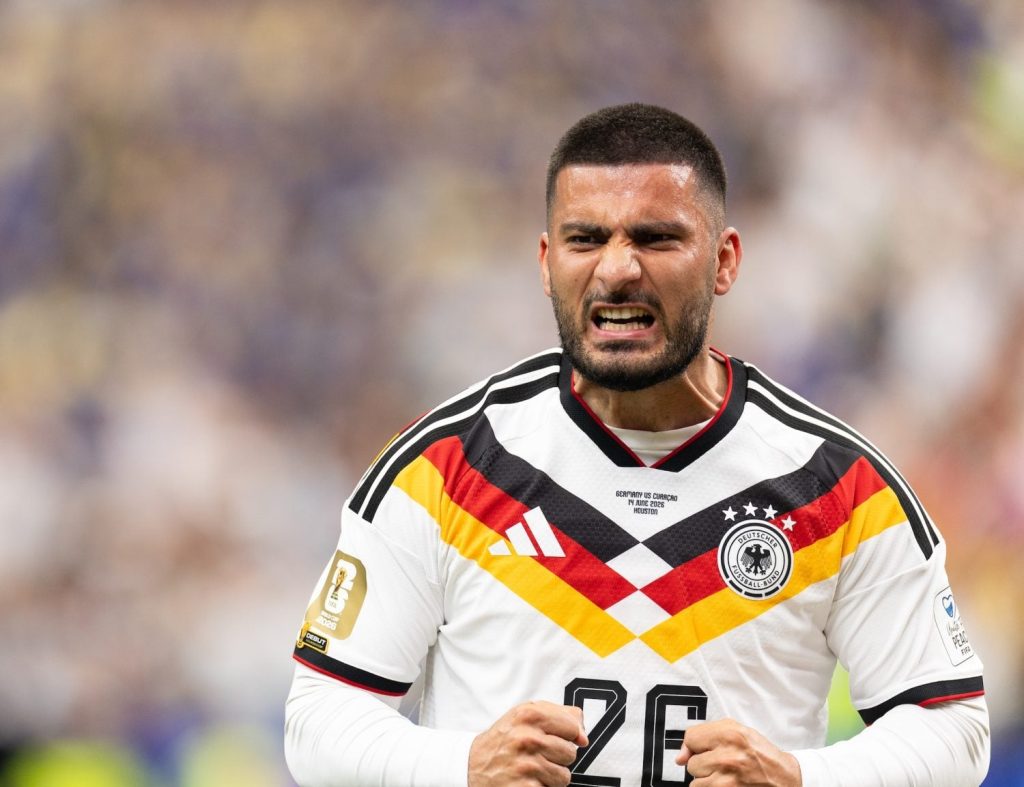
When Deniz Undav came on in the 60th minute of Germany’s match against Ivory Coast, the game shifted almost immediately. Up to that point, the Ivorians had defended with discipline, protecting the centre through a compact low block that limited Germany’s circulation in the final third. With his introduction, the geometry of the Mannschaft’s attack changed: a recognised centre-forward occupying the box, engaging the central defenders, allowing Germany to use the full width of the pitch more consistently and stretch the game through earlier, more insistent crosses that began to force uncertainty rather than control.
Eight minutes later, the breakthrough arrived. Amiri found the time and space on the right to deliver a precise cross, and Undav attacked the right zone between defenders, finishing like a natural goalscorer, the kind of striker who appears in the exact place where the ball is about to arrive, as if anticipating not just the pass but its consequences.
If the first goal was instinct, the second was control under reduction. In the 94th minute, with the match almost gone and tension flattened into something more abstract, Undav received a through ball from Nmecha and executed what looked almost minimal: an angled first touch to remove the defender from the line of action, followed immediately by a left-footed finish into the far corner, the entire sequence unfolding in a matter of seconds, with neither touch carrying the simplicity it appeared to have in real time.
Undav arrived at this World Cup after a strong season with Stuttgart, finishing as the Bundesliga’s second-highest scorer with 19 league goals and 25 in all competitions, numbers that no longer require interpretation so much as acceptance, and that increasingly make his case for a central role in Germany’s attack difficult to ignore within Julian Nagelsmann’s hierarchy.
He belongs to a specific German attacking tradition, not always aesthetically defined and rarely dependent on visibility, but consistently oriented toward consequence, the type of forward who can spend long stretches outside the frame of the game and still determine it in a single action. In Germany they call them Torjäger, literally goal hunters, players who do not need constant involvement to alter a match, and it is within this lineage that names such as Gerd Müller, Rudi Völler and Miroslav Klose are repeatedly invoked, not as direct comparisons but as references to a recurring logic of efficiency that Undav, in his own way and in a different era, appears to echo.
His record for Germany, for now, is almost excessive in its clarity: nine goals in his first eleven appearances, a return that sits uncomfortably with any attempt to define him as secondary. And yet that is still his position in Nagelsmann’s structure, a hierarchy that has never fully resolved itself around him, something already visible in March after a friendly against Ghana, when Undav scored the winner but was still assessed critically by his coach, who said he “wasn’t very involved in the game, before the goal he had barely had an action, I don’t think his performance was good,” a judgement that travelled widely not because it was extreme but because it separated performance from consequence in a way that felt almost dissonant with the result itself, and which some interpreted in relation to Undav’s own suggestion that he deserved a more permanent starting role.
That tension sits against the background of Nagelsmann’s internal “role talks,” the individual meetings used to define squad expectations and hierarchy before tournaments, and in that framework Undav has consistently been positioned as an impact option rather than a structural one, a designation that nevertheless proved decisive against Ivory Coast, when his introduction for the final half-hour altered the match state and carried Germany into the knockout rounds for the first time since 2014.
His career, in contrast, does not follow any such structural clarity. Released at sixteen by Werder Bremen for being physically underdeveloped, he restarted at SC Weyhe, an amateur club outside the professional pyramid, before moving through TSV Havelse, Eintracht Braunschweig II and Meppen in the third division, a sequence that reflects not progression but persistence in environments far removed from elite development pathways and the acceleration typically reserved for academy prospects.
The turning point came at Union Saint-Gilloise in Belgium, where his goals shifted him from obscurity into one of the most productive forwards in the league, leading to a move within the same ownership network to Brighton & Hove Albion, where his Premier League spell never fully materialised in terms of minutes or continuity, although Roberto De Zerbi repeatedly valued his tactical discipline, work without the ball and willingness to subordinate himself to structure, qualities that rarely define narrative profiles of centre-forwards but often determine internal coaching trust.
It was at Stuttgart that everything consolidated into scale, with 57 goals and 30 assists across three seasons, numbers that describe not only a finisher but a participant in multiple phases of play, capable of linking combinations, creating space for others and finishing sequences he also helps construct, a profile that complicates the simpler label of penalty-box striker.
From that point, his case for Germany became less a question of emergence than of selection. He may not start, and at this stage perhaps does not need to, because the team often appears to benefit from his presence later in matches rather than earlier, a pattern that repeated against Ivory Coast when he arrived and immediately altered the rhythm and direction of the game.
There remains, even now, a scenario in which he finishes the tournament as Germany’s top scorer without ever becoming a first-choice starter, a possibility supported by three goals in two matches and by the arithmetic of impact players whose minutes remain limited but whose output accumulates disproportionately.
Modern football continues to frame itself through systems, pressing structures and spatial organisation, yet matches are still decided in moments that resist those frameworks entirely, when an action arrives slightly earlier or slightly later than expected, and the outcome shifts accordingly, because ultimately the game still returns to the same principle it has always had, which is that the ball either goes in or it does not, and at present, for Germany, no one ensures that outcome more reliably than Deniz Undav.