
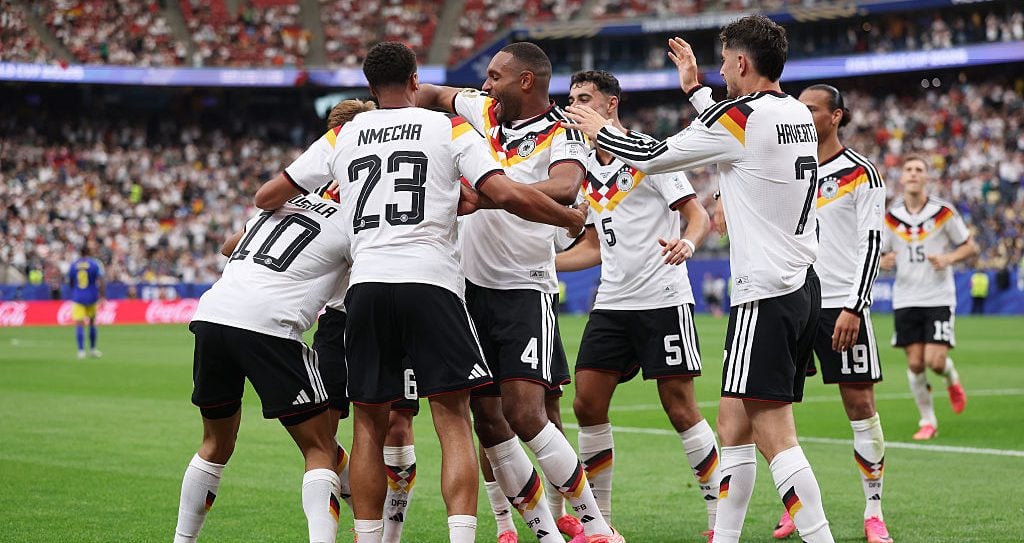
Just looking at the latest scoring sheet from the rout against Curaçao. More broadly at the list of 26 German players called up by Nagelsmann for the World Cup in the United States: Felix Nmecha, Jamal Musiala, Antonio Rüdiger, Jonathan Tah, Leroy Sané, Assan Ouédraogo, Malick Thiaw, Jamie Leweling. Eight players of African origin — Senegal, Sierra Leone, Nigeria, Ghana, Ivory Coast. Almost a third of the squad. Seventeen if the frame widens to those who have entered the national team setup over the past year alone.
A reality now in plain sight. A break from the recent past. The World Cup hosted at home twenty years ago still lingers: David Odonkor’s surname and profile as exception rather than pattern. Germany never carried the same football multiculturalism as France — it is told elsewhere in detail — nor the same colonial imprint stretching across the African continent. And yet, within football alone, the DFB now appears to be moving, slowly, towards something closer to the French federation model, almost half a century later. A transition that, as in Paris at the time, carries wider political weight.
“The great diversity within our national team today symbolises a new generation of German players,” Annalena Baerbock told Deutsche Welle, president of the United Nations General Assembly. “It has not always been like this: it shows how important anti-racism campaigns are. The Germany team is always a reflection of its society.”
Not insignificant, all of this unfolding alongside the rise of the far right represented by AfD. Local observers note how “while the sovereigntists lead the polls by 5–7 points, this national team acts as a counterpoint, offering hope to immigrants in Germany now reconsidering whether to leave the country”.
The German federation itself, with all the expected diplomacy, frames the shift in meritocratic terms: “We are all united in making the best decisions for Germany, trying to develop players ever more suited to the national team. In this squad we can see a strong attachment to the shirt from the very first moments. Economics tells us the same thing: cultural mix is an advantage for the final product. We are happy to work with this diversity.”
For players like Tah or Rüdiger, the path has not been simple, breaking sociological barriers, among the first to choose the country that developed them as footballers over that of origin. In doing so they become reference points, examples for younger players further down the line, for those still on the margins.
Even the presence of a figure like Vincent Kompany at Bayern, the country’s biggest club, sits in the same current. As Nagelsmann put it ahead of Euro 2024: “A football team can be a model for integrating different cultures, religious backgrounds and skin colours. We are happy with what we are today. We play football to represent everything in our country, and anyone performing at the top level is welcome in our national team.”
That alone could already be read as a kind of victory for Germany, regardless of how the World Cup unfolds. But the political undertow remains. In the event of failure in the United States, a large part of the political discourse will be ready to turn to an ethnic reading of defeat. And there, more than anywhere, composure will matter.