
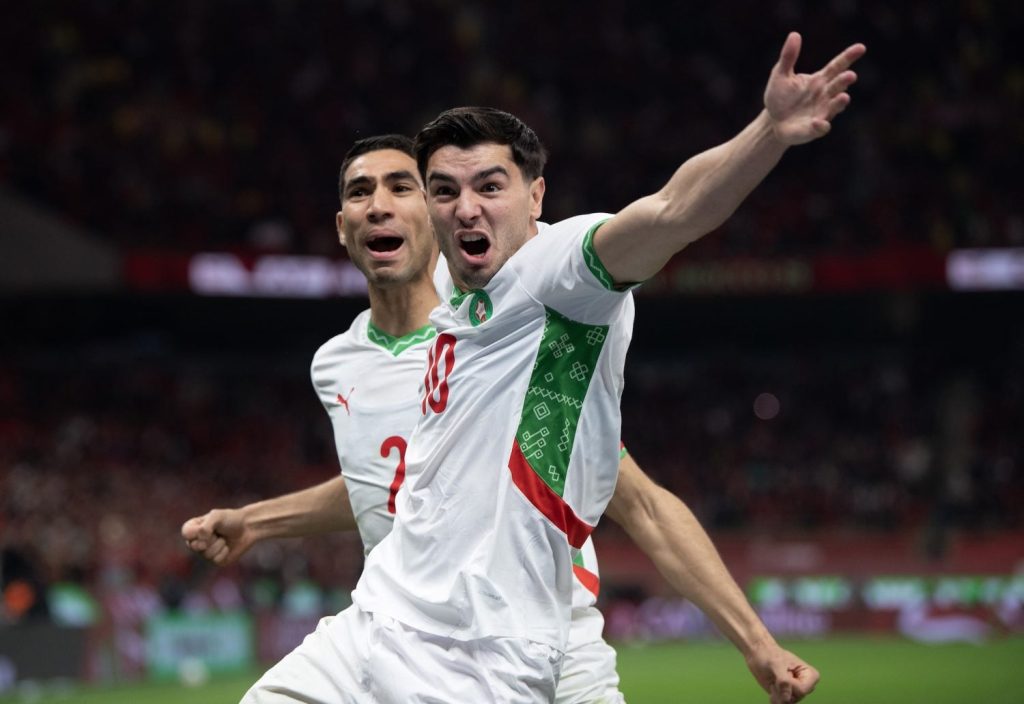
At the final whistle of the 2022 World Cup semifinal between Morocco and France, very few Morocco fans registered anything like disappointment. The 2–0 defeat, the final slipping away at the last step, already felt slightly displaced. Morocco had written history, becoming the first African nation in a World Cup semifinal. Belgium, Spain, Portugal gone before that, the sequence almost carrying its own momentum. The match lost, yes, but something else already there, heavier than the result, not fully contained by it.
The milestone was never accidental. Morocco’s run in Qatar came out of a political, cultural and sporting construction built over decades, not in a straight line. Behind the images — players with their mothers at the touchline, supporters scattered across cities and time zones — there was a structure already in place, half-visible, administrative in some parts, improvised in others, pulling the diaspora back into the frame without announcing it.
The 2022 squad was profoundly multicultural. Out of 26 players, 14 were born outside Morocco, more than any other team at the tournament. Achraf Hakimi and Brahim Díaz in Spain, Hakim Ziyech and Noussair Mazraoui in the Netherlands, Bilal El Khannouss and Anass Zaroury in Belgium. Walid Regragui, the coach who led them to the semifinals, born in France.
European national teams, over time, have come to depend on players of African origin. Colonial histories, migration routes, youth systems absorbing talent early, refining it elsewhere. France sits almost as shorthand for this: 17 of the 23 players who eliminated Morocco had family roots outside the country, a fact that no longer needs emphasis to be understood.
Morocco, in 2022, worked against that current. Or alongside it, depending on where you stand. The federation had been building links with dual-nationality players across Europe for years. A recruitment drive launched in 2014, named “Bring Back Talents Belonging to the Soil”. Bring back the talents belonging to the land.
The approach was simple on paper, less so in practice. Identify early those born in Europe with Moroccan roots. Keep contact. Stay present without urgency. Let decisions form slowly, around families, around time. The Atlas Lions shirt arriving later, almost quietly.
It sits inside a broader rhythm with the diaspora. Between five and six million Moroccans live abroad. Movement is constant but not dramatic: Madrid, Brussels, Amsterdam back to Tangier, Casablanca, Fès. Nothing fully closes, nothing fully starts again.
Sofyan Amrabat, who came through the Netherlands youth system before switching allegiance, put it without framing. Going back, it is home. That was all.
That sense of attachment does more work than any structure on its own. Without it, the model would have felt fragile. Instead, players arrive into something already partially there, already assumed.
Walid Regragui, during the Qatar run, cut through the old distinction between local and foreign without ceremony. Every Moroccan is Moroccan.
Hakim Ziyech spoke from another angle entirely. Growing up in the Netherlands with a sense of constant adjustment, of always being slightly measured differently. If you play well, you are Dutch. If you play badly, you are just “that Moroccan”.
Belonging does not hold evenly. The racist abuse directed at Lamine Yamal, despite playing for Spain, sits in that same unresolved space, not contained by selection or shirt.
For many dual-nationality players, the question never fully settles on choice. It stays on recognition, and where it lands.
African football has long moved inside a split system. Talent produced in volume, structure absorbed elsewhere. Morocco interrupted that flow by pulling part of it back, something Myriam Cherti reads as decolonisation, though the term sits slightly askew against the mechanism.
Dependence remains. Most of these players pass through Amsterdam, Madrid, Paris academies before wearing red and green. The imbalance is not erased, only redirected, used.
Investment followed, uneven at first, then increasingly visible. Federation reform, expanded scouting, coaching standards adjusted, training centres appearing across the country without a single pattern of arrival.
The Mohammed VI Academy, a 65-million-dollar facility designed to produce elite players, sits at the centre of that map, without fully explaining it.
Major bids followed — AFCON 2025, the 2030 World Cup shared with Spain and Portugal. Stadium projects on another scale, including the planned Grand Stade Hassan II with 115,000 seats, still present as plan and image at once.
Women’s football moved in parallel, the national team reaching its first World Cup in 2023.
Still, the gaps are visible in uneven ways. Infrastructure that rises and fades, distances from European tempo that do not collapse.
The direction holds without needing to be restated. A hybrid system, domestic production alongside continued recruitment from the diaspora, neither fully separated nor fully merged.
At AFCON 2025, more than a quarter of players were born in Europe. Tunisia, Senegal, Ghana following related paths, not coordinated, not isolated either.
Replication is not simple. Morocco’s stability, state backing, economic trajectory, proximity to Europe — conditions that sit around the model without fully defining it.
But the logic travels anyway, in fragments.
Not just scouting abroad. Building at home, unevenly, over time. Diaspora talent becoming capital only when held inside something longer than selection cycles.
In the Qatar semifinals, a World Cup last four once felt exceptional, almost unstable. The frame has started to loosen since.
Mohamed Ouahbi, continuity after Regragui, speaks less of rupture than of continuation, as if the question has already changed shape.
The axis has moved. Not whether an African nation reaches the top table.
How far Morocco can still go.