
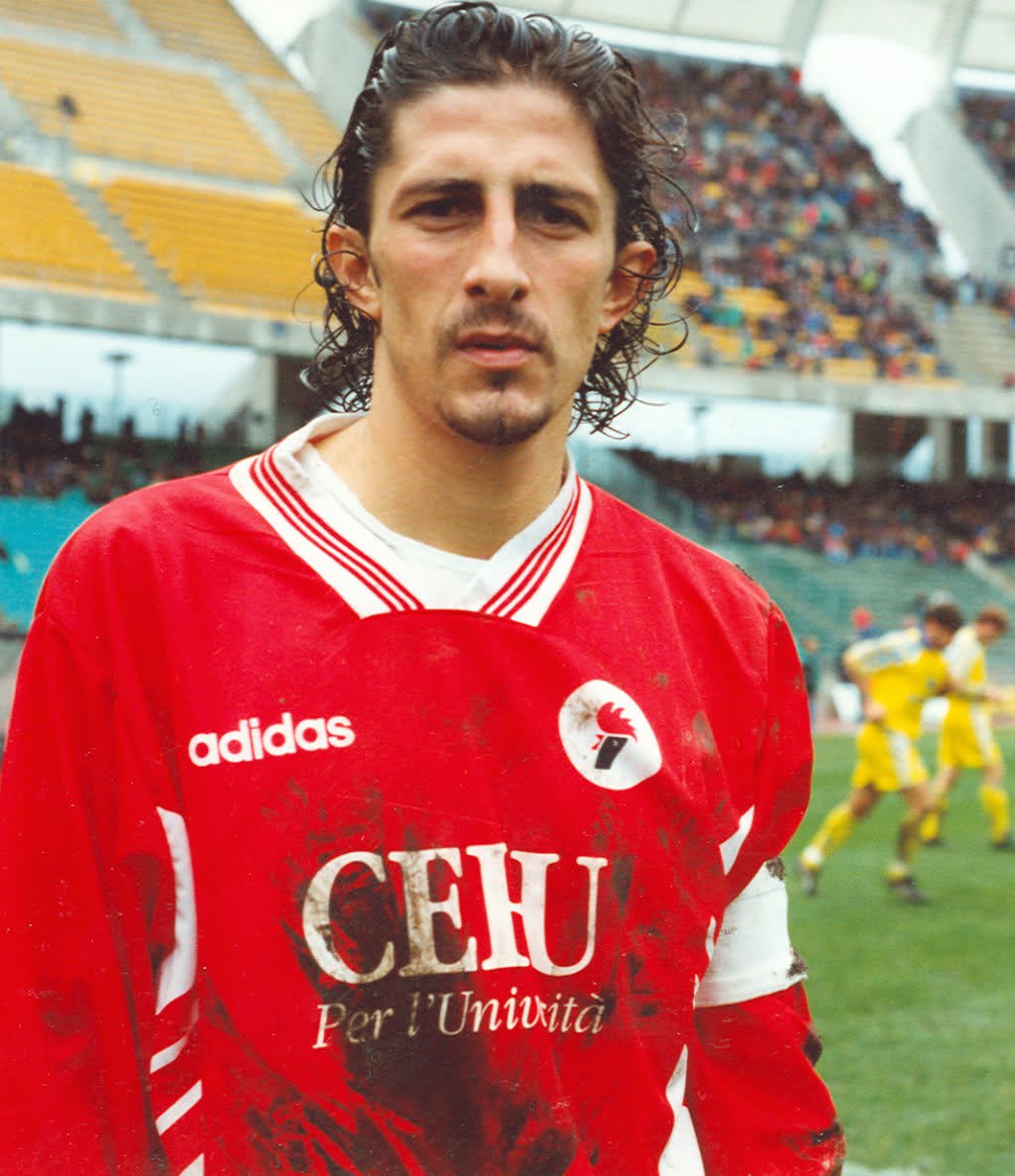
Igor Protti was the first footballing hero of my childhood.
In a provincial city, Ronaldo and Van Basten felt far away. It did not matter. Igor Protti was everything a child discovering football could have wanted: courage, initiative, audacity. The hero of impossible goals and acrobatics nobody else would even attempt. Energy. Pride. The kind of player you would take into battle every time, because with him it never felt over.
Even through illness, Igor Protti remained that figure. An example of courage. He never hid his condition, never looked away. He wanted to face people directly. Face to face.
Thirty years have passed since his Bari days, since that uniquely improbable, almost Kafkaesque capocannoniere title: the league’s top scorer, yet with a team relegated to Serie B. Still, three decades later, the affection around him felt untouched, as though he had stopped playing only last week.
Those who were there remembered. Those who were not seemed to know anyway. Igor belonged to everyone. He was the player who made us believe any opponent could be beaten. While the current Bari side slipped quietly into Serie C, the city gathered around one of its few enduring football symbols.
Igor, Bari loves you, read a huge banner displayed in the 1990s.
The goals mattered, of course. But there was something else. He embodied what that team was: combative, proud, impossible to tame. Provincial football, at the time, was everything to us.
You did not need to dream about other players when Protti played for your club.
Goals counted. The way they arrived counted more.
One rainy afternoon in April, in a relegation battle against Cremonese, he decided the match in his own way: stubbornly. He refused to lose, and so he did not. He scored two goals I do not think we will ever see again. Not even in a Champions League match.
I do not need to search YouTube for footage of the second one. It is still there in my head. Protti hunched beneath the downpour, Cremonese defenders hanging off him, searching for space once, twice, three times. The first attempt blocked. The second, almost falling, running on fumes, struck from an impossible angle and somehow unstoppable.
Video games were not really part of football yet. But that goal belonged in one.
The stories around him only enlarged the myth.
The man who slept before matches. Calmly. How was that possible? How did all that competitive ferocity emerge after a nap on a treatment table in the dressing room?
Then you saw him walk onto the pitch: proud, upright, charged with energy. You would never have guessed he had been asleep twenty minutes earlier.
And then there was the blank contract.
He wanted to stay in Bari. He told president Matarrese: I will sign, you decide the figure.
A banner for the curva. The pride of a city.
Those were not ultras slogans. They were descriptions.
Lazio and Napoli never really suited him. He needed identification: with a team, with a place, with a people. He found it again at Livorno.
There he led a remarkable rise from Serie C1 to Serie A, becoming the top scorer in each of Italy’s top three divisions, a record shared with Dario Hübner.
It was never really about divisions, trophies, major stadiums. Certainly not money.
It was about belonging.
About happiness.
I do not think playing for one of Europe’s giants, or appearing in the European Cup, would have meant much to him. Whatever he wanted from football, he received.
Immortality. The love of ordinary people.
The photograph on this page, taken from Wikipedia, shows Protti in a Bari shirt in the mid-1990s. A close-up. Behind him, the great petals of the stand. His shirt stained with mud and earth.
A striker who never measured himself through statistics or aesthetics alone, although both mattered. Go back and watch some of those goals.
The measure of his value was elsewhere.
In the struggle.
And he struggled for you.