
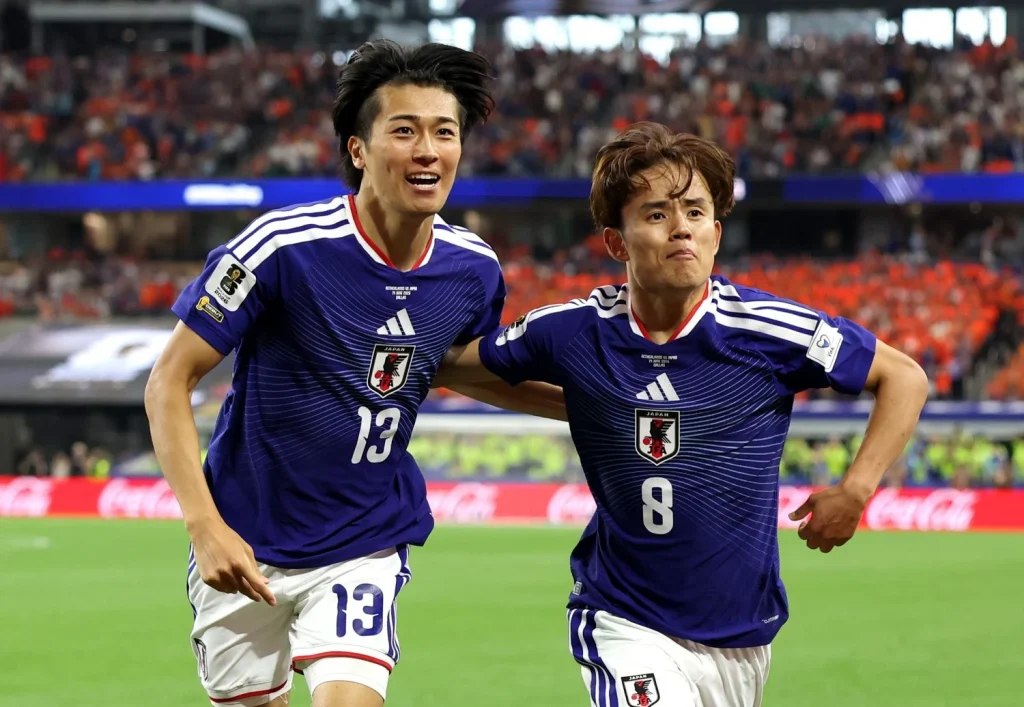
There is an image that captures the 2–2 draw between Japan and the Netherlands more clearly than any statistic: the entire Japanese bench spilling onto the pitch in the 89th minute, swept up in celebration after Daichi Kamada’s equaliser.
It is not only the joy of taking a point against one of Europe’s most talented sides. It is, in a way, a celebration of an idea — a football culture and a system that continues to grow regardless of who is on the pitch.
The draw should be read first through the lens of absences. Japan arrived without two of its brightest stars, Takumi Minamino and Kaoru Mitoma. Yet the identity remained intact. And the most striking paradox of the night is that the equaliser came from a corner — a set-piece that, on paper, should have played into the hands of the Netherlands, a side built around physical dominance, with Virgil van Dijk scoring their opener with a header, naturally.
In recent years, Japanese football has built its reputation on organisation. Wins over Germany and Spain at the 2022 World Cup had already shown that the Samurai Blue were no longer an outsider story. This draw against the Netherlands adds another layer: Moriyasu’s team is now mature enough not to depend on its most recognisable names.
Much of the pre-match attention had focused on the absences of Minamino and, above all, Mitoma — perhaps the most electrifying winger in Asian football. Without his bursts and his ability to create numerical superiority in wide areas, Japan might have been expected to take a more cautious approach.
Instead, the opposite happened.
Japan played with courage, accepting long stretches without the ball but never abandoning its principles: structured pressing, intelligent use of wide areas, and a constant search for verticality. The press was not always aggressive, but the mid-block remained coherent, and Moriyasu’s side resisted the temptation to distort its identity.
Even after conceding twice, Japan did not shift its approach. It stayed aligned with the same framework that has defined it for years. The first equaliser, scored by Keito Nakamura, came precisely from that consistency — no panic, no chaotic response, just continuity in execution.
That may be the most important takeaway from the match.
Japan’s strength is increasingly structural: players change, but the language does not. Nakamura, Kamada, Maeda, Ogawa — none carry the global profile of Mitoma, yet all interpret the game with the same clarity in transition, the same instinct to attack space quickly. It is the product of a system that has invested heavily in tactical and technical education, and which continues to export players across Europe’s top leagues.
Against the Netherlands, that continuity was most visible in moments of difficulty. After Summerville’s second goal, the game seemed to tilt decisively in favour of the Dutch. Yet Koeman’s side, unusually for an Oranje team, dropped into a more conservative shape, defending in a compact block — a posture they have historically struggled to sustain.
Japan kept pushing, pressing, and breaking forward in transition. Not always cleanly, not always in control, but with persistence. The idea was simple: stay close enough for something to happen.
And it did, in the 89th minute.
From a corner that, in theory, should have suited the Netherlands’ physical advantage, Ogawa made contact with a header. The ball was then turned in by Kamada, credited with the decisive 2–2.
For almost ninety minutes, the Netherlands had tried to assert their physical superiority. Yet the goal that denied them victory came in the very situation where that advantage should have mattered most.
https://www.youtube.com/watch?v=Ar125v5c9IQ&time_continue=1&source_ve_path=NzY3NTg&embeds_referring_euri=https%3A%2F%2Fwww.rivistaundici.com%2FIt is a victory of organisation and persistence over inconsistency and shifting control. A reminder that in modern football, detail can flatten even structural differences. And above all, it reinforces the personality of this Japan side.
The draw leaves the group wide open, especially after Sweden’s 5–1 win over Tunisia. Mathematically, it gives both teams a point. Psychologically, it feels very different.
The Netherlands leave with regret, having led twice without managing the game. Japan, meanwhile, leave with something more valuable: the belief that they can compete with anyone — even without their biggest names, even while remaining entirely themselves, and even by scoring from a corner against one of the most physically dominant sides in the tournament.
Not a small thing. Far from it.