
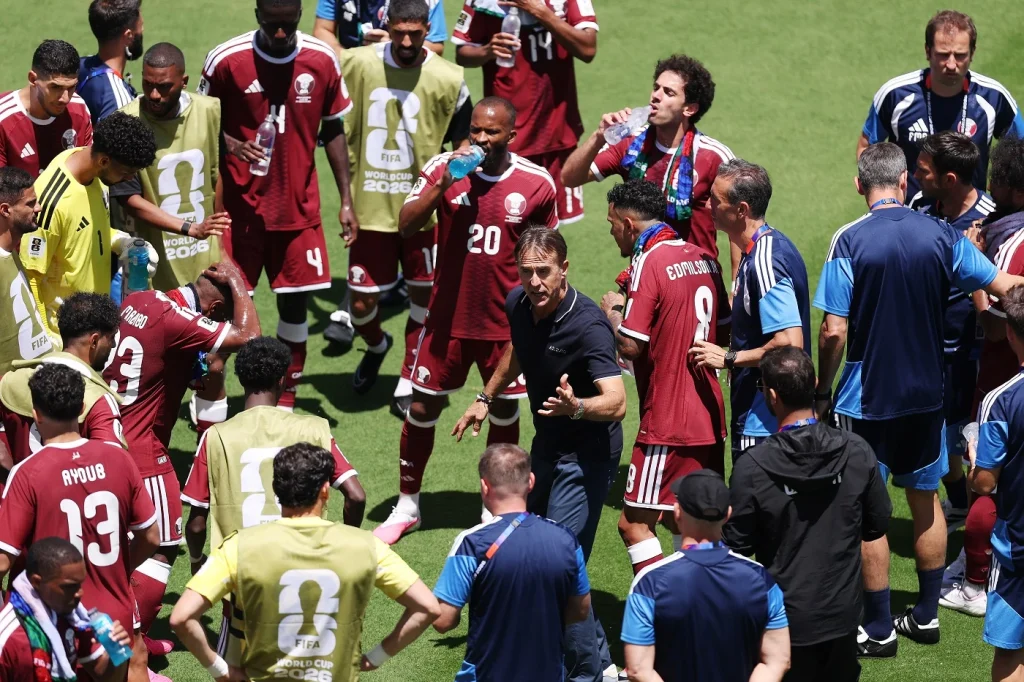
The debate leading up to this World Cup had focused heavily on heat, sudden weather shifts, and the changing atmospheric conditions across stadiums hosting — and set to host — matches, particularly in the United States. So much so that the cooling break — or rather, the hydration break, as FIFA has chosen to call it — during each half, to allow players to drink and recover, initially seemed like a reasonable, even obvious measure.
And yet, it is now becoming clear that the decision has found very few supporters.
The issue is that the interruption has now been made mandatory for all matches, regardless of actual temperature conditions. During the United States–Paraguay game in Los Angeles, for example, temperatures stood at 24°C with 68% humidity — far from ideal, but hardly unusual conditions for a football match. As reported by El País, criticism followed quickly.
Former US international Alexi Lalas, who also had a spell in Italy with Padova, joked on social media during the opening match between Mexico and South Africa: “Mexico 1, South Africa 0 at the end of the first quarter.” A remark pointing to how the half-time break risks turning football into something closer to American sports, divided into four quarters rather than two halves.
The reaction from former World Cup winner Carli Lloyd was even more direct: “I hate it,” she wrote on X.
Even the United States head coach Mauricio Pochettino has expressed reservations about the change: “I don’t like these breaks; I only accept them in extreme weather conditions,” said the Argentine manager. It is somewhat ironic that Pochettino himself had recently been involved in a minor controversy over his use of the hydration break — during the final warm-up friendly before the tournament, he was seen opening a laptop and giving tactical instructions to his players during the stoppage.
What has caused frustration is not only the interruption itself, but also how it has been handled in broadcasting terms. Networks such as Fox, DAZN and TVE have used the breaks to air advertising spots. During the opening match, however, a synchronization issue between the broadcast director and the restart of play meant that American viewers missed a few seconds of action.
According to several sources, FIFA presented the measure during a meeting with international rights holders. Alongside arguments related to player welfare, an operational guide was reportedly distributed outlining how the new time windows could be used for commercial messaging.
As the tournament has progressed, broadcasters have improved coordination around the stoppages. Still, unusual scenes have emerged: players waiting on the pitch for advertising slots to finish before play could resume. The situation has been particularly visible in covered stadiums in Los Angeles and Atlanta, where environmental conditions do not justify extended hydration breaks.
The introduction of these mandatory stoppages is also altering stadium habits. During the breaks, queues form at bars and restrooms, while large sections of seats are temporarily empty. A pattern that reinforces the sense that football is moving closer to North American sporting models, defined by frequent interruptions and a growing overlap between sport and commercial spectacle.