
It felt almost like a violation. Still, the raw FIFA ranking data had suggested it quite plainly: Brazil–Morocco might well be the most balanced and compelling fixture of the opening round of this World Cup — sixth against seventh. And so it proved.
Even so, most expectations still tilted towards Brazil, despite the acknowledged progress Morocco have made since their semi-final run in Qatar. What unfolded in East Rutherford told a slightly different story. Morocco in red, pressing high, sharp in possession, spending long stretches in Brazil’s half with a clarity that was hard to ignore. Brazil, by contrast, unsettled, occasionally stretched, held together more by isolated moments from their forwards — or, more accurately, from Vinícius Júnior alone — enough to limit the damage, especially through a first half that felt increasingly uncomfortable.
There is probably a form of cognitive bias at work here: a quiet assumption that Brazil is always Brazil. With Ancelotti on the bench, perhaps even more so. Morocco, meanwhile, tends to be filed away as a well-organised outsider whose intensity fades over time. Football, though, keeps moving away from those categories — more global, more levelled, less deferential to reputation.
Ouahbi’s side were the story of the night, though not because of the result itself — a draw on debut that, in isolation, was not especially surprising — but because of the performance behind it. With Hakimi and Brahim Díaz, decisive with the assist, there is now a structure that feels complete. A full team capable of sustaining that level. And that level, on this evidence, is very high indeed.
It was not a given. Morocco still carry elements of the group that reached the last four four years ago, but several of those figures are absent in the United States for different reasons: Ziyech, En-Nesyri, Aguerd, Ezzalzouli. Yet the turnover has not diluted the team. If anything, it has clarified it.
The breakthrough of 2022 has become the foundation of something more continuous — a longer process of development, built on players formed domestically and others effectively “repatriated”, or simply persuaded to represent the country of their birth. The Under-20 success sits somewhere in the background of that trajectory too. Morocco may not replicate fourth place from Qatar, but the aim now feels different: consolidation among the world’s established sides. The 1–1 against Brazil points in that direction.
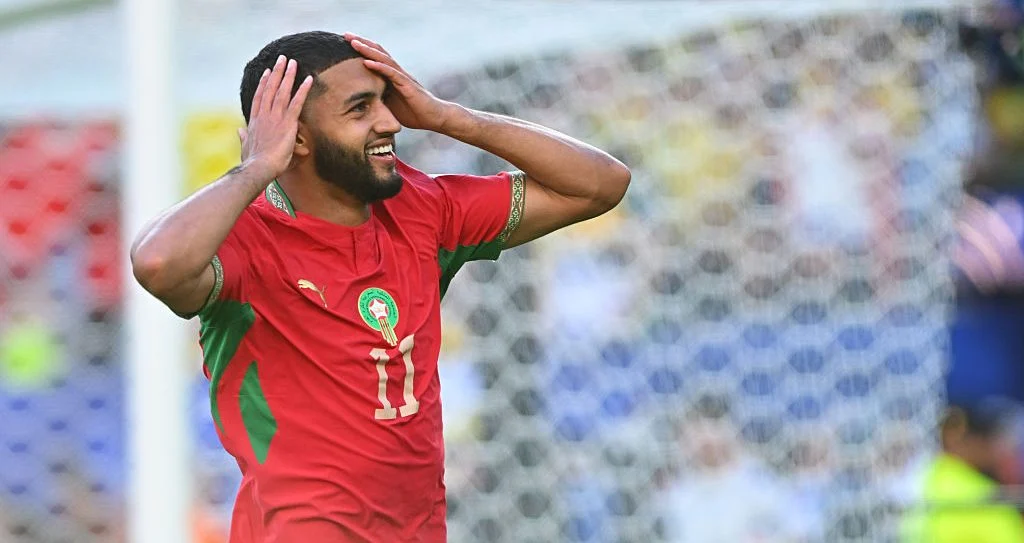
For a spell, Morocco even looked capable of taking all three points. Ismael Saibari, operating as a false nine and one of the most intelligent players on the pitch, celebrated the opening goal with his hands in his hair, as if he could barely process it. Until Vinícius’ moment of individual quality, though, Morocco had controlled the game’s rhythm and shape more convincingly than Brazil — something rarely said against them at this level.
El Khannouss and Ounahi were more composed than Thiago and Raphinha in key phases. Bouaddi, still very young, looked physically and mentally at ease alongside Casemiro. Mazraoui and Roma’s El Aynaoui both played with a level that sits comfortably above squad status.
The perception gap may in fact be wider than the financial one. Brazil’s squad value approaches a billion euros; Morocco’s is closer to 450 million. Not insignificant, but still a different scale. And yet many observers would struggle to place players like Talbi, El Mourabet or Salah-Eddine. That anonymity could become an advantage here. Playing under the radar rarely hurts in a tournament like this.
Hakimi and his teammates have already cleared what was, on paper, the most difficult fixture in the group. From here, qualification looks entirely within reach, and beyond that, there is no obvious reason why another deep run in the knockout phase should not be possible. The 2022 campaign is no longer the reference point. Repetition would now mean something else entirely.