
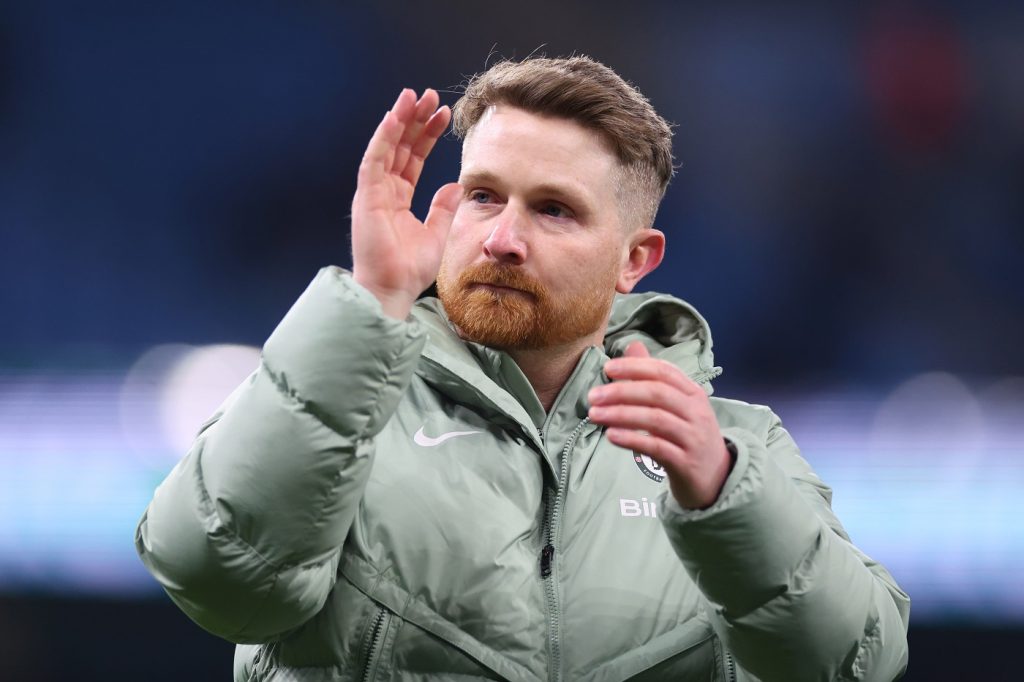
Calum McFarlane is the third coach of the season for Chelsea, after Maresca and Rosenior, and will lead the Blues at least until Monday, May 4, the day of the match at Stamford Bridge against Nottingham Forrest. In the meantime, he will also guide the team in the FA Cup semifinal against Leeds. The real objective, however, is to secure qualification for the Champions League, but the five consecutive defeats in the Premier League have made the mission extremely difficult. Because at this moment Chelsea is seven points behind fifth-placed Liverpool, and aside from the direct clash at Anfield Road, it’s hard to imagine a comeback. Unless McFarlane repeats what he has done in the past. Yes, because his story is truly incredible.
McFarlane himself describes his career as “a real ‘whirlwind’.” He has never been a professional player, has yet to manage a first team, yet he is a highly regarded coach. His recent history, his rise from grassroots football to the elite, speaks for itself, as do his two experiences as Caretaker of Chelsea – after the one between the sacking of Maresca and the sacking of Rosenior, just three months ago – at just 38 years old. Finally, it is evident in the fact that he will debut again at Wembley, a stage he has only known as a spectator so far.
An incredible story, as we said. McFarlane was indeed the coach of Chelsea’s Under 21 but then Rosenior had “promoted” him to the first team staff. Before that, there is a career made of insights, chance meetings, and years of quiet work. Growing up in Forest Hill, South London, McFarlane ironically defines himself as a “failed footballer,” who quickly moved to youth coaching. While working part-time with the youth teams of Crystal Palace and Fulham, he began coaching the Lambeth Tigers, where a chance meeting changed his destiny. Two young Norwegian players, sons of former Tromsø player Thomas Hafstad, put him in touch with Tromsø. Just to clarify a bit of geography, it is the northernmost club in professional football worldwide. Hafstad himself recounts that he immediately sensed McFarlane’s talent, particularly impressed by his ability to relate to young players and the depth of his understanding of the game. He was the one who brought him to Norway as the Under 14 coach, an experience that quickly turned into a leap to the Under 19 and even some sessions with the first team, during a time when the club was also engaged in European competitions.
After the adventure in the Arctic Circle, McFarlane spent six years in a completely different context: the Kinetic Foundation, a London-based organization that combines football and training for young people from difficult backgrounds. Here, McFarlane contributed to the development of many talents, but above all, he honed a reputation as an educator and developer of prospects that many still recognize today. From Kinetic emerged players who reached important levels in English football, and McFarlane was one of the coaches tasked with guiding the boys towards professional academies. James Fotheringham, one of the founders of the organization, reminded the BBC how the coach returned to London after his Norwegian experience and how, although it was not possible to retain him financially, his work inevitably opened new doors.
Then came prestigious roles in the Academies of Manchester City and Southampton, before arriving at Chelsea at the beginning of this season to lead the Under 21. There has been criticism for the fact that McFarlane only has the UEFA A license, and therefore lacks a Pro license: a condition that prevents him from remaining as an interim coach for more than 12 weeks and aspiring, for now, to a permanent appointment in the Premier League. But those who have worked with him, among executives, families, and agents of young players, emphasize his technical and human value.
Even at Chelsea, according to sources close to the club, his first period as a caretaker impressed with professionalism and composure, qualities that emerged even in media management. In January, the call to the first team came suddenly: on New Year’s Day, he was planning an evening with his family when he received the call that redirected him to a Premier League match against Manchester City (which ended in a draw, by the way). McFarlane is the product of years of apprenticeship among youth sectors, peripheral fields, and complex contexts. An unconventional profile, perhaps still enigmatic, but today he finds himself leading Chelsea in one of the most delicate moments of the season, with the possibility of transforming an already extraordinary story into something even greater.