
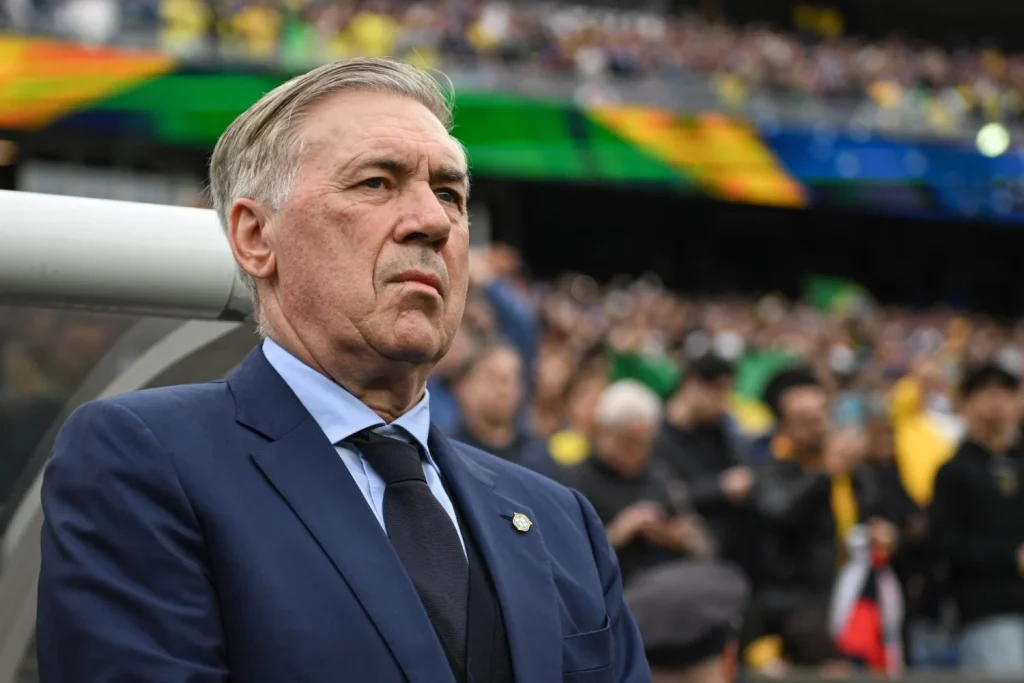
The most successful national team in football history arrives in North America carrying the weight of a 24-year wait. The script seems to echo 1994, when Brazil went on to win the World Cup on American soil. This time, however, the journey to the United States comes with an unmistakably Italian accent.
For the first time in its history, Brazil has arrived at a World Cup with a foreign head coach: Carlo Ancelotti, one of the most successful managers of all time, the man who rewrote the record books in the Champions League. This is not Ancelotti’s first experience in international football. By a twist of fate, he was on Italy’s bench during that very tournament in 1994, serving as Arrigo Sacchi’s assistant, only a few metres from the pitch where Parreira’s Brazil, led by Dunga and Romário, triumphed on penalties in front of the Rose Bowl crowd in Pasadena.
Today, Ancelotti carries the responsibility of restoring the stature of a Seleção that, since its last triumph in 2002, has reached the semi-finals only once: at the home World Cup in 2014. The tournament that would end in the traumatic and indelible 7–1 defeat to Germany.
“I feel immense pride in being here, because history tells us that Brazil is the greatest national team in the world. It has won five World Cups and is chasing a sixth, and it has chosen me to help achieve that goal. It is a huge responsibility, but one I embrace with enormous pleasure.”
These were Ancelotti’s first words as Brazil manager, delivered at a presentation attended by more than 200 journalists and drawing global attention to Rio de Janeiro. Upon his arrival, the Italian coach was welcomed by Luiz Felipe Scolari, the last manager to take Brazil to the top of the world, as well as legends such as Falcão, Zico and Rivelino.
Appointed in May 2025, Ancelotti has become the main attraction in a football culture still living with the active absence of historic giants such as Pelé, Garrincha, Romário and Ronaldo. He moves through Brazil like a professor in a dark suit, carrying his Italian accent and innate elegance into a país tropical, to borrow the famous words of Jorge Ben Jor.
This is how he has spent his first year in Rio de Janeiro, home of the Confederação Brasileira de Futebol. From his first days, Ancelotti surprised public opinion by making an immediate effort to speak Portuguese. His residence overlooks the ocean, and one of his first decisions was to visit Christ the Redeemer. During his first Carnival, he even appeared as an ambassador for a major beer brand, dividing his time between Salvador and Rio’s Sambadrome, the country’s two great cultural epicentres.
He might have looked like just another tourist. He was anything but.
“Ancelotti is fantastic. He is a simple man and deeply humble. We have the best manager of recent years, someone who has won everywhere he has been, managing dressing rooms full of stars,” said former full-back Branco, a World Cup winner in 1994 and now coordinator of Brazil’s youth national teams.
The charisma of the coach from Emilia-Romagna can be measured in the warmth with which Seleção supporters have embraced him. He lives a curious existence, somewhere between anonymity and celebrity: baseball cap pulled low, sunglasses on, attempting brief walks along Barra da Tijuca beach. Yet he is constantly stopped for photographs, videos and spontaneous displays of affection.
With his usual sense of humour, he has even spoken about finding a type of polenta in Rio remarkably similar to the one from his hometown of Reggiolo.
Pedro Ivo Almeida, ESPN Brasil columnist and one of the leading voices covering the Seleção, has witnessed first-hand the impact the Italian has had on both players and supporters, both of whom remain desperately hungry for a major trophy.
“People were missing a figure with genuine stature. The last three managers lived with the stigma of not being considered big enough for the role. Ancelotti embodies that stature, regardless of nationality,” Almeida says.
“He also understood how to position himself from the moment he arrived. His effort to speak Portuguese created immediate empathy in a country that is usually the one adapting to other people’s languages. On top of that, he genuinely tries to understand local customs. He experiences Carnival, he even appears in advertising campaigns.”
Carlo Ancelotti was not Plan A.
The leadership of the CBF dreamed of convincing Pep Guardiola, even while recognising that the Italian represented an equally unquestionable alternative. Since his arrival, however, the mister has become far more than a backup solution. He has turned into a pillar of stability amid the deep managerial and credibility crisis engulfing Brazilian football.
He was hired by a federation president who was removed from office shortly before his arrival, while another predecessor had already been dismissed amid allegations of sexual misconduct and corruption scandals linked to the aftermath of FIFA Gate.
For that reason, long before the World Cup kicked off, his contract was secured through to 2030. An act of complete faith, despite a record that has so far been relatively modest: eight matches, four wins, two draws and two defeats, for a win percentage of 58.3%.
“More than a coach, he has become the face of a new era. Within the CBF and within the national team, nobody carries greater weight than he does right now. He represents something unprecedented, something that goes beyond the pitch,” Almeida adds.
“His stature is reflected financially as well. No Brazil manager has ever earned this much, and none had ever seen his contract extended to the following World Cup before even coaching at the current one.”
After the disastrous 1950 World Cup — the country’s deepest sporting trauma until the 7–1 defeat of 2014 — playwright Nelson Rodrigues coined the famous expression complexo de vira-lata, the “mongrel complex”.
The phrase described a deeply rooted sense of inferiority within Brazilian society, a tendency to revere what comes from abroad while undervaluing domestic excellence.
With Ancelotti, Brazil is undergoing a complicated reassessment of that idea.
Cafu, captain of the 2002 World Cup-winning side, was among those who publicly opposed the appointment of a foreign coach. Until now, Brazil’s bench had seen only brief spells under a Uruguayan, a Portuguese and an Argentine. Local coaches, too, have not entirely embraced the arrival of the Italian, leading to one of the coldest moments of his tenure.
At the second Brazilian Coaches Forum, held at CBF headquarters, Ancelotti took the stage in a relaxed outfit — polo shirt, no tie, trainers — and called for unity in strengthening the image of Brazilian coaches.
Emerson Leão, goalkeeper in Brazil’s 1970 World Cup squad, then stood up and bluntly reiterated that he had not changed his views on foreign managers in Brazil.
“I have always said I do not like foreigners in my country. I used to say I could not stand them. But I have to be intelligent enough to admit that there is one culprit behind all this: us. We coaches are the real people responsible for this ‘invasion’.”
He delivered those words only a few metres from Ancelotti.
It was a moment of pure discomfort.
The CBF immediately defended the Italian and expressed regret over the incident. Davide Ancelotti, then manager of Botafogo and present in the audience, stood up and left the room after his father stepped down from the stage.
Ancelotti, for his part, downplayed the episode with his customary diplomacy. The effect was unexpected: he became even more popular, receiving public support from some of the most influential figures in Brazilian football.
“The debate about foreign coaches does not need to get stuck in resentment. It needs competence. The solution is simple: be better than them,” wrote Falcão, Brazilian football icon and a friend of Ancelotti since their playing days together in the 1980s.
Brazil will begin its World Cup against Morocco before facing Haiti and Scotland.
A few days ago, Ancelotti turned 67.
Managing a national team remains unexplored territory for him: reconnecting with players months apart, orchestrating no more than five training sessions during each FIFA window, then returning to scouting ahead of the next squad announcement.
Ancelotti approaches this new life with characteristic calm.
In a country that likes to soften the names of its stars into affectionate diminutives such as Ronaldinho, “Carlinho” Ancelotti continues to move at his own pace.
Between meetings with the President of the Republic, walks along the beach, visits to Christ the Redeemer and the occasional game of footvolley with Vini Jr. and Raphinha, he appears to hold the keys to the pentacampeões.
And he is determined to sew another star onto the shirt of the most successful — and perhaps the most demanding — national team in the world.