
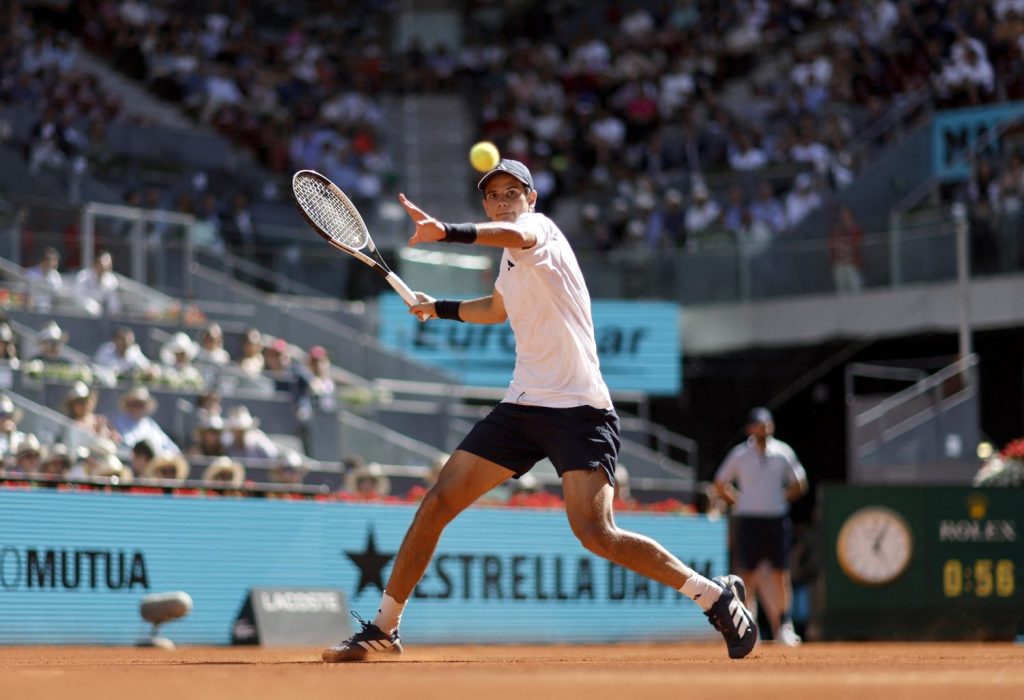
At the Madrid Masters 1000, Rafael Jódar beat Alex de Minaur, João Fonseca and Vit Kopriva in succession, and is preparing to face Jannik Sinner in the quarter-finals. And yet, despite everything, there has been little talk about him, perhaps too little. Everyone only began to really notice his presence when, in the third set of their match, Fonseca smashed his racket into a thousand pieces, perhaps because he was overcome by frustration, by anger at a victory that had seemed a foregone conclusion and instead turned out not to be.
The point is that many, perhaps everyone, believed that the only possible third wheel between Sinner and Alcaraz, at least in the short to medium term, could be precisely the boy from Rio de Janeiro. Jódar, however, is changing the cards on the table. And he has seriously put himself forward as a potential crack of tennis. Born in Madrid, class of 2006 and not yet twenty, Jódar (190 cm for 70 kg) is a tall, slender tennis player. He does not have a physique like Rafa Nadal’s, but more like Sinner’s or Isner’s, so to speak. Just a year ago he was 687th in the world, while today he occupies 42nd position in the ATP Ranking. Raised in the Leganés neighbourhood, he started using a racket in a garage with his father, who is still his coach today. His first major trophy came in 2024, with victory at the US Open Junior, while 2026 is the year of his breakthrough: in January he took part in a Slam for the first time (Australian Open), in March he won his first ATP title (Marrakech) and shortly afterwards reached the semi-finals in Barcelona. Now he is in the quarter-finals in Madrid, where in the space of a few days he has beaten the world number 66 (Kopriva), number 31 (Fonseca), and number 5 (De Minaur). Not bad.
As anticipated, Jódar cannot be considered Nadal’s heir, nor Alcaraz’s twin. With them, in fact, he shares only a Spanish passport: he is a solid, granite-like player, very attentive and in some ways even robotic. Unlike the vast majority of his compatriots, he prefers hard courts to clay and does not live off exaggerated top-spin and drop shots, but rather off flat, fast strokes. He is a modern player, one who is in some ways destroying the archetype of the Spanish tennis player, the one who wears down the opponent’s legs and head with balls that bounce close to the stands. His playing style, however, is also aggressive: he likes to stay well behind the baseline, take time away from his opponent (just like Sinner) by hitting the ball on the rise and give his matches a suffocating rhythm. His serve is one of his best weapons, with heavy first serves designed to make his way into the court and kick second serves. In short: thanks to Jódar, in effect, we are getting to know the Spanish answer to Sinner’s solidity.
«Jódar has talent, I’m happy to play against him», Jannik Sinner himself said. He then uttered another significant sentence: «It is good that it happens before Rome or Paris». And indeed Jódar arrives at what is the most prestigious match of his career with important numbers: he has won 17 of his first 25 matches (better than Nadal, Alcaraz, Sinner and Djokovic) among the pros and, on clay, he has lost only once in 12 occasions. The victory against Kapriva, which came with a score of 7-5, 6-0, was also convincing: in the first set the match was balanced, but the Spaniard’s mental strength made the difference.
At 5-5 and 40-40, Jódar pulled an incredible drop shot out of the hat (not exactly his speciality), which allowed him to move ahead at a key moment in the match. In the second set, the Spaniard managed to break his opponent straight away, and so he definitively steered the match in his direction. Of course, over the course of the match against Kapriva, Jódar’s limitations also emerged, obviously linked to his age: at times he was too hasty, at others he hit shots that were more powerful than precise. But Rafael has all the time he needs to improve, and to claim the coveted throne of third wheel between Sinner and Alcaraz, even if we did not see him coming.