
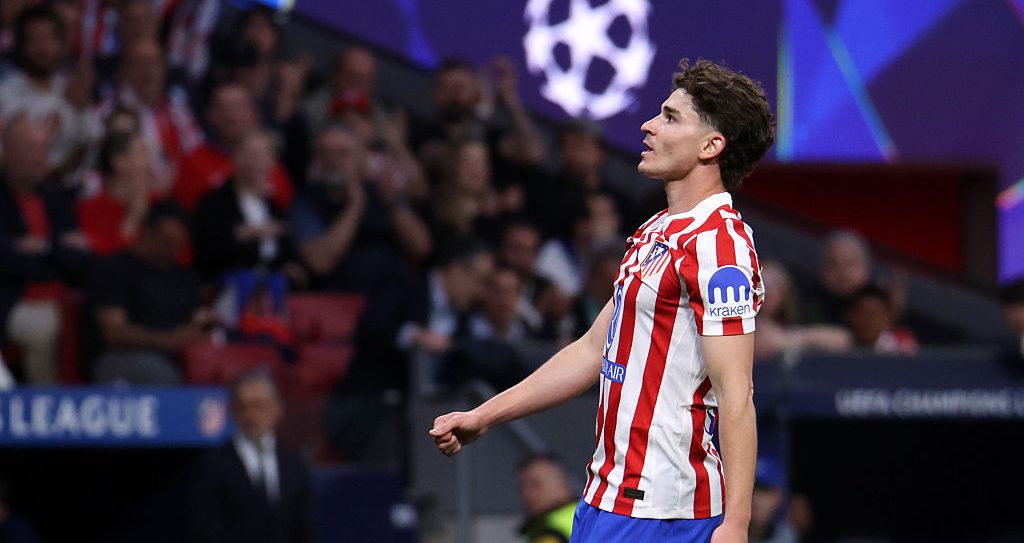
Penalty draw, in the most classic sense. A goal for each side, a few chances, some nice plays, and see you at the Emirates for the return semifinal. It certainly wasn’t a memorable match between Atlético Madrid and Arsenal. Especially when compared to the day before’s PSG-Bayern 5-4, destined to remain in the annals of the Champions League for its spectacularity and offensive dominance. Yet – a message to all skeptics of carefree defenses, or those inferior to stratospheric attackers – these two teams show everyone that another style of football is still possible. Even at the top of the Champions League, even in the year 2026.
Just a glance at the formations on the field: in terms of tactical organization, the Gunners and Colchoneros have much to teach football schools just as the Parisians and Bavarians do for individual creativity. The fact is that not everyone has Olise and Kane, Dembélé and Kvara and Doué. Probably, the best offensive player among the 22 on the field at the Wanda Metropolitano – currently Julián Álvarez, and by a significant margin – would sit on the bench for both Bayern and PSG, perhaps with a nice role as a luxury substitute. Certainly not as a leading actor. That’s why the other two Champions semifinalists shouldn’t be blamed if they play differently from PSG and Bayern.
Atlético and Arsenal are two fine teams, coached by strongly identifiable coaches. Simeone and Arteta are not failures of the game, compared to Kompany and Luis Enrique: give the former Barça coach a tough squad, without visionary playmakers or explosive wingers like Atlético’s, and his admired champagne football in Paris would become something very, very different. It is indeed a virtue to get the most out of one’s technical and human resources. Cholo knows this, remaining true to his beliefs and continuing to challenge Europe’s big teams as a perennial outsider. And indeed, after the 1-1 against Arsenal, the Atlético coach scrutinized the previous night: “When a match ends 5-4, everyone thinks ‘wow, how beautiful!’. I instead say: damn, they scored five goals on us.” Arteta knows this too. That, psychological slip-ups aside, he has long managed to checkmate Manchester City in the Premier League – a team much more similar, in terms of resources and variety of players, to PSG or Bayern. In short: if Arsenal is up there, fighting on the fronts that matter until May, it is thanks to their solidity in the non-possession phase and a scientific superiority on set pieces. And that’s just fine.
The philosophical lesson from this two-day Champions event – so antithetical from Tuesday to Wednesday, in many ways – is that football continues to be beautiful and unpredictable precisely because it remains varied. It is not an exact science or a board game, where there exists a theoretically better strategy than all others. There is no doubt, nights like those at the Parc des Princes inflate player ratings, go viral on social media, and will remain in the collective imagination: like it or not, goals leave a mark more than 0-0s, almost always, on an emotional level. Yet it is the dirty, hard-fought draws like the one in Madrid that continue to give hope to all those teams – almost all, to be honest – that are not PSG or Bayern Munich.
Because however it ends, the Champions final will put these two systems face to face. And it is not said that the outcome is already written. “Attacks sell tickets, defenses win matches,” goes an old saying – some attribute it to Sir Alex Ferguson, but it bounces around fields all over the world and in all team sports. This is not a theorem either. But tell that to Italy in 2006, Spain in 2010, and the Champions League winners in six of the last seven editions: the anomaly was PSG’s five-goal match, because from 2019 to 2024, no more than two goals per match have ever been scored in the final. And even Guardiola, when necessary, has become Cholo.