
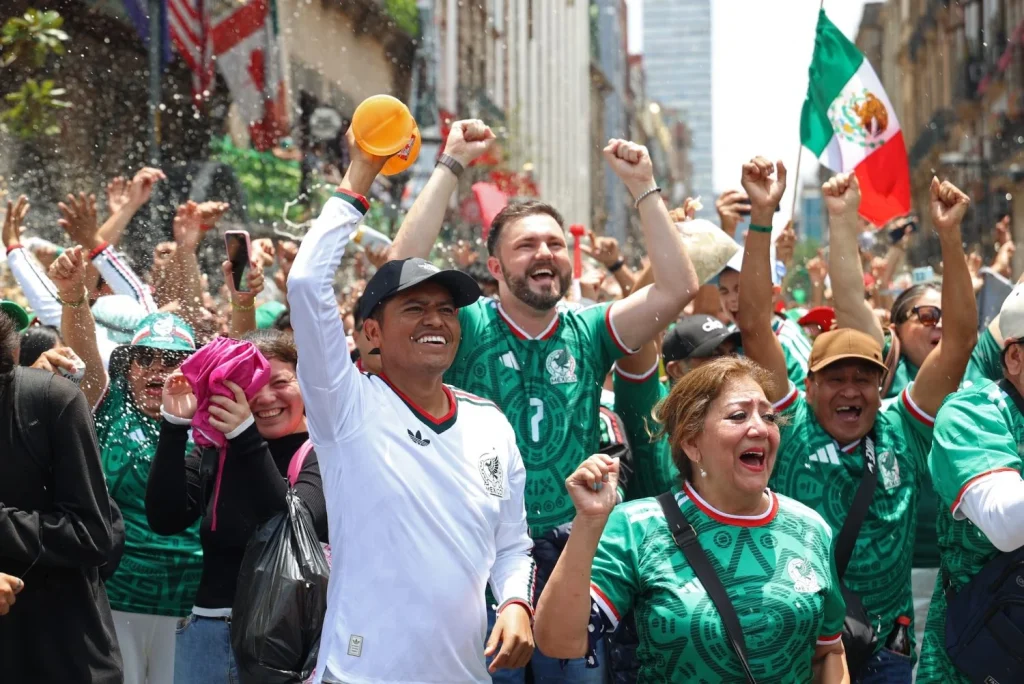
There are World Cups that widen football, and World Cups that widen the world. The 2026 edition will do both, and for that reason alone it already feels like the most political, the most global, and the most contemporary ever staged. For the first time, 48 national teams will take part. For the first time, the hosts will be three countries — the United States, Canada and Mexico — spread across an entire continent. And for the first time, the tournament will attempt to resemble the planet it claims to represent.
It is, in that sense, the most open World Cup yet. More Africa, more Asia, more North America, more Oceania. More places at the table, more flags in the frame, more anthems before kick-off. A broader geography of entry into football’s central narrative.
For decades, the World Cup worked as a kind of sporting aristocracy: Europe and South America at the centre, everyone else appearing only intermittently. That was never simply a question of design, but of the sport’s own historical distribution of power. Yet every phase of football’s globalisation has eventually forced the tournament to adjust its shape.
Thirteen teams in 1930. Sixteen from 1934 to 1978. Twenty-four from 1982. Thirty-two from 1998. The move to 48 is less rupture than consequence — the reflection of a game that no longer belongs to a single geography.
To understand 2026, it helps to stop treating it purely as a sporting event. It is also a geopolitical adjustment. When Gianni Infantino was elected FIFA president in 2016, the logic was already visible: expansion as a way of extending influence. The reform of the World Cup format became, in effect, a political programme expressed through football. More places meant more federations inside the system, more alliances, more representation for continents that had historically carried less weight within FIFA’s internal balance.
Infantino framed it in simple terms: football is global, and the World Cup should reflect that. At the time, the decision was read by many as commercial in essence — more matches, more broadcast inventory, more sponsors, more revenue. That dimension was real. But it does not fully explain the shift that followed.
Behind the numbers sits a quieter structural change. Africa moves from five to nine direct places. Asia from 4.5 to eight. Oceania receives a guaranteed slot. These are technical adjustments, but they describe a redistribution of presence within the game.
For years, entire continents approached qualification as a narrow corridor: one bad evening and the cycle ended. The expanded format alters that condition. An African or Asian team no longer arrives as a statistical exception, but as part of the competition’s stable architecture.
And that inevitably reshapes expectation at home as well — investment, infrastructure, attention, and the gradual normalisation of the idea that a World Cup appearance is not an extraordinary interruption, but a plausible objective.
In reality, football has already been moving in this direction for some time. Recruitment networks are global. Domestic leagues are transnational products. Players circulate as cultural figures as much as athletes. The 48-team World Cup does not invent this world; it formalises it.
Still, expansion carries its own tension. Greater inclusion inevitably reduces exclusivity. There are concerns about competitive imbalance, about diluted group stages, about a loss of intensity in the early rounds. Whether those fears prove justified will only become clear in time. For now, they sit alongside a broader truth: modern football already operates on the same scale this tournament is now adopting.
The choice of three host nations reflects the same logic. The United States, Canada and Mexico are not simply neighbours; they are different sporting cultures sharing a continental framework. Three ways of organising space, identity and spectacle. Three relationships to football that do not fully overlap.
In the 1990s and early 2000s, the World Cup still tended to belong to a single country at a time — Italy, France, Germany, Japan-Korea. The idea of the host nation carried a certain narrative unity. The 2026 edition moves away from that model. It behaves less like a national project and more like a regional infrastructure.
The scale is the clearest sign of this shift: 104 matches, vast distances, multiple time zones, and a logistical network stretching across North America. It is no longer a tournament contained within a country, but an event distributed across a continent.
That geography mirrors a broader contradiction in the present. Borders are more politically charged than they have been in decades, yet global circulation remains constant. Goods, capital and images move freely; people move less so. Public discourse tightens around identity, while cultural production becomes increasingly transnational.
The World Cup exists precisely inside that tension. North America, in particular, is currently defined by debates over migration, sovereignty and belonging. Yet it will host the most internationally dispersed edition of the tournament ever staged.
As Victor Montagliani has put it, this will be a multicultural World Cup. The phrase is simple, but difficult to argue with.
For a month, movement becomes collective. Stadiums turn into temporary points of convergence for diasporas and travelling supporters. Cities such as Los Angeles, Toronto, Mexico City, New York and Vancouver become spaces where national identity is constantly refracted through distance — where support often carries two addresses at once.
Football remains unusual in its ability to produce this kind of simultaneity. It synchronises attention across different contexts and languages, creating a shared frame of reference that is otherwise rare. Not consensus, but co-presence.
It would be naïve to suggest the game dissolves political tension. It does not. Conflicts continue, inequalities remain, and World Cups unfold inside them rather than above them. But the tournament does create a temporary shared stage on which those differences are at least made visible within a single narrative structure.
In a fragmented era, that matters more than it might once have done.
Of course, the expansion is not without controversy. Human rights organisations have already raised concerns about migration policy and labour conditions across host territories. And the fact that the tournament is frequently framed through the political figure of Donald Trump only sharpens the sense that this will be a World Cup embedded in its own geopolitical context.
Football is never separate from power. It never has been. It is an economy, a cultural system, and a mechanism of visibility. But it is precisely because of that entanglement that it remains one of the clearest mirrors of the contemporary world.
The 2026 World Cup may therefore be remembered less for any single team or result than for its attempt to align itself with the shape of the present: enlarged, uneven, interconnected, commercially saturated, culturally plural, politically exposed.
More teams, more matches, more cities, more languages, more stories. And inevitably, more friction. Yet that, in its own way, is also the point. Not harmony, but scale.
And perhaps that is what defines this edition more than anything else: not that it is the biggest World Cup ever staged, but that it is the first to feel structurally similar to the world that contains it.