
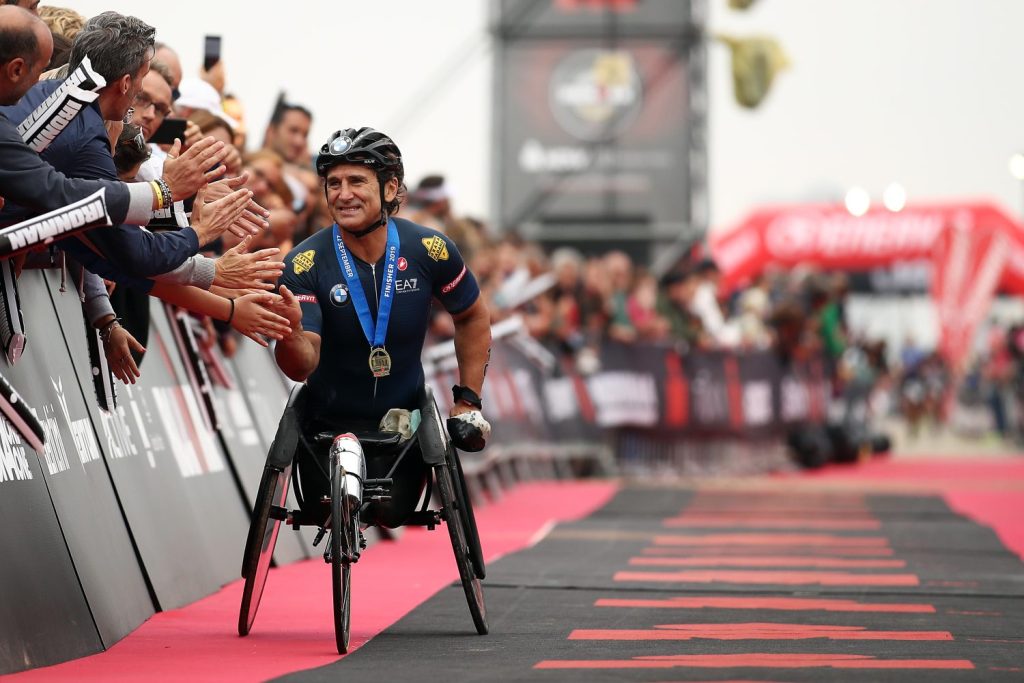
No one can be certain, but Alex Zanardi probably left this world happy. After almost six years of silence, the former Formula One driver and Paralympic athlete passed away on May 1, 2026, 2142 days after that accident on a downhill stretch of the provincial road between Pienza and San Quirico d’Orcia, with his handbike, during a charity relay. His vehicle overturned and collided with a truck. Then came the coma and absolute discretion regarding his health conditions, requested by the family and respected by all. That had been his last public appearance, with that handbike he loved and which had given him a second life after his career as a racing driver.
It’s easy to imagine Zanardi’s smile, even in the end, because that’s who he was: always optimistic, always positive about a life that was undoubtedly very full, a life that gave him but also took away a lot. “If I hadn’t had the accident in which I lost my legs, I wouldn’t be this happy,” he had said on several occasions. Words that seem circumstantial, a bit rhetorical, perhaps even a bit dishonest. But spoken by him, with that conviction in his eyes, they were the truest in the world.
Alex Zanardi would have turned 60 on October 23. His story is not just that of a winning driver or an extraordinary Paralympic athlete: it is the tale of a continuous restart that somehow involved everyone, athletes and non-athletes alike. Zanardi was already an established name in international motorsport between the 1990s and the early 2000s. His feats in the CART championship in the United States had crowned him as one of the purest talents of his era: spectacular, courageous, always on the edge.
On September 15, 2001, at the German circuit of Lausitzring, during a CART championship race, his career and life came to a halt for a moment suspended between tragedy and miracle. With 13 laps to go, Zanardi exited the pits, lost control of the car, and spun out on the track. The impact with the car of Alex Tagliani, traveling at over 300 km/h, was horrific. The images went around the world. The conditions were desperate: seven cardiac arrests, massive blood loss, only one liter left in his body. A priest administered the last rites. Yet, against all logic, Zanardi survived. But the price was extremely high: he lost both legs.
From that moment on, his story ceased to be merely sporting and became something different: a rebirth, a reinvention. Zanardi did not just survive: he chose to truly live, starting from different conditions. And with a determination that astonished everyone, perhaps even those who knew him best. Two years after the accident, he performed an act that is already legendary: he returned to Lausitzring to complete those thirteen laps that had been left unfinished. It was not a race, there were no opponents. But it was an enormous symbolic victory. It was a sign that a tragic path can also end well, but in the meantime, Zanardi had already become something different. He transcended, he went beyond.
The return to competition came in 2005, when he won the Italian supertouring championship. He did it with a modified car, demonstrating that talent and will can redefine even the technical parameters of sport and motors. Once again, Zanardi did not just participate: he won. But it is in another discipline that he found a new dimension, perhaps even more significant. He discovered handbiking, almost by chance, and fell in love with it. It was the beginning of a second career, equally extraordinary.
At the Paralympics in London 2012 , he won two gold medals and a silver, becoming a global symbol of Paralympic sport. Four years later, at the Games in Rio 2016, he repeated this feat: two more golds and another silver. These successes were complemented by 12 world titles on the road, creating a legendary palmarès. Yet the numbers only tell part of his greatness. The true legacy of Zanardi is human. His smile, his irony, the ability to face every obstacle with apparent lightness but authentic depth made him a reference point far beyond sport. He never hid the struggle, but he always chose to tell it without rhetoric, transforming it into positive energy.
This spirit finds one of its most concrete expressions in the project Obiettivo 3, the organization he founded to help people with disabilities embark on a sporting journey to the Paralympics. An initiative that perfectly embodies his vision: to give opportunities to those who have lost something, helping them discover what they can still become. “What happened to you is not important, but what you choose to do with what happened to you.” This phrase has become a sort of manifesto. Zanardi never sought compassion, but simply sought possibilities. Perhaps he never truly wanted to be an example, but he became one. Because his is, inevitably, a collective story. To say: he was also a television host, he engaged in outreach and told sports stories.
Today, reflecting on his life, it is difficult to separate sporting victories from personal ones. Both intertwine, building a unique narrative. From American tracks to rehabilitation, from car racing to the roads of the Paralympics, to television, each chapter adds a piece to a figure that eludes definitions. Perhaps this is his greatest lesson: there are no definitive boundaries, only limits that can be shifted. Not always surpassed, certainly, but faced with dignity and courage. One of the last memories he left was built on the handbike, and this is something that surely made him happy, even in his final moments. The sad ones, today, are all of us.