
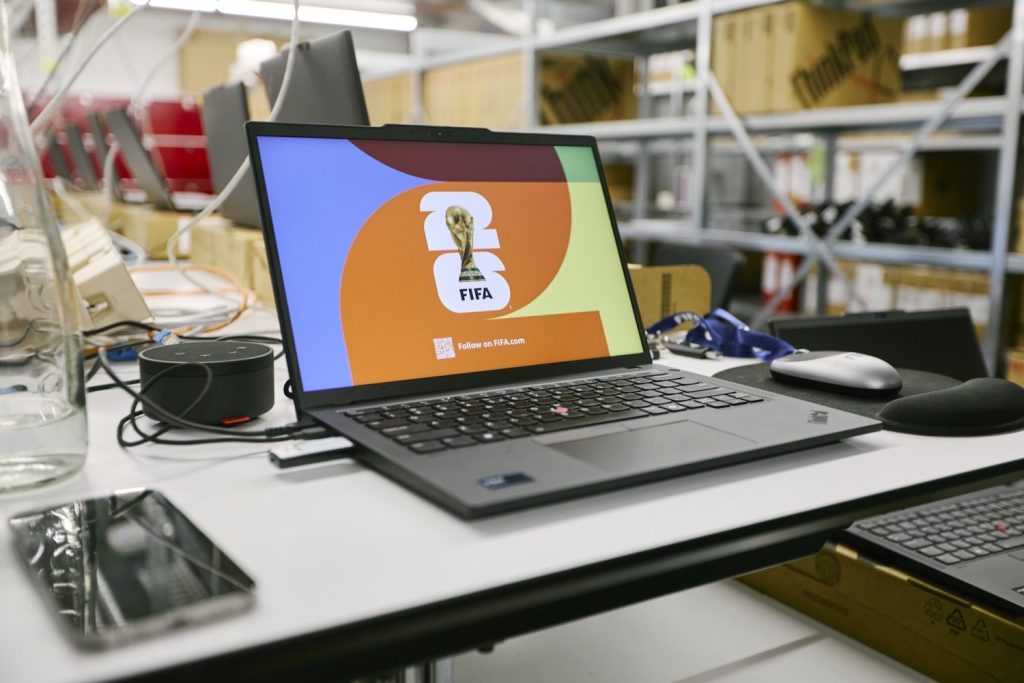
Although football can be considered a relatively young sport, it has a deeply rooted identity and traditions. That is why every proposal — yes, it already starts with the proposal — for change is seen and experienced, by a significant portion of fans and enthusiasts, as a possible attack on history and, therefore, on the very nature of the game. The reality, as always happens in these cases, is much more nuanced: football has basic rules and monolithic points of reference, that is true, but at the same time it is a microverse in constant evolution; practically every season new codes are approved, technologies never seen before are introduced, tactics are invented that change the essence of the discipline. Thinking that everything must remain still, or even just that things should move slowly, is not only wrong: it is truly naive.
The companies that invest in football, then, have a difficult task. They have to work by accommodating the supersonic speed at which the sport and the business that revolves around it are evolving, but they also have to show a certain sensitivity, meaning they have to find a way not to betray what could be described as the historic soul of the game. It is not easy, but it is not impossible. To understand what we mean, it is enough to look at the revolution carried out by Lenovo ahead of the World Cup that will begin in a few days in the United States, Canada and Mexico: as FIFA’s Official Technology Partner, the company has created two technologies that will allow artificial intelligence to have a real, yet non-invasive, impact on the dynamics of matches. More precisely: AI will begin to be a co-protagonist in tactical analysis and refereeing.
As far as tactical analysis is concerned, Lenovo’s big bet is called FIFA AI Pro. It is a platform to which the analysts of all the National Teams taking part in the World Cup will have access, and which will make it possible to obtain figures, graphics, videos and 3D reconstructions of what happens on the pitch. All of this starting from simple prompts that are interpreted and processed by artificial intelligence, based on the data and images accumulated during previous matches. Described this way, it may seem like an extremely complicated technology, even just to understand, and yet its most obvious characteristics are immediacy and ease of use: an analyst, in practice, will be able to ask the AI a question and receive, in return, a whole series of statistics and multimedia content that will allow them to explore one or more tactical aspects of the game, of a match, of a team.
Alvaro Pérez Rivero, Senior Product Manager (Football AI Pro), Services & Solutions Group at Lenovo, explained the meaning of this project as follows: «We had access to FIFA’s official data and images, and from there we started to create a kind of centralized archive that all the teams taking part in the World Cup can draw on. Artificial intelligence will make it possible to speed up and facilitate match analysis: starting from conversational commands and requests, coaches will be able to receive answers organized into clear themes, video highlights, representations with 3D avatars that show actions from different perspectives. In short, everything needed to broaden the understanding of what happens on the pitch. The platform, then, does not replace technical staff members or coaches: it supports them, practically in real time, during a phase that, historically, takes a lot of time away from those who dissect matches from a tactical and statistical point of view».
For those who have not yet understood the mechanisms, inputs and outputs of FIFA AI Pro, here is a super-quick summary: an analyst from any National Team qualified for the World Cup will be able to ask the platform “what are the most recurring and most dangerous attacking mechanisms of our next opponents?”. FIFA AI PRO will provide feedback organized into data, graphics, videos and 3D footage — entirely similar to those seen in video games — containing the possible answers to the initial question. In practice, then, it is as if everything that happens automatically in Football Manager — the most accurate football simulation game in the world — were also taking shape in reality, in real matches. In this way, Pérez Rivero explains further, «we will be able to witness a real democratization of advanced tactical analysis: some teams will arrive at the World Cup with an army of analysts, of coaches, while others will have smaller staffs. Thanks to this new tool, everyone will have the exact same possibilities of access to data, the same amount of information and the same margins for interpretation. Also because we have worked on a common, universal football language, starting from the terms most widely used within FIFA. In this way, regardless of the language in which the prompt is written, artificial intelligence will be able to give an answer that is consistent with the questions it is asked. Then it will be up to the analysts and coaches, as always, to find the best solutions for their teams and their players».
The basic concept, as mentioned, is to offer an entirely new kind of support to those who can determine the course of a match. And the exact same reasoning applies to referees, who for the first time — thanks to Lenovo’s 3D Digital Avatars technology — will be able to use realistic images to assess controversial incidents. Starting from the name of the technology, 3D Digital Avatars, it is easy to begin to understand what we are talking about: actual digital alter egos of the players who will take part in the World Cup. But how will these projections be created? What does artificial intelligence have to do with it? And how will they be used by referees and their assistants?
In this case too, exactly like FIFA AI Pro, we can start from what we see in video games: in the simulations of our era, footballers’ avatars are increasingly accurate, increasingly similar to the real athletes. Ahead of the World Cup, through its new technology, Lenovo will scan the bodies of all the players taking part in the tournament and will use their 3D models in the reconstructions that will be used for VAR and semi-automated offside. To create them, artificial intelligence played a fundamental role: Valerio Rizzo, head of the project and AI Senior Manager & Solution Architect at Lenovo, explained that «the arms, legs, heads and all the other parts of the players were segmented through a foundational model called SUWA: starting from post-scanning processing, we will be able to change certain parts of the avatar, I’m thinking of the colour of the shirt, the number, the boots, without having to recreate the entire projection. The complexity of this work is enormous, we are talking about around three hours of work to generate a single avatar. But we are ready to scan 1,200 bodies, and the credit goes precisely to the flexibility and “speed” guaranteed by AI».
The scanning of the players will take place thanks to 28 terminals that will be set up and then moved to the training camps of all the National Teams that will play in the USA, Canada and Mexico. The process will begin in the first days of June, and will end practically on the eve of the first match of the World Cup. And it will have a result that at first glance will be purely aesthetic, but in reality will have a major functional impact: the digital reconstructions for semi-automated offside will be based on the real measurements of the players involved, allowing referees and VAR officials to judge a hyper-realistic image. An image in which Lamine Yamal will be 179 centimetres tall, in which Haaland will have very broad shoulders, in which Bremer’s leg keeping Mbappé onside will have the length, the musculature, all the features of Bremer’s real leg. Santiago Manso, Director, Sports & Entertainment Vertical at Lenovo, said that «from now on referees and spectators will see images that faithfully reflect what happened on the pitch». It may seem like a small thing, but it is huge.
And for Lenovo, well, this is only the beginning: «The models and avatars we are going to build are very realistic», Valerio Rizzo added, «This way we can guarantee the best possible experience for referees, fans and the players themselves. Who, moreover, are increasingly attentive to their image. But the possibilities are truly endless: what prevents us, for example, from imagining a match simulated by hyper-realistic players built with AI, perhaps managed by AI?». Perhaps it is still too early for that, but in the meantime in a few days we will begin to familiarize ourselves with a football in which the decisions of coaches and referees will be directly influenced by an algorithm. And there is no attack on the spirit of the game; it is only its inevitable evolution. So that it can be more transparent, more democratic, fairer.