
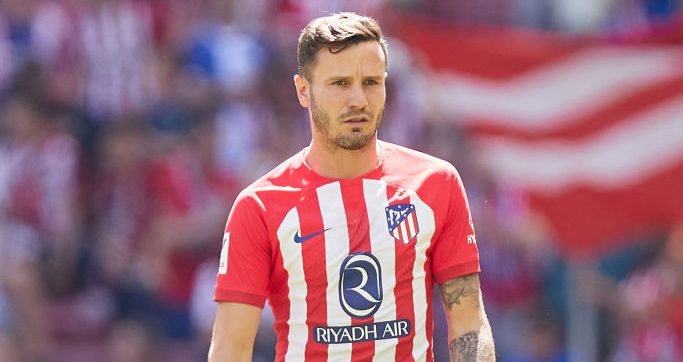
Today Saúl Ñíguez is 31 years old. He plays for Flamengo in Brazil and will always be “grateful to the Brazilian club: at a time of great personal weakness, they showed me affection without me having given them anything,” the midfielder recounts in a lengthy interview with the Spanish publication ABC. Things have gradually improved at Flamengo, culminating in the conquest of the Copa Libertadores – with Saúl cheering on his teammates from the bench. Yet there was a time when, among the ranks of Atlético Madrid, this boy seemed like a true prodigy. “The Gerrard of Spain,” they called him, with his market value reaching 90 million euros. And then?
“I wanted to become a symbol of Atlético like Koke, but it ended with me being shown the door,” Saúl Ñíguez recounts. “It was a long mental problem: you stop having fun and lose that magical touch. You no longer have what sets you apart from others, that enthusiasm, that passion. Until I was 25, I thought I was Maradona, then I don’t know what happened in my head, but I started having problems, I stopped having fun, and my destiny changed.” The first loan, in 2013 to Rayo Vallecano, was to allow a young promise to gain experience elsewhere. The second, to Chelsea in 2021, after seven successful years with the Colchoneros – memorable was his stunning goal in the Champions League semi-final against Bayern – had the characteristics of a diminutio. Of a relationship that was beginning to crack. The third, to Sevilla three years later, was the farewell. “I wasn’t having fun anymore also because they were moving me from one position to another, increasing the pressure on me. One day the national team coach called me and said: ‘If you play in that position, I won’t call you up.’ So you start to see things, to lose confidence. Bam, bam, bam. I didn’t have the strength to change my mindset and return to my level.”
Saúl’s words weigh heavily because they tell the backstory of some dynamics common to many players. Dynamics that, if not addressed in a certain way, risk paralyzing talent and affecting the person. “I didn’t accept the change of role,” explains Simeone’s former number 8. “I didn’t handle it well because I wasn’t having fun. They expected the same standards from me, but in my head, it just wasn’t happening. And this negative inner dialogue caused a significant drop in my performance. When Cholo told me he no longer counted on me, I think he was surprised: instead of blaming him, I simply thanked him for the opportunity and for his honesty. Because in the end, I understand that if a player is not performing at their best at Atlético Madrid, they have to leave, whether they grew up in the youth system or not. Period. I thanked him for allowing me to fulfill my dream and, in a way, you feel indebted to him for not continuing to give 100% to the club of your life. I wanted to do it, but because of my mental state, I couldn’t maintain that level.” After 427 appearances for the club.
The problem is that in the meantime, the fans, the environment, and social media also notice that decline. And what bothers Saúl the most today is having to endure the accusation of being a mercenary. Of playing half-heartedly because he did not accept a pay cut. “A lie among many. When they told me to leave, I simply left. I don’t want to be in a place where I’m not wanted, and I never want to be a problem for Atlético: I’m sorry I haven’t been there to help them today in their Champions League run.”
Instead, injuries also got in the way, some of which were quite serious. Another aspect that can prove devastating for an athlete’s mental health. How did Saúl Ñíguez come out of it? Always, with therapy. “I’ve been working with a fitness coach and a psychologist since I was 18. There’s a phrase that he told me during a dark period that I really liked: ‘I’m much prouder of you now than when you were 23 and scored that fantastic goal against Bayern, because you’ve learned to manage everything much better.’ Back then, I didn’t handle difficult moments well: if I played poorly, I wouldn’t leave the house. I take responsibility for my performances on the field, but there are many situations that don’t completely depend on the player, and in those cases, I didn’t have the support or closeness of my football environment.” And like him, many others: in addition to normalizing the issue, there needs to be a willingness to start addressing it as a system. To put future champions in better conditions than those in which Saúl found himself.