
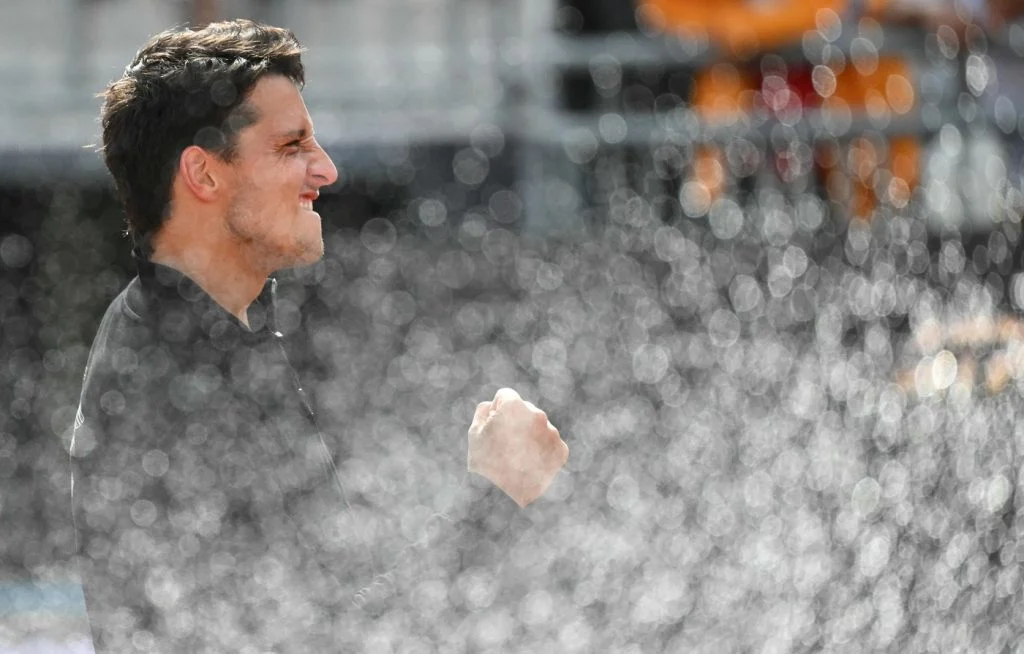
The victory of Luciano Darderi against Alexander Zverev at the Internazionali di Roma will rightfully go down as one of the symbolic matches of contemporary Italian tennis: not only because of the calibre of the opponent, the world number 3, but above all because of the way it happened. The match was practically lost. The first set was a Zverev monologue: a clear, heavy, relentless 6-1. Darderi seemed overwhelmed by the tension, unable to withstand the German’s rhythm from the baseline. His backhand was not working, and all the important rallies were going the German’s way. Even in the second set, the script seemed the same. Zverev served for the match and even had four match points. Four chances to close it out, to end the Italian’s resistance and advance without too much fuss. Instead, right there, something changed.
Darderi himself explained it after the match, speaking to Sky Sport, with words that describe the nature of his comeback better than any technical analysis: “I started badly because my blood pressure was low, then at the end of the first set I went into the locker room, looked at myself in the mirror and understood that I had to fight until the end,” he said. It is a frank sentence, but inside it lies the whole meaning of his Roman afternoon. Darderi won a mental battle against the fear of not being up to the task, against an opponent superior in ranking and experience, against a situation that seemed definitively compromised.
The crowd at Stadio Pietrangeli sensed the emotional moment and dragged the Italian along. The Foro Italico, already extraordinary on great occasions, turned into a cauldron. Every point won by Darderi was greeted like a goal. And yet it would be wrong to reduce everything to the visceral aspect. The match also changed on a technical and tactical level when Darderi began to work on his opponent’s forehand. In the first set and in the first part of the second, Zverev dominated with his backhand, superior in depth and speed to the Italian’s. That is how the world number 3 built the 6-1 with which he closed the first set and the 5-4 with which he steered the second.
But just when it mattered most, something changed in Zverev. It is not the first time the German has experienced sudden blackouts during matches that seemed to be under control. When the challenge turned into a point-by-point fight, the world number 3 stopped imposing his tennis and ended up accepting Darderi’s game plan. His forehand shortened, his timing became uncertain, and unforced errors began to multiply. Darderi, instead, grew point by point. He understood that he no longer had to look for the immediate winner, but enter the battle of resistance. And there he showed surprising maturity. He accepted suffering, playing long rallies, staying attached to the match even in the most complicated moments. The second-set tie-break, won after saving four match points, was the psychological point of no return of the contest.
From that moment, Zverev collapsed. Not only technically, but above all emotionally. His body language spoke of frustration, nervousness, disbelief. Every missed opportunity seemed to weigh on him more and more. Darderi, by contrast, ran on, pushed by a new energy. The third set went by smoothly, dominated and closed with a surprising 6-0. The Italian immediately took control of the rallies, continued to hammer the German’s forehand and allowed him no openings. When the final point was over, the image of Darderi in tears said everything. Those tears were not only for a prestigious victory. They were the symbol of a definitive leap in dimension. In his career, Luciano had already won ATP 250 titles in Cordoba, Bastad, Marrakesch and Umag. Of course, important results that had certified his growth, but beating the world number 3 in a Masters 1000, in Rome, in front of the home crowd and after a comeback like that, represents something different. It is the success that changes the perception of a player, inside and outside the tour.
From next Monday Darderi will be number 17 in the ATP world ranking. A historic achievement for Italian tennis too, which for the first time will have four players in the world’s top 20: Jannik Sinner, Lorenzo Musetti, Flavio Cobolli and Darderi himself. It is the photograph of a movement without precedent in Italian history, now capable of producing talent, continuity and depth at the very highest level. Yet another confirmation that Italian tennis is living through a new golden age. Within this extraordinary generation, Luciano Darderi has just found his place. With heart, character and a comeback that the Foro Italico will hardly forget.