
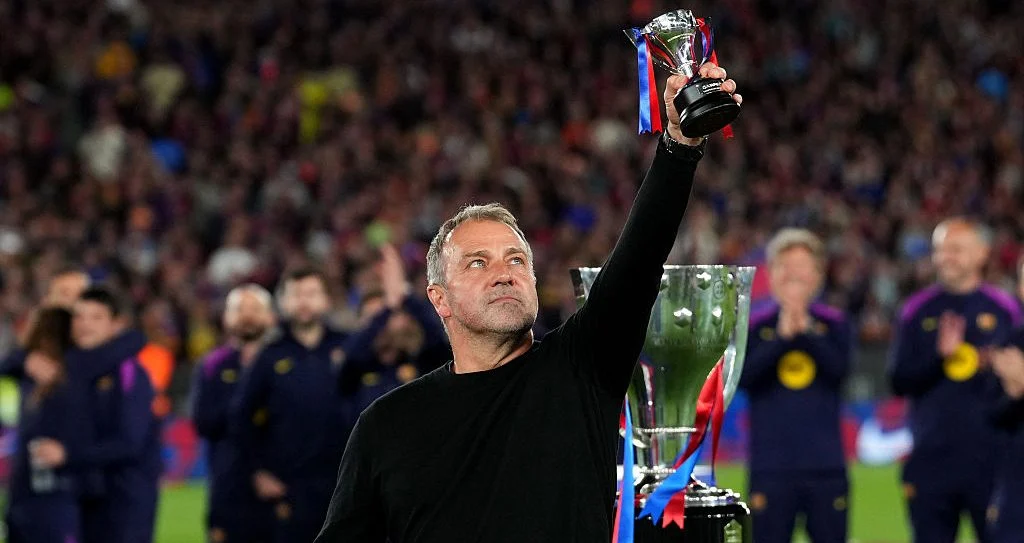
Five trophies in two years, the latest celebrated on a wave of emotion. With Hansi Flick on the bench, Barça have returned to the centre of the Spanish and European football map: the 2025/26 La Liga title, won well ahead of time — with the added satisfaction of mathematical certainty arriving precisely against Real Madrid — certifies the work of a coach who has brought back to Catalonia the feeling of dealing with a great team. Perhaps not perfect, but with unlimited attacking potential, used to taking the field with the mentality of always scoring one goal more than their opponents. And it is no coincidence that this path of sporting recovery — accompanied, in infrastructural terms, by the restoration of Camp Nou, amid a thousand ordeals — bears the club’s trademark. That is, its cantera: the Masía and its procession of homegrown talents.
Lamine Yamal is naturally the most dazzling case. But he is not the only one. In fact, it is emblematic that Flick’s first match on the Blaugrana bench — August 2024 — also coincided with the consecration on the pitch of three young prospects in the starting line-up: Pau Cubarsí in defence, Marc Bernal in midfield and, indeed, Yamal deciding matches. Three players born in 2007, twenty years after that class of ’87 — Piqué, Fàbregas, Messi — which made Barcelona’s fortune for an entire era. Of course, in the meantime the Masía had not exactly fallen into disgrace: think of Gavi, Pedri, Ansu Fati. And yet, during the most delicate phase in Barça’s modern history, amid serious financial turmoil and chaos in the chain of command, even its legendary academy had begun to lose some of its edge.
Nothing irreparable, but it was Flick who brought the Masía back to the centre of the village. It is enough to consider, as El País points out in this in-depth piece, that this season around 50% of the minutes played by the Blaugrana have been played by players from the youth academy. There are now once again nine members of the team from the academy: according to Transfermarkt, they have a combined market value of around 610 million euros — all right, “inflated” by Yamal, who alone is worth 200. This is a fundamental component, capable of transmitting identity to the whole of Barcelona and allowing it to rest on foundations built patiently, over the course of a lifetime. Pau, Marc and Lamine grew up together, have been playing football with one another for as long as they can remember, and the German coach had the merit of noticing this too. Not only the enormous technical baggage at his disposal.
Today Barça have an average age of 24, perhaps they do not yet have the experience needed to impose themselves in Europe as they did in the days of Messi, Xavi and Iniesta — the eliminations at the hands of Inter and Atlético will be a healthy lesson for the future — but they have all the ingredients to do it again. And it is no coincidence either that today’s stars were formed thanks to the teachings of those of yesterday: “Local players are more prepared than those who come from elsewhere,” Xavi had explained, during his brief experience as Blaugrana coach before Flick. “I try to make them even less fearful: when things are not going well, I have learned that you have to put everything on the youngsters. I see their faces and they are hungry for success.”
The former Bayern man did the same: Yamal and Cubarsí have become two of the most-used players during his tenure, perhaps even too indispensable given their young age. But the readiness of talent, after all, is difficult to dose. “Performing at this level at 18-19 is incredible,” Flick acknowledged. “I congratulate the Masía for what it has managed to do with these boys: being able to count on the youth academy is our way of doing things.” And indeed today Barcelona are the club with the largest number of professional footballers raised in their own youth academy among the top five European leagues: as many as 40, most of them with big-club minutes. With promises like these, returning to winning is the most natural consequence.