
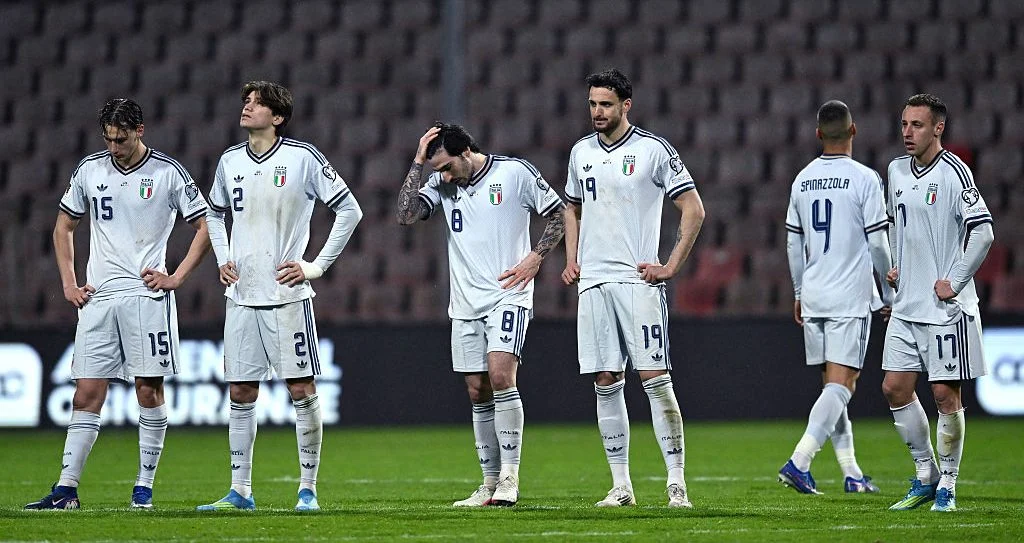
By now we are the joke of football, and it would be childish to take offence. But among the endless problems that have long gripped Italian football, always ready to rewrite the dimensions of the abyss, there is one that unfortunately often slips into the background: the absolute inability to produce talents capable of making their way abroad. The new data published by the CIES Football Observatory are decidedly discouraging. If, for example, Brazil remains the world leader in footballer exports (1455 in 2026), followed by France (1275) and Argentina (1016), Italy is languishing near the bottom of this special ranking — 27th out of 50 — with 181 players in total. Fewer than Ghana, Ukraine and — would you look at that — Bosnia and Herzegovina.
The causes of this structural fragility must be traced over time. With glorious history becoming a punishment for the present: as a football system, in fact, we have always been used to importing, to being a point of reference, the dream of every young champion and “the most beautiful league in the world”. True. But in the Eighties and Nineties. In the meantime, the world has moved forward at great speed and we — not only in football, which nonetheless remains a good thermometer of the country — have deluded ourselves beyond measure that we could live off past income and reputation alone. Medieval presumption, rather than futuristic planning. Not even the triple slap of as many missed World Cups seems enough to truly start again — but as for the future still to be written, let us at least give it the benefit of the doubt.
The data, instead, photograph the present and describe a Serie A that is increasingly peripheral on the European chessboard, with the lower divisions dotted with club bankruptcies and very little space for young Italians on the pitch. There is not the slightest consolation in this sense: perhaps other sports have to deal with similar structural problems, and yet they show some signs of life. Take basketball, for example, where in the face of clubs with limited economic resources — and a Serie A that is just as second-tier — the movement is experiencing a period of great ferment precisely in terms of exporting young Italians, who choose to go and play elsewhere in order to find space at adequate figures. And they are good enough to do so at high levels: the 25 Italian basketball players in the current NCAA are an absolute record, and a sign that our youth systems, on that front, still work.
In football, by contrast, everything is pitch black. And to convey how closely talent exports are correlated with the sporting performance of their respective national teams, just look again at the CIES ranking: the top 10 is completed by Spain, England — despite the appeal of the Premier League — Nigeria, Germany, Colombia, Portugal and the Netherlands. Practically all the greatest football powers in the world, with the exception of the Africans. Ahead of Italy there are also much smaller countries, but with youth reservoirs that are evidently more structured: Croatia, Uruguay, Belgium, Denmark, Sweden, Japan, Switzerland, Norway — with the Scandinavians, not coincidentally, recording one of the highest growth rates in this category. Behind the Azzurri? Russia, Slovakia, Greece, Romania. Let us keep staring at our own little patch, if we are not tired of stringing together humiliations.