
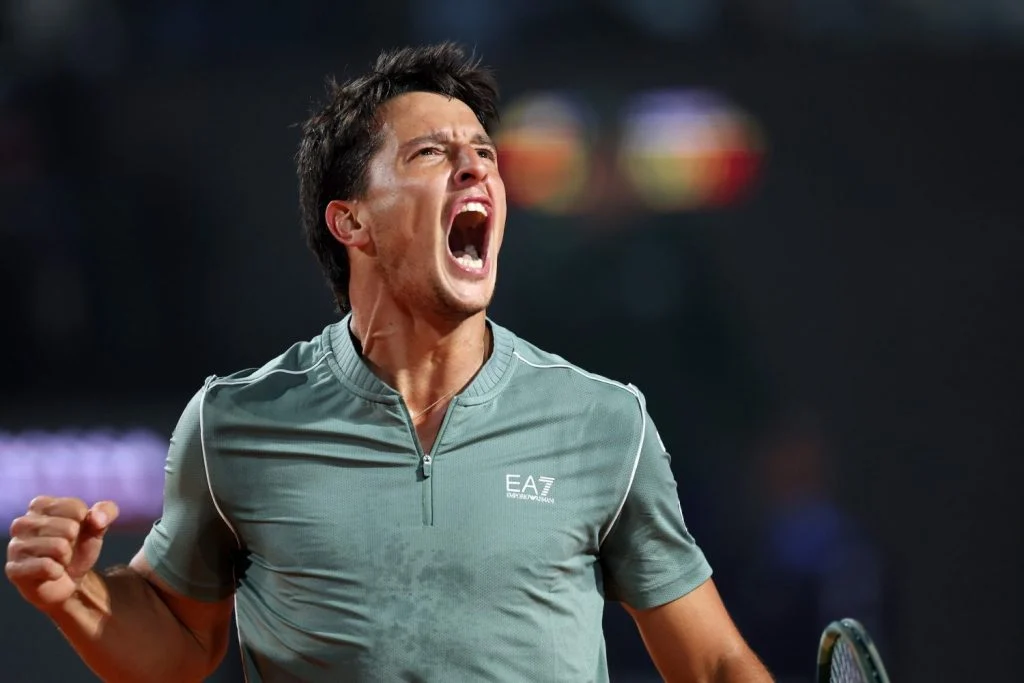
It was two in the morning when Luciano Darderi released all the tension of the most intense week of his tennis life in tears. A semifinal at the Internazionali d’Italia to celebrate, but even more to absorb and internalize for someone who in his career has never gone beyond 250 titles (he won in Santiago, Umag, Bastad, Marrakech and Cordoba), but who could not even have imagined emotions like these, in front of a crowd that rivaled the curva of the Coppa Italia final taking place at the same time. The quarterfinal against the young Spanish talent Jodar was an endless, fragmented, nervous match, lived through emotional surges and constant shifts in momentum. But it was worth it. Because what the Foro Italico is admiring is not only the best Darderi ever, but also a player who can belong in tennis’s elite.
The 7-6, 5-7, 6-0 with which he beat Jodar certifies a technical, mental and athletic growth that can no longer be considered episodic. Darderi is not just winning: he is learning to stay inside complicated matches at all times, to survive negative moments and to get into his opponents’ heads. He had already done it against Zverev, and he did it again against the young Spanish talent, resisting the storm and then overwhelming everything in the decisive set.
It was a strange match, almost schizophrenic in the way it unfolded. Made up of interruptions, sudden accelerations and moments that were completely opposed to one another. In the first set everything even stopped for about twenty minutes, when fireworks coming from the Olimpico, after Inter’s victory in the Coppa Italia, made it impossible to continue play. A surreal pause, which broke the rhythm and forced both players to cool down just as the tension was rising. Up to that point the match had been balanced, with Jodar good at taking time away and using the speed of the ball to prevent Darderi from taking control with his forehand. The Italian player, however, was already giving the impression of having something extra in the important moments. Not always consistent, not always brilliant, but capable of suddenly increasing the weight of his shots.
And that is exactly what happened in the first-set tie-break. Down 2-5, with Jodar close to moving ahead after more than an hour of hand-to-hand combat, Darderi suddenly changed gear. He raised the level of his tennis, but above all the speed and intensity of his shots. His forehand began to travel heavier, his backhand became deeper and his serve gave him quick points in the decisive moments. From there, the tie-break was completely overturned. Jodar, who until then had been extremely lucid, began to feel and suffer the pressure. Luciano strung together five consecutive points, recovering the deficit all the way to the final 7-5. It was the first real sign of psychological superiority in his match. Not only the shot of a champion, but the ability to recognize the moment and take it.
The comeback seemed to be the turning point of the match, also because in the second set Darderi continued to push, giving the impression that he could run away with it. The key game came immediately, in the second game, when he found himself 0-40 down on serve. An extremely delicate passage: losing serve there would have meant putting everything back into question. Instead, Darderi reacted with personality, saving the three break points with courage and aggression. That saved game seemed to be the prelude to the definitive escape. In the fourth game, in fact, Darderi even earned two points for the double break. The crowd on the Centrale could smell the semifinal, and Jodar too seemed close to collapsing.
But that was when the young Spaniard’s talent came out. With his back to the wall, Jodar began to risk everything. He raised his level of aggression enormously, took control of the rallies from the very first shots and above all found some impressive down-the-line winners, struck onto the intersection of the lines. Darderi, who up to that point had seemed in total control, slowly began to dip. First physically, then mentally as well. His legs became heavier, his first-serve percentage dropped and his push from the baseline lost incisiveness. Jodar sensed it immediately, continuing to hammer away and forcing Luciano to defend more and more often. The match entered a completely different phase: no longer the Italian’s progressive dominance, but a battle of resistance.
The break suffered by Darderi put everything back into question, and from that moment Jodar never lost serve again. With courage and quality he continued to command many of the most important rallies, exploiting the Italian’s moment of difficulty. The twelfth game of the second set was the perfect symbol of that shift in momentum. Darderi, by then clearly struggling, gave away too much with his second serve and Jodar took advantage without hesitation. The Spaniard broke serve at the decisive moment, closing the set 7-5 and dragging the match into a third.
After losing a set in that way, after having had the match in his hands and having seen everything reopen, Luciano could have collapsed. It would have been human, almost predictable, and instead, as had already happened against Zverev, Darderi suddenly found physical and mental energy that had seemed spent, but above all he once again managed to get into his opponent’s head.
The third set was a monologue. Darderi began to move lightly again, to push with his legs and to vary the game constantly. It was the set of technical completeness. Violent forehands, deep backhands, precise drop shots, sudden accelerations: Luciano seemed to be everywhere. eJodar gradually melted away. The comeback in the second set had required enormous effort from him, and the moment Darderi regained control the young Spaniard was no longer able to react. Unforced errors began to pile up from the first games of the decisive set, fuelling his nervousness and stripping away his confidence. Luciano immediately understood that this was the moment to go for the kill. The Foro Italico crowd definitively lit up, dragging the Italian towards a triumphant finish.
The final 6-0 was harsh, almost cruel in its proportions, but perfectly consistent with what had been seen in the third set. Darderi dominated in every respect, showing impressive athletic, mental and technical superiority. And this, historically and for the movement, is the real news: for years Italian tennis produced technically valid players who were fragile in moments of emotional chaos. Darderi, instead, is showing something different: the ability to suffer without falling apart. With this victory he becomes the tenth Italian to reach at least a semifinal at Masters 1000 level and the eighth Italian of the Open Era to go as far as the semifinals of the Internazionali d’Italia. Important numbers, but ones that only partly convey the scale of what he is doing in Rome.
Darderi is playing tennis full of confidence, aggressive but increasingly mature in his choices, conveying the feeling that he belongs at this level., on the other hand from Monday he will be number 17 in the ATP ranking. On Friday, for a place in the final, Casper Ruud awaits him. An extremely tough opponent, probably one of the worst possible on clay. Ruud is extremely solid, experienced, used to managing big matches and at this moment is playing tennis at a very high level. But Darderi comes into the appointment with a confidence that seems almost unreal, or maybe not, because when a player enters that mental state in which everything seems possible, even the most difficult matches take on different outlines. Luciano is living on a cloud that, at least for now, really seems very solid.