
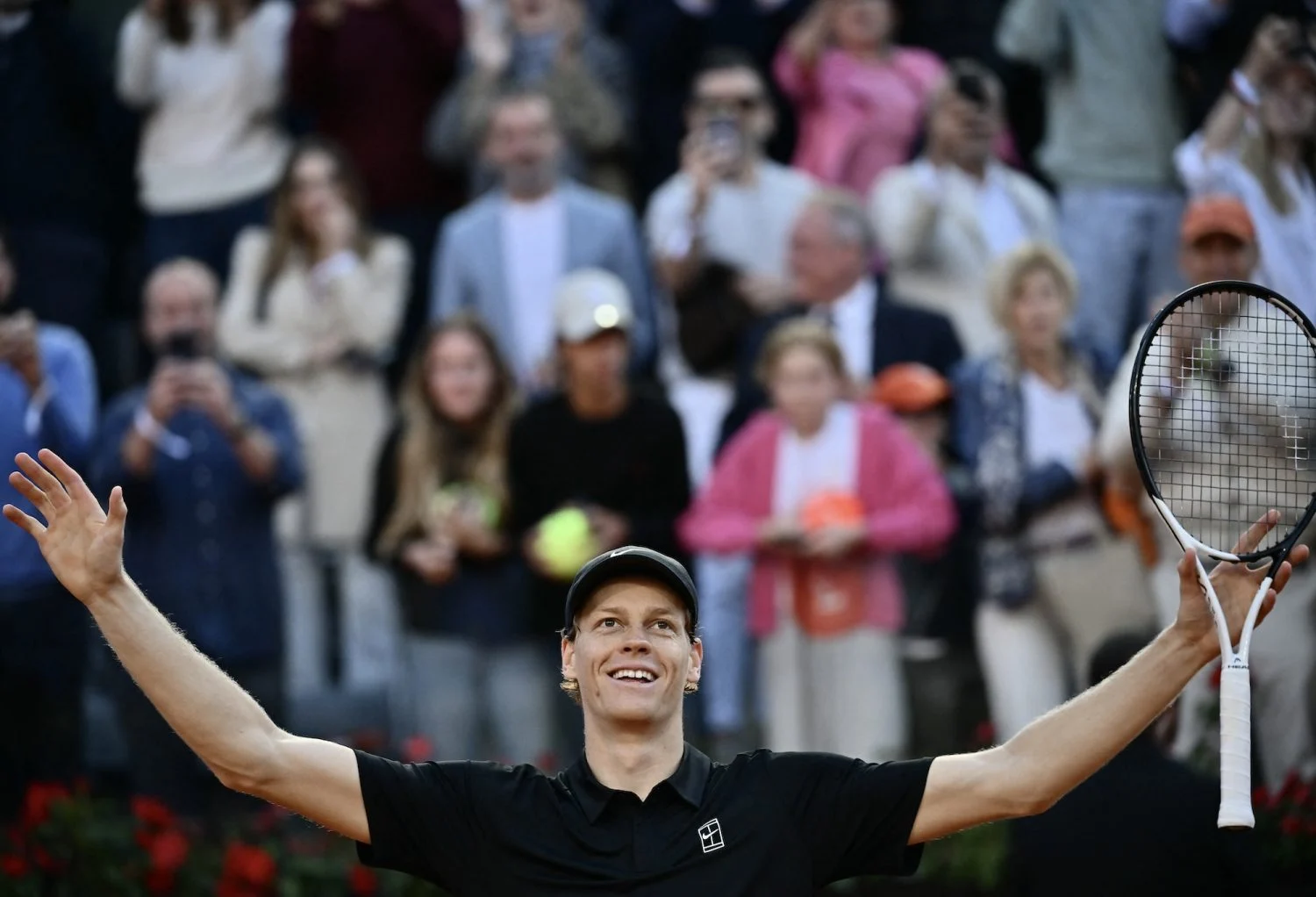
Beyond the historic impact of the victory itself — an Italian had not won in Rome for exactly fifty years, it was 1976 and the Italian in question was an absolute legend like Adriano Panatta — Jannik Sinner proved that he has become an absolute marksman. This is something that applies to the court, to what happens during matches, in the sense that every opponent is read and then swept away, literally, with relative ease. But now the question is also strategic, one of personal planning: aside from the absence of Carlos Alcaraz, which inevitably carries significant weight in this incredible winning streak at Masters 1000 events, the decision not to skip any tournament, to go to Monte Carlo, Madrid and then Rome, while awaiting Roland Garros, proved to be the right one. It proved to be a winning one.
Because Sinner has made history not only in Rome, at the Internazionali of the Foro Italico and in Italian tennis: he has made history in an absolute sense. He has become only the second player ever to win all the Masters 1000 tournaments on the calendar; before him, only Djokovic had managed it. Except Jannik has done it before even turning 25, with a career still entirely to build. To make (even more) legendary. The potential magnitude of this record probably ended up making Sinner tense. You could see it at the start of the first set, when Jannik felt a bit of the pressure of the Foro Italico and of the final. There were the signs from the crowd asking him to “nun fare scherzi”, phrased in Roman dialect, then perhaps also the presence of Mattarella and Panatta, Ruud’s powerful backhand that the number one was not expecting. All elements that melted even the ice man, who found himself 0-2 down almost without realizing it, with a first serve that was struggling to click.
And yet Jannik’s strength lies precisely there: carrying on with his match plan and then imposing himself, until he goes and takes the match. Regardless of what happens to him. And so Sinner immediately recovered the deficit, sometimes returning more aggressively, other times staying further back from the line and limiting as much as possible the Norwegian’s forehand, which if activated could really hurt him. When his shots on serve then improved, his confidence also grew, and at 4-all came the shove, simply, from the strongest player on the court and in the world. With three drop shots Sinner took the break in the ninth game, before closing it out easily at 6-4 in 46 minutes. The difference, as often happens for the South Tyrolean, was made by the serve: it is true that Jannik ended the first set with only 52% of first serves in, but when they landed he lost only one point.
Ruud thus lost the chance to take advantage of a less-than-perfect start from the number one, and paid for it psychologically. The number 25 once again revealed himself to be fragile, even on his beloved clay. Maybe because those four previous meetings say 4-0 Sinner without losing a single set, or maybe because Jannik somehow won a set even when he seemed to be in difficulty, but Ruud went completely off the rails, even with his forehand. The quality of Sinner’s return drove him mad and the Norwegian was broken immediately in the first game and risked losing his serve again in the third. The 1-2 with which he stopped a haemorrhage of five games lost in a row was a breath of fresh air for Ruud.
Too bad for the Norwegian that Sinner started playing wonderful tennis again, increasingly natural, simple, when in reality the drop shots, only a short time ago, seemed a little rigid, mechanical. The loose arm and a serve that was constantly more centred did the rest. From the break in the second set, the match was no longer in question, even though Ruud recovered from the moment of wobble, returning to the standards of the start of the match. For Casper, however, it was too late. Sinner closed with another 6-4, becoming the only player in history to win six consecutive Masters 1000 events, five in one season.
Here, there was this record too to reel off, to celebrate. An incredible record, absurd even to think about, that certifies the absolute dominance of a player who at this moment has no opponents. The only one worthy of that title – obviously we are talking about Carlos Alcaraz – is currently out injured, and this absence has created a context in which no one can even trouble the world number one. Maybe they manage it for a few minutes, for a few games, like Medvedev in the semifinal, but then Sinner’s superiority takes the stage again. The whole stage, and the others are left with crumbs. It always happens this way when champions capable of making history arrive.