
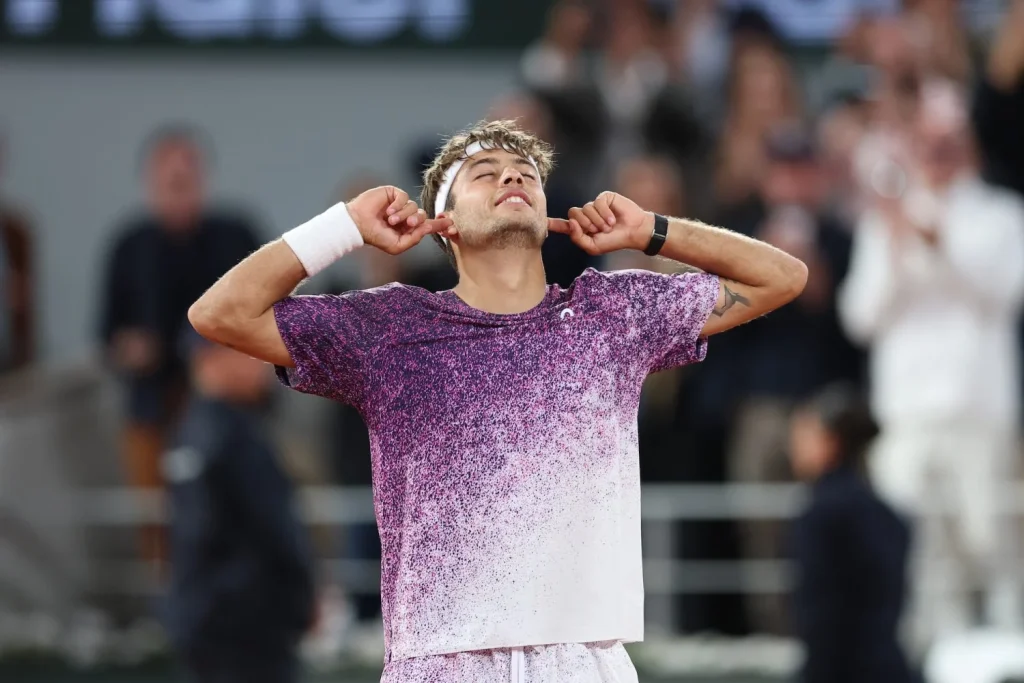
The best week of his life, as he described it, has been built on the feeling of recognising an opening and staying inside it long enough for it to become something larger.
On Court Philippe-Chatrier, a place he has often spoken about as his favourite stage, Flavio Cobolli produced another chapter of this run, reaching his first Grand Slam semi-final with a 4-6, 6-4, 6-4, 6-4 win over Félix Auger-Aliassime in 3 hours and 24 minutes.
The score carries the outline. The match carried something heavier: a steady redefinition of who was controlling it.
It began under a moving sky, roof open, wind cutting across the court in irregular bursts. Conditions that made the ball behave differently from rally to rally. Auger-Aliassime settled into them first. He struck through the wind with more certainty, taking the opening set 6-4 and finding cleaner patterns in the longer exchanges. Cobolli stayed close, but without fully settling into timing.
Then the roof closed.
The match did not shift immediately in score, but it shifted in rhythm. The air stopped moving in the same way. Trajectories flattened. Timing became more readable.
Cobolli was the first to adjust to that stillness.
From the second set onwards, the forehand began to carry more weight through the court. The backhand found depth more consistently. He started taking slightly earlier positions inside the baseline, not as a statement but as a consequence of better contact. The rallies began to tilt.
The second set, 6-4, arrived with a different structure underneath it. Auger-Aliassime was still striking the ball cleanly, but the court no longer responded in the same way. Cobolli’s return position crept forward by half-steps. Service games started to extend. The balance moved, slowly, without a single turning point that stood out on its own.
By the third set, the match had settled into Cobolli’s tempo more than his opponent’s. Not faster, not slower. Just more predictable in its patterns. Long exchanges began to end with Cobolli still in control of the last ball rather than reacting to it.
He took the third 6-4, then the fourth by the same scoreline, each set following a similar internal shape. Early holds, then pressure building on return games, then a break that arrived not from a single swing but from accumulated positions.
Auger-Aliassime, used to late stages of tournaments like this, began to lose ground in those longer sequences. First a step, then a half-step more. The final games were played with Cobolli standing slightly further inside the court, taking the ball earlier, shortening the distance between decision and execution.
There were no gestures that changed the direction of the match. Only repetition.
Across the tournament, Cobolli has been building matches in this way. Early instability, then a gradual settling. The adjustments do not always arrive cleanly; they accumulate through games rather than moments.
Here, against an opponent with more experience at this level, that accumulation held.
When the final forehand went long, Cobolli stayed still for a second, racket in his left hand, looking briefly towards his box. No immediate reaction that broke the rhythm of what had just happened. Then he walked forward.
Earlier in the week he had described this period as “the best week of my life”. It now extends at least one match further.
He will face Matteo Arnaldi in the semi-final, an all-Italian meeting that guarantees a place for Italy in the Roland Garros final. The draw resolves itself into a domestic meeting, while the surface remains unchanged, heavy and red under the lights of Paris.
Cobolli leaves Chatrier the same way he arrived on it: still adjusting, still within the match he has been playing across the entire fortnight.