
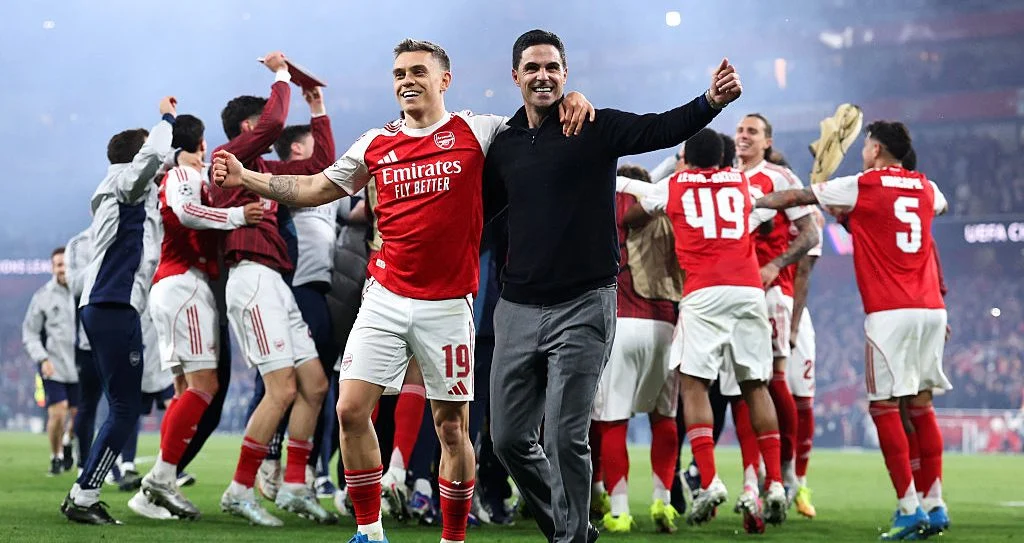
Twenty-two years without a title. Which, for a big club like Arsenal, inevitably means a string of mockery, disappointments, and sporting projects that were almost never up to the mark. Until the Gunners came across a coach like Mikel Arteta. Someone capable of bringing fresh and concrete air around the Emirates, building in just a few seasons one of the most solid groups in Europe without the pedigree of their direct rivals. Looking through the names of the champions of England, this is exactly what stands out: only Gabriel Jesus, among the players in Arsenal’s squad, had already won the Premier League in his career – four times, in a Manchester City shirt. Only six others had already celebrated any other title. For everyone else, it was an unprecedented and absolute celebration.
This is not a trivial figure, and it gives an idea of how many obstacles, including on a mental level, the Gunners have had to face in recent months. As far as England is concerned, Gabriel Jesus remains the only one able to testify to such a triumph in front of his teammates. There are a couple of other players with a major trophy in their cabinet: Mikel Merino, European champion with Spain in 2024, and Kai Havertz, European champion with Chelsea in 2021 – although this year he ended up somewhat on the fringes of Arteta’s rotations, despite scoring important goals. And the rest? Declan Rice had won the Conference League in 2023, during his time at West Ham. Noni Madueke did the same last year at Chelsea. While the only players who could boast a domestic title were Piero Hincapié – the historic 2024 Bundesliga won by Bayer Leverkusen – and Viktor Gyokeres – the Primeira Liga double, in 2024 and 2025, as Sporting’s goalscorer.
The other 18 players in the red-and-white squad, from Calafiori to Martinelli, were instead dealing with unexplored territory. None of them had ever won anything, many had not even come close or had had to deal with bitter professional disappointments – it is difficult to say which of the two scenarios is more promising on the road that leads to the Premier League. There is no doubt that the architect of this achievement, beyond every motivational eccentricity, is Arteta. Who, for his part, had never won the league either, not even as a player.
At this point, a further consideration must be made. Granted, Arsenal are one of the wealthiest clubs in the world and are currently second in the Premier League for the market value of their squad – €1.23 billion, compared to Manchester City’s €1.31 billion. In the Arteta era, moreover, taking the last five seasons into account, the Gunners have spent a genuine fortune on the transfer market: the balance between income and expenditure is -€769 million. In short, this is not a case of celebrating a “fairy tale”, because all the ingredients for an important victory were there. And yet it is telling that Arsenal, in pursuit of this objective, have almost never chosen to rely on the classic already-established champion. No crazy spending on Mbappé or the Haaland of the moment, but many investments in young players to build a lasting group.
It took a while to reap the rewards on the domestic and international fronts, also dispelling the mocking taboo of the eternal runners-up that had come to weigh on the club like an emotional shroud. But this Premier League, won with merit and authority, represents the definitive consecration of this new technical cycle. And it adds to other highly respectable achievements: one FA Cup, two Community Shields, three consecutive second-place finishes since Arteta took charge. Plus last season’s Champions League semi-final and this year’s final – another remarkable achievement, reached according to a precise team identity, which could become extraordinary in the event of victory over PSG. Sooner or later, then, the balance sheet could grow further still. And this Arsenal have only themselves to thank, for having found their very own way of becoming competitive again in today’s football. Celebrations included, finally.