
Cooling breaks were introduced as a practical solution. They are quickly becoming something else.
For years, managers have used these brief interruptions to pass on instructions, tweak a tactical shape or steady a team that was beginning to lose its footing. But there is a difference between a few words from the touchline and a full-scale video session.
Mauricio Pochettino may have been the first to test exactly where that boundary lies.
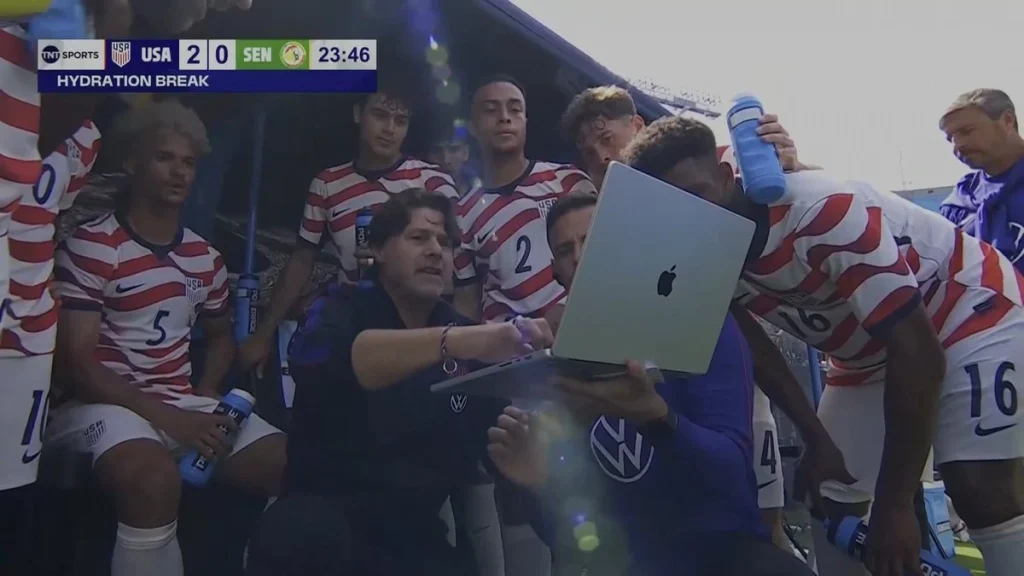
During the United States’ recent World Cup warm-up against Senegal—a 3-2 victory for the Americans—the Argentine manager turned a cooling break into an impromptu analysis session. As television cameras rolled, a member of his staff produced a laptop, players gathered around the screen and Pochettino began reviewing passages of play in real time.
The footage quickly attracted attention. Not because the idea itself was revolutionary, but because it hinted at what these interruptions could become.
Neither FIFA nor the International Football Association Board (IFAB) has ever formally defined what teams may or may not do during a cooling break. The assumption has always been that a pause designed to help players cope with extreme temperatures would remain exactly that: a brief opportunity to rehydrate before play resumes.
Football, however, rarely leaves a competitive advantage unexplored.
As the game has become increasingly analytical, every interruption has acquired value. Every pause is an opportunity to communicate information, correct mistakes and gain an edge.
💻 ABD Teknik Direktörü Pochettino, su molasında bilgisayarı açıp taktik verdi. pic.twitter.com/i1hgNjnaIT
— A Spor (@aspor) May 31, 2026
According to The Athletic, that is precisely how Pochettino approached the situation. Midway through the first half, rather than simply gathering for water and instructions, the United States players clustered around a laptop while their coach dissected specific moments from the match. Defensive positioning, build-up patterns, spacing between the lines—the sort of details usually reserved for half-time were suddenly being addressed in the middle of the action.
“It helps the players enormously to see the situations,” Pochettino explained afterwards. “It’s not enough simply to tell them what they need to improve. When they can actually see the images, the message lands much more clearly.”
His comments also highlighted a question that could become increasingly relevant over the coming months: how far will FIFA allow teams to go?
“We’ll see at the World Cup whether it’s permitted and how much we’ll be able to do,” Pochettino said.
The current regulations offer remarkably little guidance. They do not explicitly state whether laptops or similar devices may be used to display tactical footage during cooling breaks, nor do they clarify whether players are free to leave the field in order to take part in such sessions. Technology has become a familiar presence on the touchline, but the limits of its use remain largely undefined.
That ambiguity matters because cooling breaks themselves are evolving.
What began as a health measure now carries broader implications. FIFA’s decision to introduce a mandatory three-minute break midway through each half, regardless of weather conditions, was intended to protect players. Coaches immediately recognised another possibility: three uninterrupted minutes in a sport that rarely stops.
“This new rule will change football,” France manager Didier Deschamps predicted after a friendly against Brazil in March, when the format was trialled for the first time.
Portugal coach Roberto Martínez sees it the same way.
“The game will change,” he said. “It’s effectively a tactical timeout. Of course it’s there for hydration, but three minutes can completely alter the course of a match, as happens in other sports.”
Pochettino, despite expressing reservations about the rule, has been among the first to embrace that reality.
The idea even caught some of his own players by surprise.
“I was surprised because normally you’re not allowed to leave the field in situations like that,” defender Mark McKenzie admitted. “It was definitely something new.”
Television broadcasts captured much of the session: players gathered around the screen while their coach paused clips, pointed out movements and adjusted defensive details. By all accounts, the exercise proved both useful and effective.
Whether it remains possible once the World Cup begins is another matter.
Pochettino revealed that the United States squad recently attended a FIFA briefing on the tournament’s new regulations, although several practical questions remain unresolved. For now, there are no definitive answers.
One thing, however, seems increasingly clear: coaches have been handed a new piece of dead time, and they are unlikely to let it go to waste.
The United States face Germany in Chicago this weekend before opening their World Cup campaign against Paraguay at SoFi Stadium in Inglewood on 12 June. By then, cooling breaks may no longer be seen as simple hydration stops.
They may simply be football’s newest tactical weapon.