
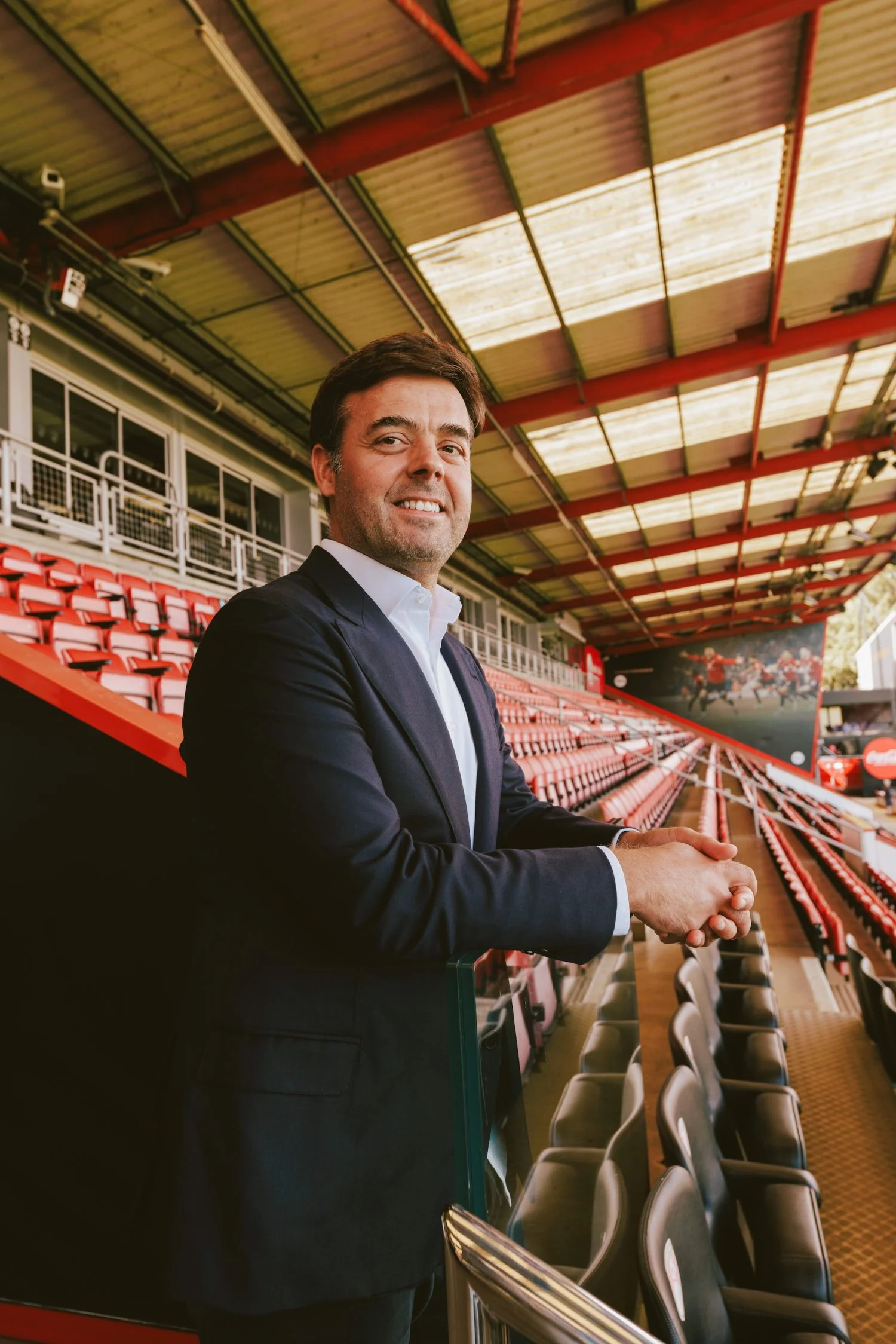
Tiago Pinto’s career in sport began with a speech. He was a simple fan when he took the floor during the Benfica members’ assembly: there were things that worked, others that did not. He did not limit himself to criticising: he said what he would have done. The club’s president wanted to meet him: shortly afterwards, Tiago Pinto would join Benfica’s multi-sport organisation, going on to handle the strategy and the transfer market of all the teams – futsal, handball, volleyball, basketball, rink hockey. His rise then became meteoric: he was promoted to Benfica’s football sector, then he passed through Serie A, with Roma, and now he is President of Football Operations of Bournemouth.
At 41, the Portuguese executive already has behind him an extraordinary experience in the world of football, fuelled by his ability to operate in the transfer market, by the ability to maintain the delicate balance between competitiveness and respect for the economic parameters, and by his modern vision of how a club is managed. Bournemouth is on one hand a personal milestone, the realisation of his dream of reaching the Premier League, on the other a reality in which to impress all-round the Pinto Way: his way of doing football, of planning a precise strategy, of creating value. His first year, in the South of England, ended with the best result ever achieved by Bournemouth in the Premier League: ninth place in the table, with a record number of points. But this is only a starting point.
What did you find in England?
I found a particular attention to the Academy. Unlike in Italy, where the Primavera leagues are governed by mechanisms of promotion and relegation, here the changes of category depend on the facilities – like the Dome (a covered structure similar to an air-supported dome, ed.) – and on the presence in the staff of qualified coaches. The results on the pitch do not count for going up to “Category 1”, the level in which teams like Manchester City, Manchester United, Chelsea play. What counts are the facilities, the quality and the quantity of the coaches, because their training is considered fundamental. Moreover, there are very strict rules on education, on the schooling aspect, in general on how we manage the lads.
But how many matches does a sporting director watch?
I think that today we watch fewer matches than in the past. Our role has become so complex and involves so many areas that, compared to twenty years ago, sporting directors end up seeing less football. To give you an example, my friend Pantaleo Corvino still today watches many more matches than me. Today, with the clubs’ structures, with all the work linked to contracts, to Financial Fair Play, to relations with owners and shareholders, to all the internal organisation to manage, in the end the time to watch matches diminishes. But with all the possibilities of today it is very easy to receive videos and analyses of the players. For this you have to trust a lot the people who work with you, your staff of scouts. Here at Bournemouth we have Simon Francis, who is the technical director and can be considered our head of recruitment. Under him we have 18 people: 12 scouts – some here, others in Uruguay, Portugal, Sweden – and six data analysts. The work that reaches me is thorough. When we discuss a player, we analyse everything: what the scouts have seen, the data, the information on the character, the history of injuries. It is a complete process.
And how is the relationship with the club’s owner, Bill Foley?
It is difficult not to fall in love with his way of being and with how he interacts with us and with the players. It is something that comes to him from his background, from his military experience and from his past in hockey, where he built a winning team. This means that he does not have those problems typical of other owners who do not understand the dynamics of the locker room. He understands that, at times, players who do not seem technically fantastic can be fundamental for the balance of the group.
How did he convince you to come to Bournemouth?
In February 2024 I had just left Roma, and in the 3-4 months that followed I wanted to rest a bit and recover energy. Bournemouth’s CEO, Neill Blake, with whom I had had dealings when we negotiated Viña and Justin Kluivert, called me to ask if I was interested in a chat. The first one I had with him, the second with Bill. There is one thing about that video call with Foley that I will never forget. After 10-15 minutes of chatting he says to me: «You know Tiago, I understand little about football, but I understand a lot about people. I have no doubts that you are the right person». Maybe he said it to convince me, I don’t know, but it seemed such a genuine way that I said to myself: all right, let’s try.
It was also he who had made a very courageous choice in 2023: to change the coach of the previous season’s safety, Gary O’Neil, and take Andoni Iraola.
He believed that the team had to play in a different way. He wanted the people at the stadium and of the local community to be enchanted by what happened on the pitch. He wanted the team to seduce the fans: an attractive, dynamic, offensive football, with goals, and with the idea of being able to win every match. For him staying in the Premier League was not enough. Then Richard Hughes, who is now the sporting director of Liverpool, and Simon Francis, our technical director, did a masterful job in the choice of Andoni. We cannot however forget that, in Iraola’s first nine matches, not even a single victory arrived. And this counts: a team that achieves safety, that changes coach, takes a new coach and this one does not win the first nine matches… and yet Bill was very calm and trusted. Obviously the work of Richard, Simon and Neill in that moment was fundamental to give stability to the choice. But when we look back we cannot forget that moment: we are all very good when the results arrive, but when they do not arrive, maintaining one’s choices is something that must be praised.
What do you think of Iraola?
I have worked with many coaches and I have learned something from all of them. Today I can say that Andoni is different, he is special. He is a modern coach, one who understands all the dynamics of football. The part of the work that he loves most is the pitch: developing the players, analysing, working with the staff. He works for the club, but above all for the team. His motivation is simple: «What is the tactical plan that allows me to win the matches? What work do I have to do with the staff to make the players grow?». Working with him is easy. In my opinion today, with so many private owners in the world of football and with an ever more professional management, the coaches who will have the most success will be those who work for the club, who have the personality to say internally what is right and what is wrong, but who do not go publicly to attack clubs or ownership. Because a coach has an enormous communicative power: he is the main spokesman of the club, he is the figure that the fans listen to and respect. But behind there are many things that are not seen. Take the example of Bournemouth: we sold players not because it pleased us to sell them, but because there are rules to respect. A coach different from Andoni might say: «They have sold all my players». He does not do it. Not only because he is a great coach and a good person, but because he has all the information and understands the context.
You have experienced football in Portugal, in Italy and now in England. What are the cultural differences in these countries – and consequently how does your work change?
I started with Benfica at 32, I was practically a boy and I had to learn a great deal. There were two phases there: the first in which I concentrated a lot on the structure of the club, the second when I became the trusted man of the president, who in Portugal has an executive role. There, thanks also to the experience I had matured in the multi-sport organisation, I was very involved in the transfer market and in the negotiations. But one fundamental thing must not be forgotten: in Portugal there are elections every four years. This completely changes the dynamic of the work: you have to obtain results immediately, you have to understand the impact that every decision can have on the future vote of the members. In Rome the system is a bit more similar to the English one, because there is an owner to answer to, involved but with a bit more distance. The management has a certain freedom, but also the final responsibility of making decisions, of involving the owner when needed, and of being responsible for the results. Here in England it is a bit the same thing, even if the dimensions of the clubs are different. And in my opinion here you are more predisposed to having a strategy and a medium-term planning. This, in my opinion, depends above all on the cultural influence, as well as on the management system.
Strategy counts for a great deal.
When I look at the clubs that win the most, I always see two elements in common: strategy and stability. At times I hear it said that Manchester City won a lot because it put a lot of money on the table. But other clubs too have spent a great deal. They won because they are the best, because they have an extraordinary strategy and because they managed to carry it forward independently of the results of the moment. It is enough to look at what they have done in the youth sector: the quantity and the quality of the players they have produced in recent years speak for themselves. And if we go to Italy, the discourse is the same. Inter wins the most because it has stability. The people who lead the sporting area guarantee continuity, there is a clear, stable line. No one can always win, but in any club in the world, if you have a strategy, if you have the right people and if you manage to maintain it even when things do not go well, then you have many more probabilities of winning.
In Rome, was the possibility – or the time – to put your strategy into action lacking?
It is true that in Rome people want to win very quickly. And at the same time it is true that, in three years, we reached a Europa League semi-final, a Europa League final and we won a Conference League. If you ask me whether it is enough, in my opinion no. Everyone wanted qualification for the Champions League. But we did bring something home: there are areas of Roma in which, in my opinion, the strategy won. What we did in the youth sector in three years is extraordinary: Zalewski, Pisilli, Calafiori and other players in such a short span had the opportunity to play at a high level. With Vincenzo Vergine, who today works at Milan, we built a true strategy and the results were seen. And the role of Mourinho must not be forgotten, who put those lads on the pitch. On the economic level, we had many limitations linked to Financial Fair Play, and I think that we managed to do a lot with little. Those who do not appreciate Tiago Pinto will always talk about Renato Sanches, about Viña or about Shomurodov. But some things were also done very well: taking Svilar on a free transfer, or Celik for seven million, are operations that made sense. At times the fact of not having a lot of funds forces you to find intelligent solutions.
Is the pressure in Rome an advantage or a disadvantage?
For me it is not a disadvantage. Even in the difficult moments, when the results did not arrive, the fans were always alongside the team. The passion of Roma’s fans gives you an enormous push, but at the same time it also gives you a great responsibility. More than the pressure, the real problem in Rome is the lack of stability. If you win two matches it seems that you can win the Champions League, if you lose two it is a tragedy.
What is Tiago Pinto’s recipe for success?
I always answer in the same way: the capacity to work. I am sure that you will find sporting directors or managers better than me, but you will not find one who works more than me. My strength is this: the capacity to suffer, to work, to be constant. We can win or lose, things can go well or badly, but every day, at 7.45, I am there.
A man on a mission.
People sometimes look for an external motivation. People say: today the team won and played well thanks to the coach’s speech, things like that. But external motivation is not enough. You have to have discipline, you have to set the example as a leader. I cannot allow myself to transmit my state of mind if there are five matches without victories, if I do not sleep thinking about what we got wrong or what we can improve. I cannot let it show. For this I arrive every day at 7.45, I have a coffee with the medical department at 8.30, and I always do it. Whether I feel bad, whether I am happy or worried, this is the way in which I exercise leadership. For me, leadership is not going into the locker room when we win, complimenting the players and then disappearing when we lose. My leadership is serenity, stability. It is simply my way of being.